
Cut-Out NumeralsInternational Version
The first photo is the maker's own. The other shots are illustrative.
Inv. no. NIE-003520
- Maker
- Nienhuis Montessori, since 1929
- Approval
- AMI
- Primary Material
- Plastic
- Surface
- Smooth finish
- EAN
- 8719924001902
Final price incl. VAT. Delivery €5.90, €120.10 to go for free delivery.
Advice, warranty and returns are handled by us.
Why it costs €28.90
Behind the price of the original are things you can check yourself.
AMI approval
The material is approved by the Association Montessori Internationale (AMI). Nienhuis has made Montessori materials since 1929.
A verifiable original
The EAN 8719924001902 is on the box. It is the maker's number, not ours.
Cut-Out Numerals in a child's hands
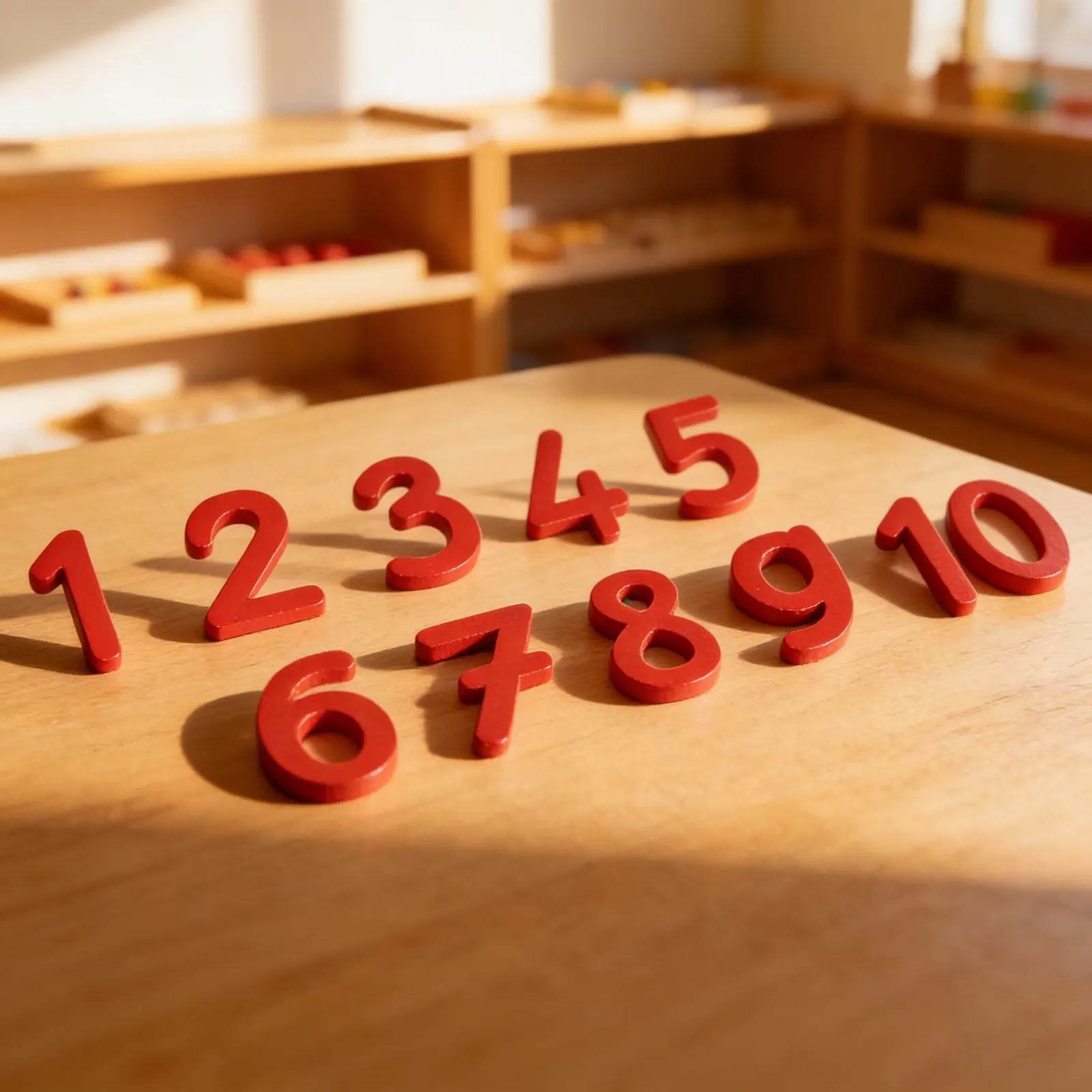
Red cut-out numerals in the international version are a Montessori material for arithmetic. According to the manufacturer, these red numerals are used in numerous arithmetic exercises, that is, in counting and calculating. In such an exercise the child picks, as the task requires, the red numeral that matches a quantity or a calculation and places it beside it. The numerals are made of plastic. They belong to the area of mathematics called the introduction to numbers, and the packaging measures 11 × 7 × 1 cm. For ages 3 to 6.
Number Recognition
Cut-out design creates a clear visual and tactile impression of each numeral's unique shape.
Sensorial Learning
Raised edges provide tactile feedback that reinforces proper number formation patterns.
Mathematical Foundation
Physical manipulation of numerals builds concrete understanding before abstract number concepts.
How to present it
Have a small basket of counters nearby for quantity matching activities.
- 1Invite the child to trace numeral 1 with their dominant index finger, starting at the top
- 2Name the numeral as they trace: 'This is one'
- 3Introduce numerals 2 and 3 using the three-period lesson
- 4Once familiar with tracing, match quantities using counters
- 5Progress to tracing numerals with eyes closed
3 tips for parents
- Practice tracing numerals during calm moments, not as rushed homework
- Let your child teach you the correct tracing pattern they learned at school
- Create number hunts at home, matching foam numerals to house numbers or calendar dates

If you are not sure it suits your child, we answer in person.
Norbert Kovalčín, founder of Faborino · write to him
There is no review here yet. We will ask you for one after you buy. Write the first review
What's in the Box
- Cut-out numerals: red numerals for arithmetic exercises
Size and material
| Packaging | 11 × 7 × 1 cm |
| Primary Material | Plastic |
| Surface | Smooth finish |
| Recommended Age | 3-6 years |
Frequently Asked Questions
What makes these cut-out numerals different from regular number cards?
This multi-sensory approach engages touch, sight, and movement simultaneously, making number recognition more memorable than flat cards.
How thick are the foam numerals and what size are they?
Each numeral is approximately 10-12cm tall, making them easy for small hands to manipulate while being large enough for clear visibility.
Why is the 'International Version' specification important?
The International Version uses numerals that follow universal number formation standards, ensuring consistency with global mathematical notation. This means the number shapes align with how numerals are written in most countries, making them suitable for international schools and multilingual environments.
How do these numerals support the Montessori approach to mathematics?
They embody the Montessori principle of concrete-to-abstract learning by providing a physical, touchable representation of abstract number symbols. The self-correcting design (fingers naturally follow the cut-out path) promotes independent learning and builds muscle memory for proper number formation.
Product safety
Manufacturer: Nienhuis Montessori, Anders Celsiusstraat 15, 7442 PB Nijverdal, Netherlands
Cut-Out Numerals