
Cut-Out NumeralsUS Version
The first photo is the maker's own. The other shots are illustrative.
Inv. no. NIE-003503
- Maker
- Nienhuis Montessori, since 1929
- Approval
- AMI
- Primary Material
- Acrylic
- Finish
- Smooth, raised edges
- EAN
- 8719924001889
Final price incl. VAT. Delivery €5.90, €120.10 to go for free delivery.
Advice, warranty and returns are handled by us.
Why it costs €28.90
Behind the price of the original are things you can check yourself.
AMI approval
The material is approved by the Association Montessori Internationale (AMI). Nienhuis has made Montessori materials since 1929.
A verifiable original
The EAN 8719924001889 is on the box. It is the maker's number, not ours.
Cut-Out Numerals in a child's hands
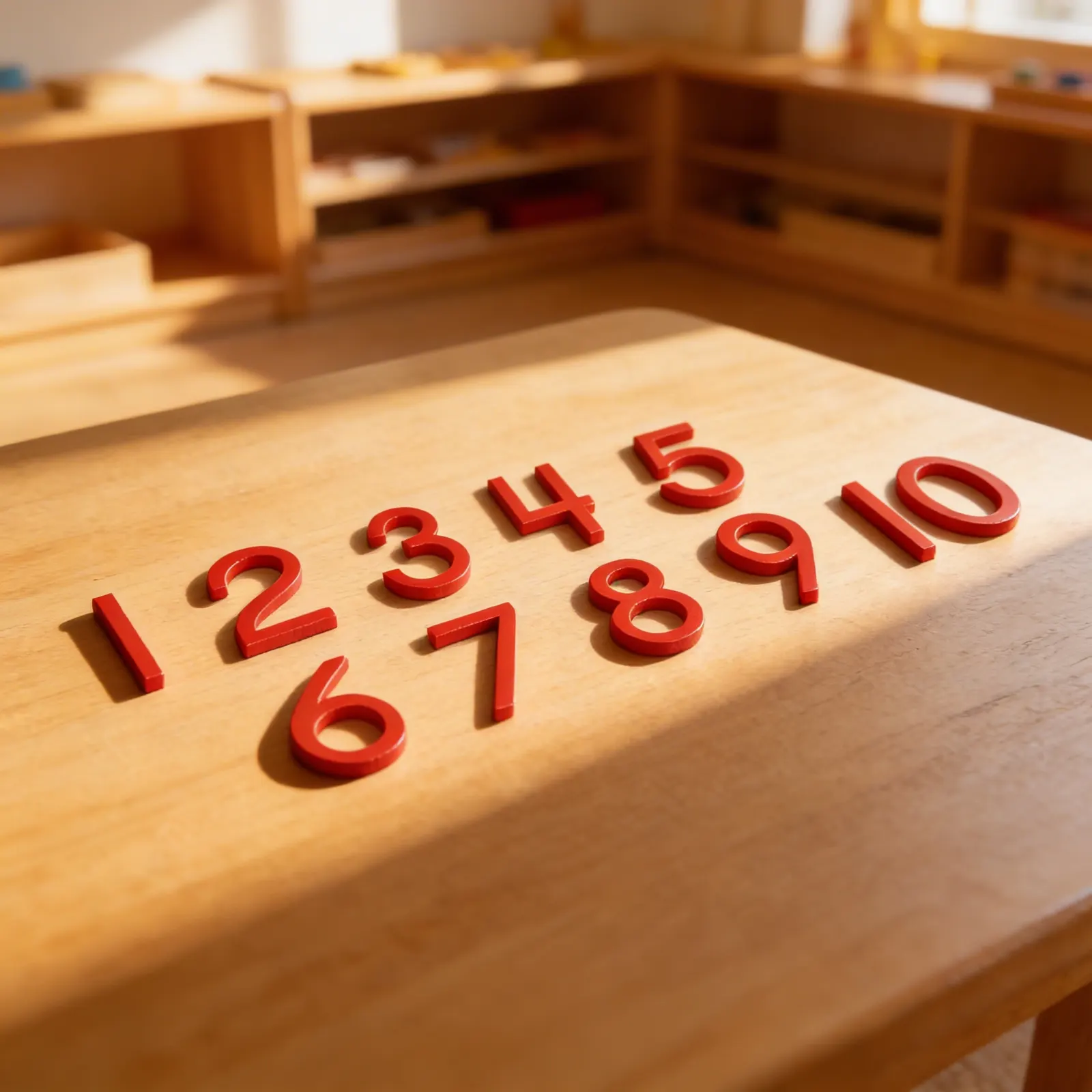
Red cut out numerals in the US version, used across a great many arithmetic exercises. Loose numerals are the most reused thing in the mathematics area: they label a quantity of beads, they head a column, they sit under a bead bar, and every material that shows a quantity eventually needs a symbol to put beside it. Red is the convention that makes them findable in a room full of colour coded everything else. Plastic, for ages 3 to 6.
Number Recognition
Clear, isolated numerals help children associate symbols with quantities and develop visual discrimination of number forms.
Pre-Writing Skills
Tracing raised edges with fingers prepares hand muscles for writing and establishes correct number formation patterns.
Mathematical Foundation
Concrete manipulation of number symbols bridges the gap between quantity concepts and abstract numerical representation.
Sensorial Learning
Tactile exploration through touch reinforces visual learning, creating multiple pathways for number comprehension.
How to present it
Place the numerals 1-10 in order on a mat or table. Ensure adequate space for the child to sit comfortably and trace each numeral. Have a small tray nearby to hold individual numerals during focused work.
- 1Introduce numerals 1, 2, and 3 using the three-period lesson. Hold each numeral, trace it slowly with two fingers while naming it: 'This is one.'
- 2Invite the child to trace each introduced numeral while saying its name. Watch for correct finger positioning and tracing direction.
- 3Mix the three numerals and ask the child to identify each one: 'Can you show me two?' Then 'Can you trace two?'
- 4Once comfortable with 1-3, gradually introduce remaining numerals in small groups (4-6, then 7-9, finally 0 and 10).
3 tips for parents
- Practice identifying numerals during everyday activities - house numbers, price tags, calendar dates
- Let your child trace numerals with their finger in various textures: sand, shaving cream, or flour
- Avoid rushing to paper and pencil - building strong mental images through tracing comes first

If you are not sure it suits your child, we answer in person.
Norbert Kovalčín, founder of Faborino · write to him
There is no review here yet. We will ask you for one after you buy. Write the first review
What's in the Box
- Cut-Out Numerals: Numbers 1 through 10
Size and material
| Packaging | 11 × 7 × 1 cm |
| Primary Material | Acrylic |
| Finish | Smooth, raised edges |
| Recommended Age | 3-6 years |
Care
Wipe with damp cloth and mild soap
Frequently Asked Questions
What is the difference between the US and other versions of Cut-Out Numerals?
The US version follows American numeral formation standards, particularly for numbers 1, 4, and 7, which may have different stroke patterns compared to European versions. This ensures consistency with US educational materials and handwriting curricula.
How do children use these Cut-Out Numerals in Montessori activities?
Children trace the raised acrylic numerals with their index and middle fingers, following the correct formation pattern. This tactile experience builds muscle memory before writing. They can also match numerals to quantity cards, sequence numbers, or use them for sandpaper numeral extensions.
Why are all the numerals the same red color?
The uniform red color follows Montessori's principle of isolation of difficulty. By keeping all numerals the same color, children focus solely on the shape and form of each number without color distractions, allowing for clearer concept absorption.
What size are these numerals and what material are they made from?
The numerals are made from durable acrylic with a raised surface, typically measuring 3-4 inches in height. The smooth, raised edges provide clear tactile feedback while being safe for small hands to trace repeatedly.
Can these be used alongside other Montessori math materials?
Yes, these numerals integrate perfectly with number rods, spindle boxes, cards and counters, and golden bead materials. They serve as a bridge between concrete quantity work and abstract symbol recognition, supporting the complete Montessori math sequence.
Product safety
Manufacturer: Nienhuis Montessori, Anders Celsiusstraat 15, 7442 PB Nijverdal, Netherlands
Cut-Out Numerals