
Cylinder SlideKnobless Cylinders with Sliding Drawer
The first photo is the maker's own. The other shots are illustrative.
Inv. no. NIE-041800
- Maker
- Nienhuis Montessori, since 1929
- Approval
- AMI
- Product size
- 3.8 × 1.4 × 1.2 cm
- Box Construction
- Plywood
- Frame & Details
- Solid wood
- EAN
- 8719924058425
Final price incl. VAT. Delivery €5.90, €79.10 to go for free delivery.
Advice, warranty and returns are handled by us.
Why it costs €69.90
Behind the price of the original are things you can check yourself.
AMI approval
The material is approved by the Association Montessori Internationale (AMI). Nienhuis has made Montessori materials since 1929.
A verifiable original
The EAN 8719924058425 is on the box. It is the maker's number, not ours.
Cylinder Slide in a child's hands
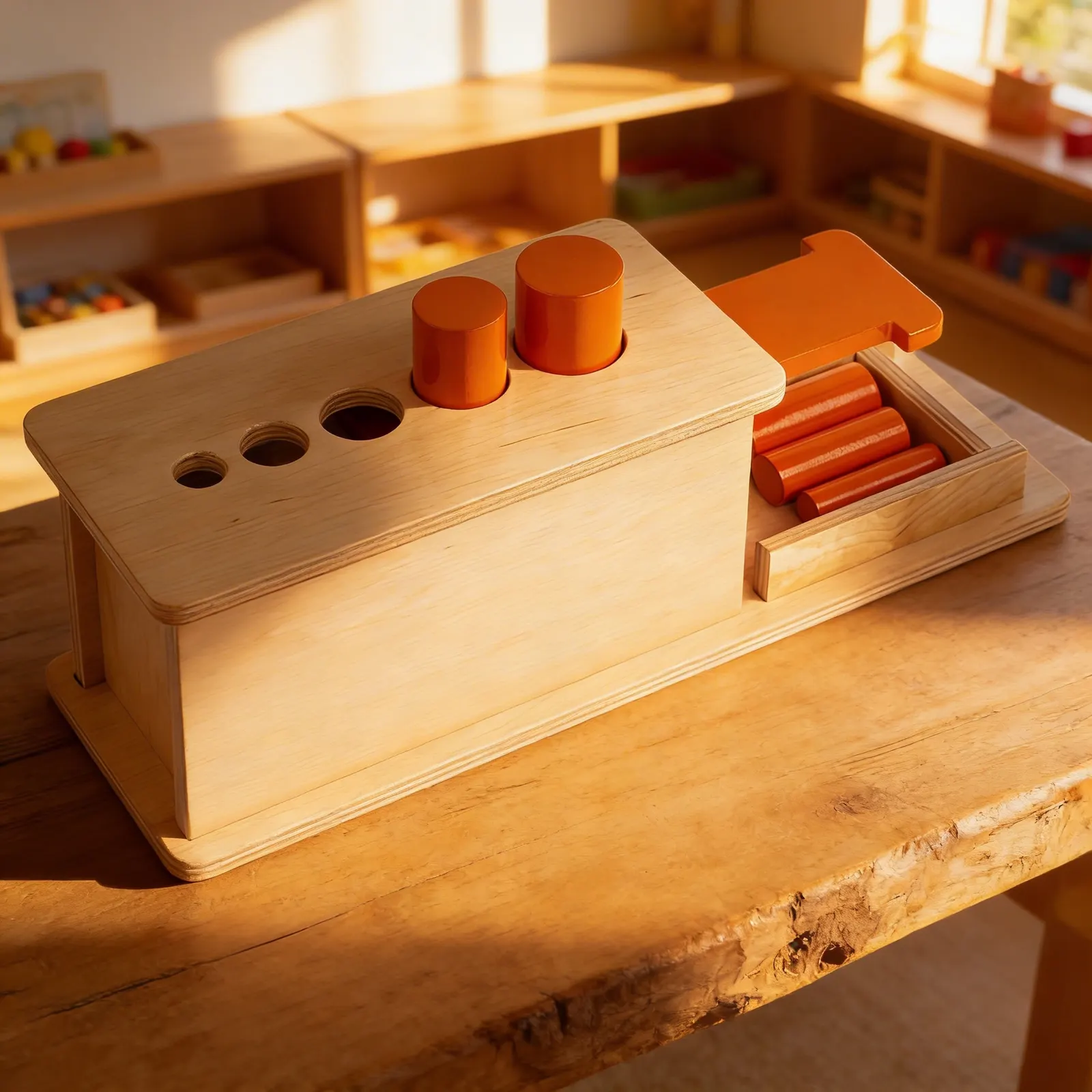
Sharpening perception one step at a time, this innovative Cylinder Slide combines the classic knobless cylinders exercise with a sliding drawer mechanism, and children can then explore dimension variations through a unique presentation. The material features three graduated cylinder holes on top with corresponding cylinders stored in a sliding compartment below, promoting refined discrimination of size and developing precise hand movements.
Visual Discrimination
Children refine their ability to perceive subtle differences in diameter through matching cylinders to holes.
Fine Motor Control
The sliding drawer mechanism develops controlled hand movements and bilateral coordination.
Problem Solving
Finding the correct match between cylinders and holes develops logical thinking and self-correction skills.
How to present it
Place the Cylinder Slide on a table mat. Ensure the sliding drawer is closed. Sit to the child's dominant side.
- 1Slowly slide open the drawer to reveal the cylinders, demonstrating the smooth movement
- 2Remove cylinders one by one using thumb and two fingers, placing them randomly on the mat
- 3Examine each cylinder visually, then test-fit into holes, rotating wrist for precision
- 4When all cylinders are correctly placed, remove them again and return to drawer
- 5Close the drawer with both hands, using controlled movement
3 tips for parents
- Resist the urge to correct - the material is self-correcting through the fit
- Observe without commenting as your child problem-solves
- Create a special place for this work to encourage repeated practice

If you are not sure it suits your child, we answer in person.
Norbert Kovalčín, founder of Faborino · write to him
There is no review here yet. We will ask you for one after you buy. Write the first review
What's in the Box
- Wooden slide box: With three graduated holes
- Sliding drawer compartment: Smooth gliding mechanism
- Orange cylinders: Approx. 3 pieces matching hole sizes
Size and material
| Product size | 3.8 × 1.4 × 1.2 cm |
| Packaging | 4 × 1 × 1 cm |
| Box Construction | Plywood |
| Frame & Details | Solid wood |
| Cylinders | Painted wood (orange) |
| Recommended Age | 0-3 years |
Care
Wipe with slightly damp cloth, dry immediately
Frequently Asked Questions
How does the Cylinder Slide differ from traditional knobless cylinders?
The Cylinder Slide features an innovative sliding drawer mechanism that stores cylinders below the work surface, adding an element of fine motor control and spatial awareness. This unique presentation helps children develop precise hand movements while exploring dimensional relationships through a more dynamic, interactive format.
What specific skills does this material develop?
This material develops visual discrimination of size, fine motor control, hand-eye coordination, and precise wrist movements. Children also strengthen their understanding of dimensional relationships, practice problem-solving through trial and error, and develop concentration through the engaging sliding mechanism.
What are the dimensions and specifications of this material?
The Cylinder Slide features three graduated cylinder holes on the top surface with corresponding cylinders stored in the sliding compartment below. The material is crafted from high-quality wood with smooth, precisely-sized cylinders that fit perfectly into their designated spaces, suitable for children ages 3-6.
How do children typically work with the Cylinder Slide?
Children begin by sliding open the drawer to access the cylinders, then attempt to match each cylinder to its corresponding hole on top. The sliding action adds complexity to the traditional exercise, requiring careful handling and control. Children develop systematic thinking as they explore which cylinder fits where through experimentation.
Can this material be used for extensions beyond the basic exercise?
Yes, the Cylinder Slide offers various extensions including grading cylinders by size outside the frame, combining with other sensorial materials for comparison work, creating patterns with the cylinders, and using blindfolds for stereognostic exercises to refine tactile discrimination of dimensions.
Product safety
Manufacturer: Nienhuis Montessori, Anders Celsiusstraat 15, 7442 PB Nijverdal, Netherlands
Cylinder Slide