
Decanomial Bead Bar Box: Advanced Mathematical Exploration to 10
Made by Nienhuis Montessori · shipped by Heutink International (Netherlands) About the maker
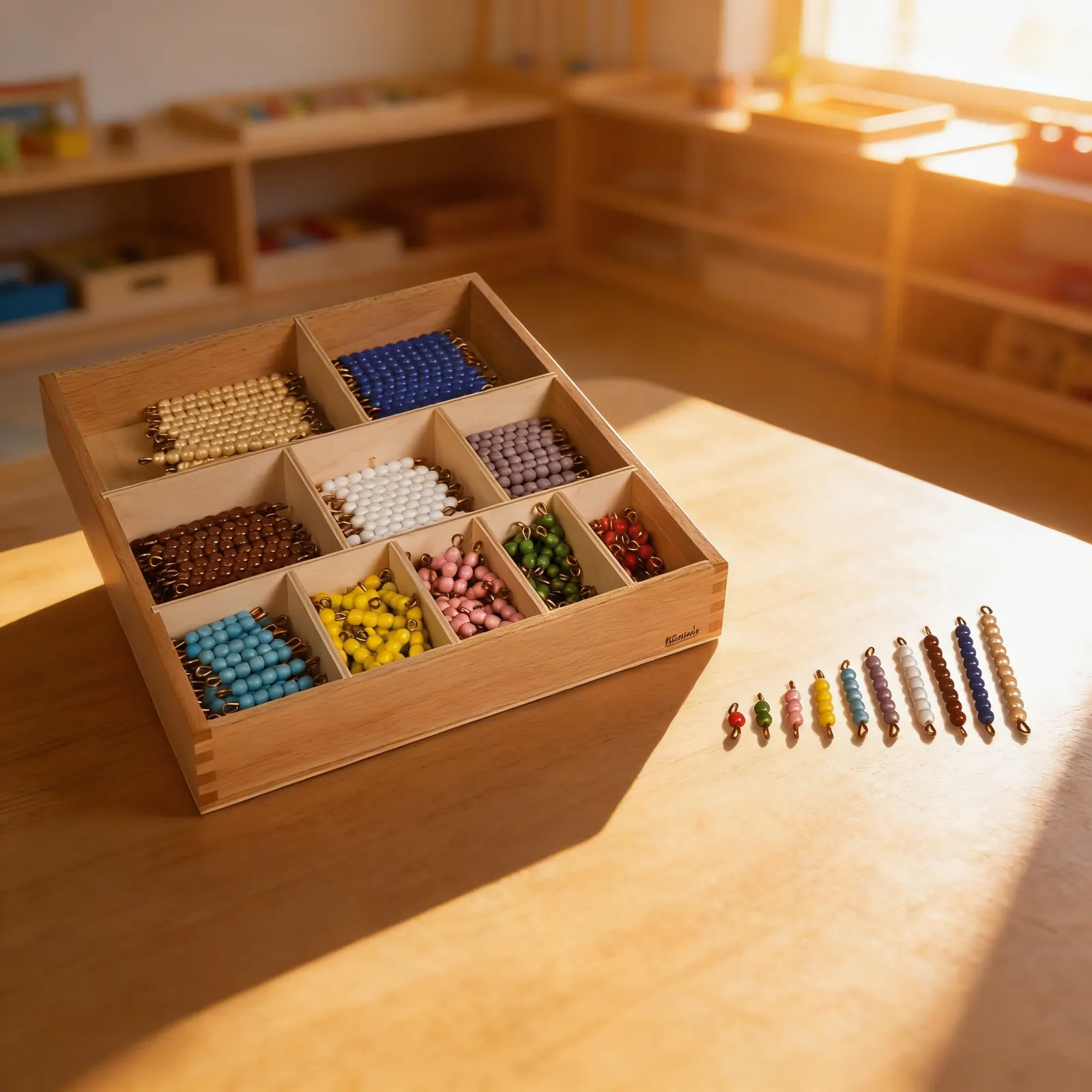
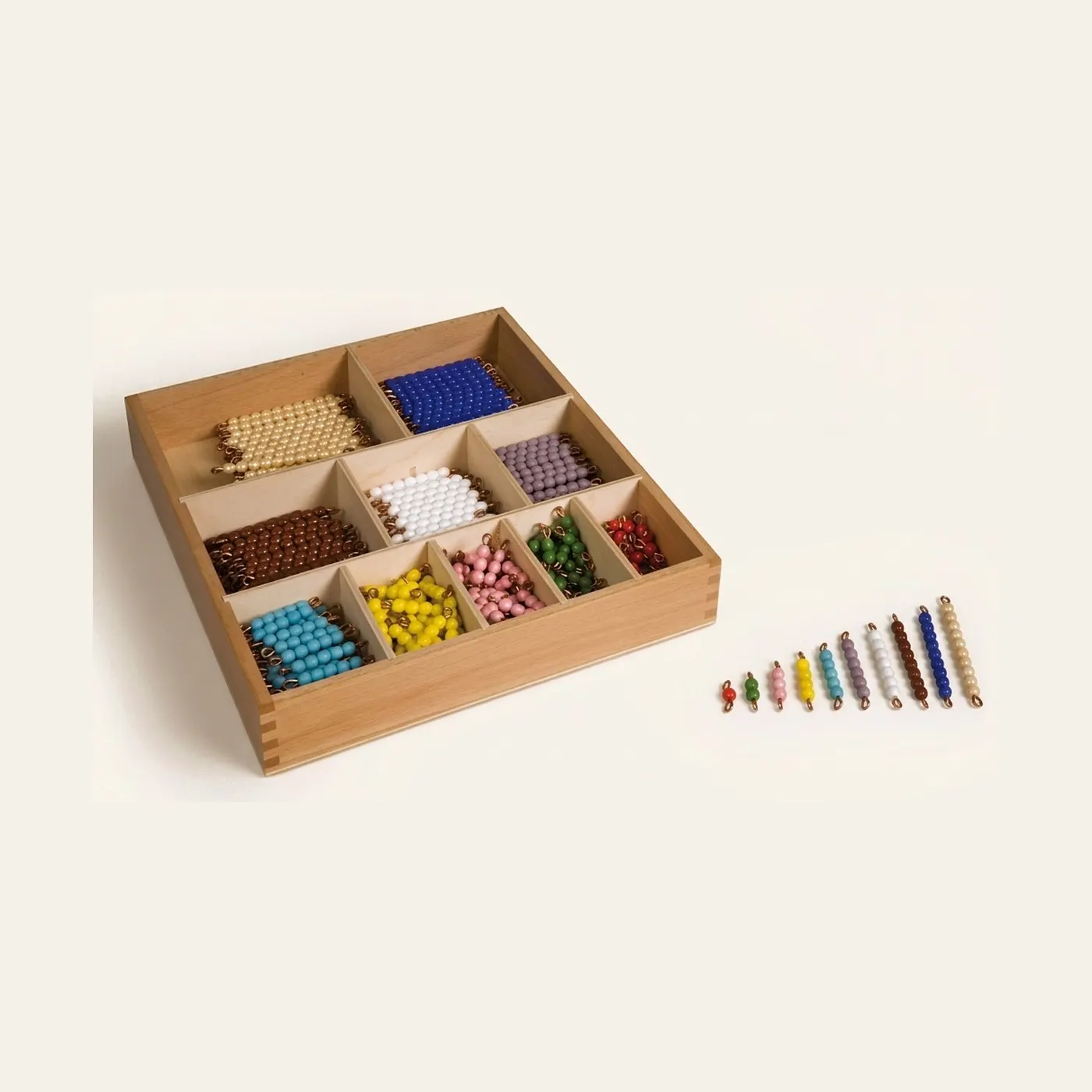
Fifty five bead bars of every length from one to ten, which is exactly what it takes to build the decanomial: the full multiplication table laid out as a square of squares and rectangles. A child builds it slowly, and the tables stop being a list to recite and become a shape whose symmetry can be seen from across the room. Taking it apart along the diagonal is where the squares of the numbers first stand out on their own. Glass bead bars in a compartmented wooden box, for ages 6 to 12.
“Education is a natural process spontaneously carried out by the human individual, and is acquired not by listening to words but by experiences upon the environment.”
The Decanomial Bead Bar Box exemplifies Montessori's mathematical sequence by providing concrete, manipulable materials that make abstract concepts tangible.
- Development of number sense and quantity recognition from 1-10
- Preparation for multiplication and algebraic thinking through pattern recognition
- Enhancement of fine motor skills through individual bead manipulation
- Strengthening of visual discrimination and color association with quantities
Read More
The individual glass beads offer precise tactile feedback, allowing children to internalize quantities through their senses before moving to symbolic representation. This material respects the elementary child's need for exactness and detail, supporting their mathematical mind's natural development. The compartmentalized design promotes order and independence, while the color-coding system creates visual patterns that reveal mathematical relationships. By handling each bead individually, children develop fine motor precision and numerical awareness simultaneously. The material's sophisticated construction reflects Montessori's belief that children deserve beautiful, precise tools that honor their intellectual capacity and support their journey toward mathematical abstraction through concrete exploration.
How to present it
Follow the Montessori method of presentation for optimal child development.
Place the bead bar box on a work mat at the child's table. Ensure adequate lighting to highlight the glass beads' brilliance and color distinctions.
- 1
Invite the child to explore one color family of beads, counting each individual bead to verify the quantity
Start with shorter bars to build confidence before progressing to longer quantities - 2
Have the child arrange bead bars in ascending order, creating a visual staircase pattern
Encourage the child to check their work by counting each bar's beads independently - 3
Introduce comparing quantities by placing different colored bars side by side
Ask open-ended questions like 'What do you notice?' rather than directing observations - 4
Guide the child in creating patterns using multiple bead bar families
Allow time for independent exploration before suggesting specific pattern arrangements
Every Child Is a Little Creator

Heritage
Since 1929

In classrooms
Around the world

European brands
Nienhuis, GAM, Educo

AMI approved
To the association standard
Decanomial Bead Bar Box: Advanced Mathematical Exploration to 10
