
Decanomial Paper
The first photo is the maker's own. The other shots are illustrative.
Inv. no. NIE-019100
- Maker
- Nienhuis Montessori, since 1929
- Approval
- AMI
- Material
- Printed paper
- EAN
- 8719924010294
Final price incl. VAT. Delivery €5.90, €126.10 to go for free delivery.
Advice, warranty and returns are handled by us.
Why it costs €22.90
Behind the price of the original are things you can check yourself.
AMI approval
The material is approved by the Association Montessori Internationale (AMI). Nienhuis has made Montessori materials since 1929.
A verifiable original
The EAN 8719924010294 is on the box. It is the maker's number, not ours.
Decanomial Paper in a child's hands
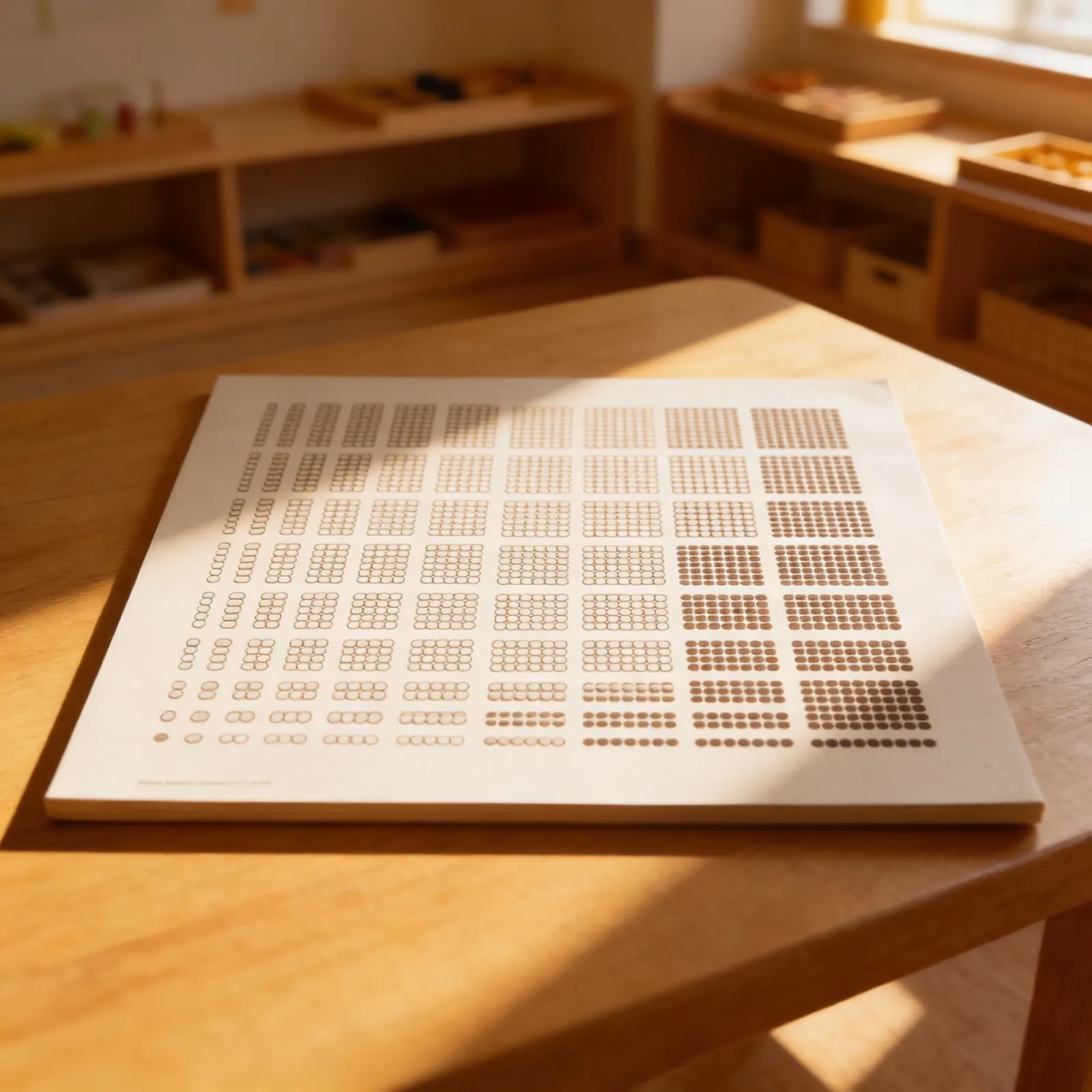
Decanomial Paper is a set of 10 printed forms of the decanomial. The forms are printed in actual size, so the outlines of the beads match the size of the bead material itself. They show the decanomial with black bead outlines. The decanomial is a bead material, and these sheets show it on paper instead of in beads, so the set holds the paper forms only. The pack measures 43 × 43 × 1 cm, the forms are white paper, and the set is for children aged 6 to 12.
Abstract Thinking
Bridges concrete bead work to abstract algebraic concepts through visual representation of mathematical patterns.
Mathematical Reasoning
Develops understanding of squared expressions from binomial to decanomial through systematic exploration.
Recording Skills
Provides structured format for documenting mathematical discoveries and algebraic expressions.
How to present it
2 tips for parents
- Display completed sheets at home to celebrate mathematical discoveries
- Notice how marking circles helps visualize complex math concepts

If you are not sure it suits your child, we answer in person.
Norbert Kovalčín, founder of Faborino · write to him
There is no review here yet. We will ask you for one after you buy. Write the first review
What's in the Box
- Printed decanomial forms: 10 forms in actual size with black bead outlines
Size and material
| Packaging | 43 × 43 × 1 cm |
| Material | Printed paper |
| Recommended Age | 6-12 years |
Care
Keep dry, store flat to prevent creasing
Frequently Asked Questions
Is this material appropriate for ages 3-6, and what prerequisites should children have?
While labeled for ages 3-6, the Decanomial Paper is typically introduced to children around ages 5-6 who have already worked extensively with sensorial materials like the binomial and trinomial cubes. Children should have experience with color coding, pattern recognition, and basic mathematical concepts before beginning this work. The material serves as a bridge between concrete manipulatives and abstract mathematical notation.
How does the Decanomial Paper relate to other Montessori mathematics materials?
The Decanomial Paper directly extends work with the decanomial bead box and connects to earlier experiences with the binomial and trinomial cubes. It provides the paper-based representation of the physical decanomial square, allowing children to record their discoveries and recognize algebraic patterns. This material prepares children for later work with squaring, algebra, and advanced mathematical concepts in elementary years.
Product safety
Manufacturer: Nienhuis Montessori, Anders Celsiusstraat 15, 7442 PB Nijverdal, Netherlands
Decanomial Paper