
Decimal Stamp Game
The first photo is the maker's own. The other shots are illustrative.
Inv. no. NIE-018301
- Maker
- Nienhuis Montessori, since 1929
- Approval
- AMI
- Tray
- Natural wood
- Tiles
- Painted wood with printed numerals
- EAN
- 8719924009786
Final price incl. VAT. Delivery €5.90, €31.10 to go for free delivery.
Advice, warranty and returns are handled by us.
Why it costs €117.90
Behind the price of the original are things you can check yourself.
AMI approval
The material is approved by the Association Montessori Internationale (AMI). Nienhuis has made Montessori materials since 1929.
A verifiable original
The EAN 8719924009786 is on the box. It is the maker's number, not ours.
Decimal Stamp Game in a child's hands
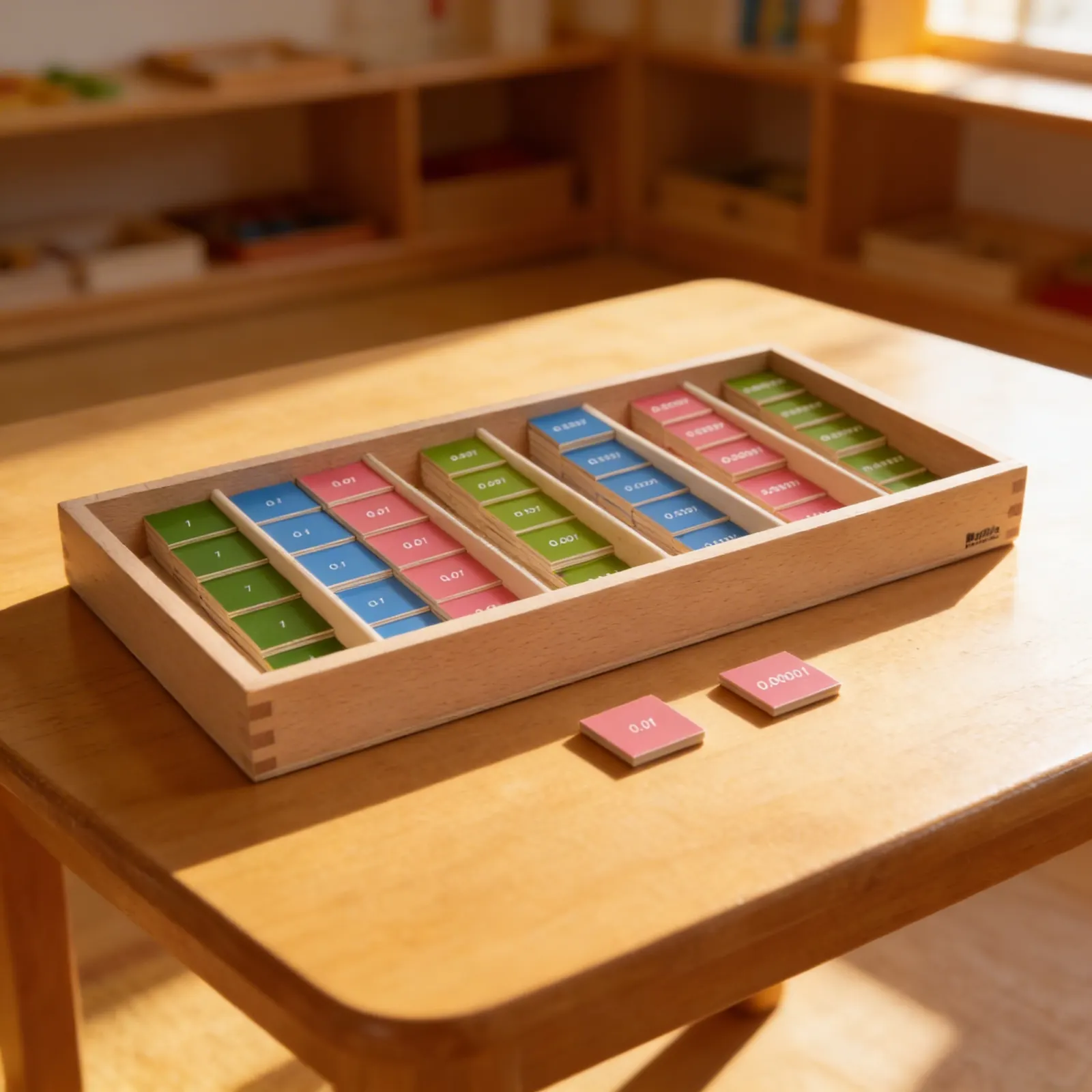
Number tiles printed with decimal fractions from one down to 0.000009, used to name decimal combinations and then to add, subtract and multiply with them. Decimals are where the decimal system finally runs in the other direction, and a child who has spent years going up through units, tens and hundreds needs to meet the mirror image as objects before as notation. Placing a tile for a thousandth beside one for a ten is what makes the symmetry visible. Wood with printed numerals, for ages 3 to 6.
Decimal Understanding
Builds concrete understanding of decimal place values through manipulative materials that make abstract concepts tangible.
Mathematical Precision
Develops accuracy in working with fractional quantities and understanding the relationship between whole numbers and decimals.
Visual Discrimination
Color-coding supports place value recognition and helps prevent errors in decimal operations.
Systematic Thinking
Organized compartments encourage methodical approach to decimal calculations and place value exchanges.
How to present it
Place the wooden tray on a mat with compartments arranged from left to right: units, tenths, hundredths, thousandths, ten-thousandths, hundred-thousandths, millionths. Ensure each compartment contains sufficient color-coded tiles.
- 1Introduce decimal notation by building 3.5 using 3 unit tiles and 5 tenth tiles
- 2Demonstrate exchanging 10 tenth tiles for 1 unit tile
- 3Build larger decimals like 24.367 using appropriate tiles from each compartment
- 4Practice addition: 3.4 + 2.7 by combining tiles and exchanging when necessary
3 tips for parents
- Practice reading prices at stores to reinforce decimal understanding
- Measure liquids in liters and milliliters during cooking activities
- Point out decimal usage in everyday life: temperature, distances, weights

If you are not sure it suits your child, we answer in person.
Norbert Kovalčín, founder of Faborino · write to him
There is no review here yet. We will ask you for one after you buy. Write the first review
What's in the Box
- Wooden storage tray: With 7 compartments
- Decimal tiles: Approx. 45 pieces total
- Place value tiles: 1, 0.1, 0.01, 0.001, 0.0001, 0.00001, 0.000001
Size and material
| Packaging | 44 × 19 × 5 cm |
| Tray | Natural wood |
| Tiles | Painted wood with printed numerals |
| Recommended Age | 6-12 years |
Care
Wipe with slightly damp cloth, dry immediately
Frequently Asked Questions
How does the Decimal Stamp Game differ from the regular Stamp Game?
While the regular Stamp Game focuses on whole numbers (units, tens, hundreds, thousands), the Decimal Stamp Game extends learning to include decimal place values (tenths, hundredths, thousandths up to millionths). It uses the same color-coding system but adds compartments for fractional quantities, allowing children to explore numbers smaller than one.
Is this material appropriate for 3-year-olds given the complexity of decimals?
The Decimal Stamp Game is typically introduced after children have mastered whole number operations with the regular Stamp Game, usually around ages 5-6. While the product indicates ages 3-6, most 3-year-olds would benefit from working with whole numbers first. The material grows with the child and can be used progressively as their understanding develops.
What specific decimal operations can children practice with this material?
Children can explore decimal addition, subtraction, multiplication, and division using the color-coded tiles. The material helps them understand decimal place value, compare decimal quantities, and perform exchanges between decimal places. It provides a concrete, visual way to understand that decimals follow the same base-ten pattern as whole numbers.
How many tiles are included in each decimal place value compartment?
The set includes wooden tiles for seven decimal place values: units, tenths, hundredths, thousandths, ten-thousandths, hundred-thousandths, and millionths. Each compartment contains multiple tiles to allow for various mathematical operations and exchanges. The exact quantity per compartment is designed to support typical classroom exercises.
What prior Montessori materials should children work with before using this?
Children should have experience with the regular Stamp Game for whole numbers, the Golden Bead Material for understanding place value, and ideally some work with fraction materials. Familiarity with the color-coding system (green for units, blue for tens, red for hundreds) is essential as this same pattern continues into the decimal places.
Product safety
Manufacturer: Nienhuis Montessori, Anders Celsiusstraat 15, 7442 PB Nijverdal, Netherlands
Decimal Stamp Game