
Discs On Vertical Dowel
The first photo is the maker's own. The other shots are illustrative.
Inv. no. NIE-045200
- Maker
- Nienhuis Montessori, since 1929
- Approval
- AMI
- Base
- Laminated plywood
- Discs
- Lacquered wood
- EAN
- 8719924012731
Final price incl. VAT. Delivery €5.90, €113.10 to go for free delivery.
Advice, warranty and returns are handled by us.
Why it costs €35.90
Behind the price of the original are things you can check yourself.
AMI approval
The material is approved by the Association Montessori Internationale (AMI). Nienhuis has made Montessori materials since 1929.
A verifiable original
The EAN 8719924012731 is on the box. It is the maker's number, not ours.
Discs On Vertical Dowel in a child's hands
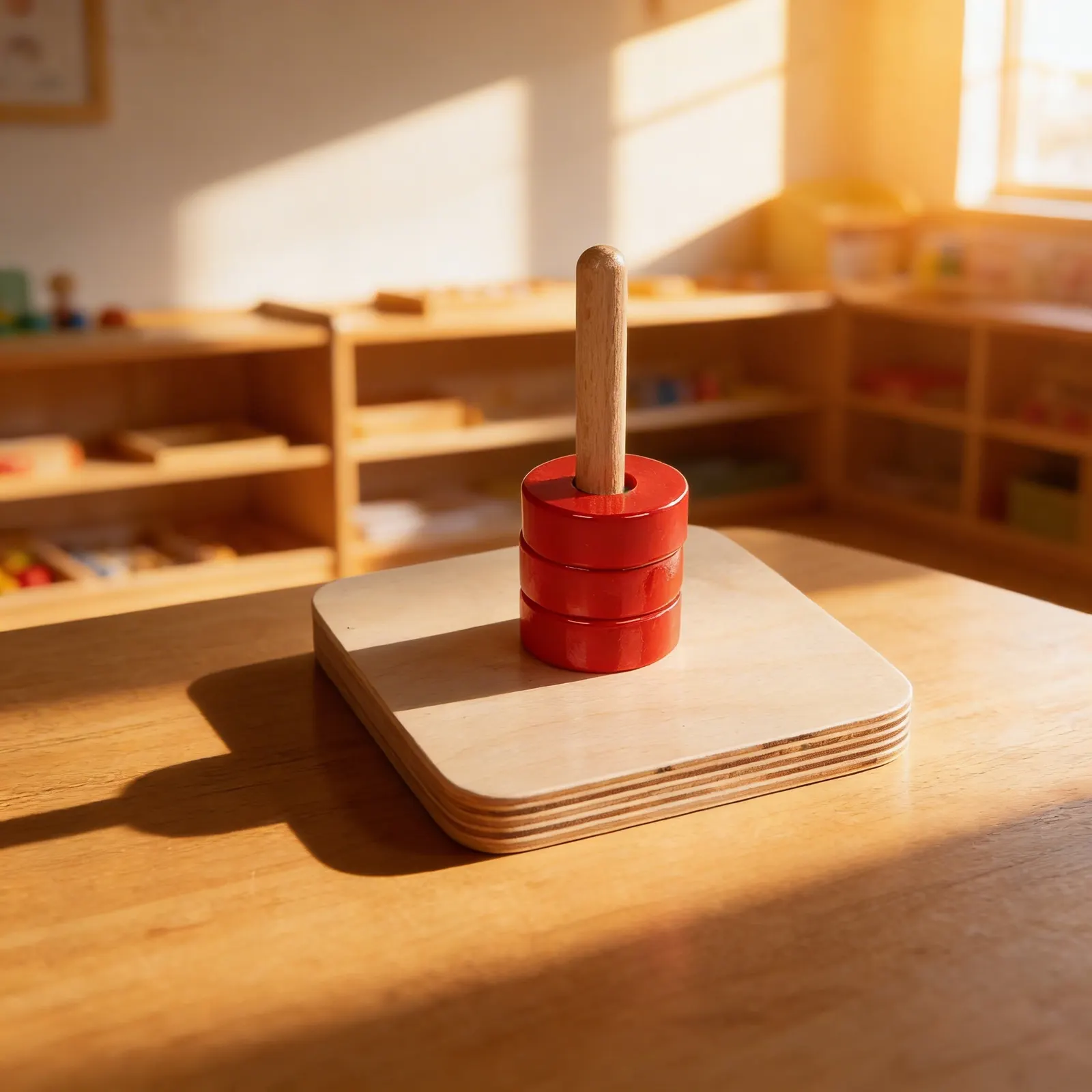
Discs threaded onto a vertical dowel. Vertical is harder than horizontal for one reason: the disc has to be lifted clear of the top of the dowel before the hole can be aligned, so the hand is holding the weight and aiming at the same moment. On a horizontal dowel gravity does the holding. Working the vertical version afterwards is where a child finds out those were two different skills all along. Wood and plywood, for ages 0 to 3.
Hand-Eye Coordination
Threading discs onto the dowel refines visual-motor integration and develops precise hand movements essential for later skills.
Concentration Development
The focused activity of stacking and unstacking builds attention span and purposeful movement patterns.
Problem-Solving Skills
Children discover through exploration how to orient and position each disc to successfully complete the stacking sequence.
How to present it
Place the dowel base on a low table or mat at the child's working height. Arrange the three red discs in a basket to the right of the dowel. Ensure the work area is clear of distractions.
- 1Sit to the child's right. Slowly grasp one disc using thumb and fingers, lifting it deliberately.
- 2Hold the disc above the dowel, pausing to show the alignment of the hole with the post.
- 3Lower the disc onto the dowel, releasing it when it rests on the base.
- 4Repeat with remaining discs, then remove all discs one by one, returning them to the basket.
3 tips for parents
- Practice similar movements at home using large wooden rings and a paper towel holder
- Watch for your child's dominant hand preference emerging through this work
- Allow multiple repetitions - young children need practice to refine their movements

If you are not sure it suits your child, we answer in person.
Norbert Kovalčín, founder of Faborino · write to him
There is no review here yet. We will ask you for one after you buy. Write the first review
What's in the Box
- Square plywood base: With vertical dowel
- Three red wooden discs: Graduated sizes
Size and material
| Packaging | 15 × 14 × 13 cm |
| Base | Laminated plywood |
| Discs | Lacquered wood |
| Dowel | Smooth natural wood |
| Recommended Age | 0-3 years |
Care
Wipe with damp cloth, dry immediately
Frequently Asked Questions
What age is the Discs on Vertical Dowel appropriate for?
This material is designed for infants and toddlers aged 8 months to 2.5 years. Children typically begin exploring it once they can sit independently and grasp objects with purpose, progressing through different skill levels as they develop.
How does this material support my child's development?
The Discs on Vertical Dowel develops hand-eye coordination, refined grasping skills, spatial awareness, and concentration. It introduces concepts of size discrimination, order, and cause-and-effect while strengthening the pincer grip needed for later writing activities.
What makes this different from regular stacking toys?
Unlike conventional stacking toys, this Montessori material isolates one concept - placing objects on a vertical dowel. The uniform red discs eliminate distractions, allowing children to focus solely on the movement and spatial relationship between the disc and dowel.
How should I present this material to my child?
Sit beside your child and slowly demonstrate lifting one disc with a pincer grip, positioning it above the dowel, and gently releasing it to slide down. Use minimal language and exaggerated, slow movements. Allow your child to explore freely after your demonstration.
What skills should my child have before using this material?
Your child should be able to sit independently, grasp objects intentionally, and show interest in manipulating items. This material typically follows the grasping beads and precedes more complex stacking materials like the colored discs on vertical dowel.
Product safety
Manufacturer: Nienhuis Montessori, Anders Celsiusstraat 15, 7442 PB Nijverdal, Netherlands
Discs On Vertical Dowel