
Elementary Negative Snake GameIndividual Beads Glass
The first photo is the maker's own. The other shots are illustrative.
Inv. no. NIE-0292G0
- Maker
- Nienhuis Montessori, since 1929
- Approval
- AMI
- Bead Material
- High-quality glass
- Storage Material
- Painted wood boxes with lids
- EAN
- 8719924012311
Final price incl. VAT. Free delivery.
Advice, warranty and returns are handled by us.
Why it costs €330.90
Behind the price of the original are things you can check yourself.
AMI approval
The material is approved by the Association Montessori Internationale (AMI). Nienhuis has made Montessori materials since 1929.
A verifiable original
The EAN 8719924012311 is on the box. It is the maker's number, not ours.
Elementary Negative Snake Game in a child's hands
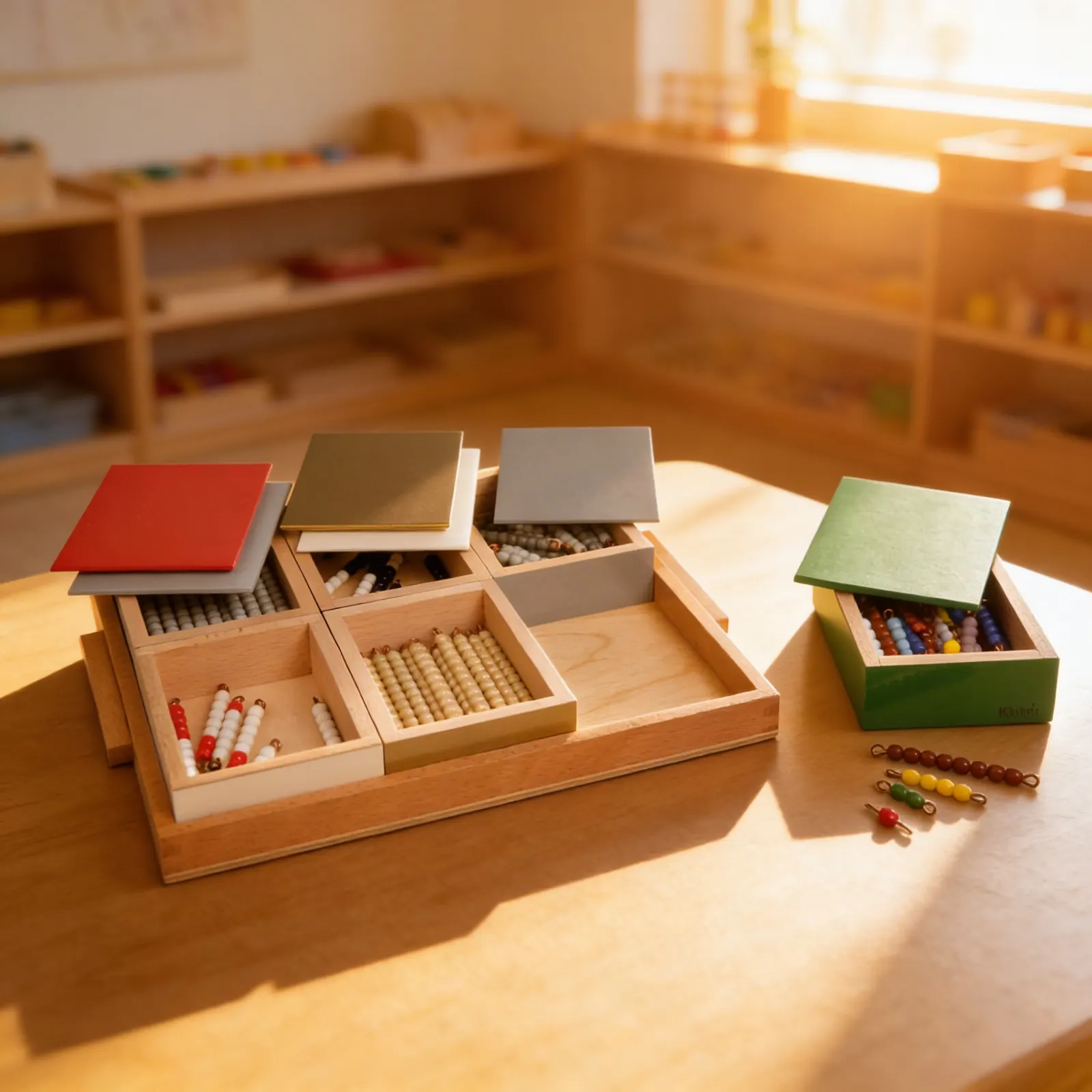
The snake game rebuilt to introduce negative numbers. A child lays a snake of coloured bead bars, then works along it exchanging for golden tens, and the negative bars force the count back down through zero and out the other side. Meeting a negative quantity as a bar you physically remove is a very different thing from meeting it as a minus sign, and children who have done this rarely find negatives strange later. The tray holds the bead material, coloured, negative, black and white and red and white stairs, and golden ten bars. Glass beads with wooden boxes, for ages 6 to 12.
Abstract Mathematical Thinking
Bridges concrete manipulation to abstract understanding of negative numbers and subtraction operations
Sequential Processing
Develops systematic approach to complex mathematical problems through ordered bead exchange
Error Control
Color-coding and physical manipulation provide immediate feedback for self-correction
How to present it
Arrange the painted wooden boxes containing color-coded glass bead bars on a large work mat. Place positive bead bars (1-9) in one section and negative bead bars in another. Ensure adequate workspace for creating the snake formation.
- 1Create initial snake using positive colored bead bars in random sequence
- 2Introduce negative (grey) bead bars, placing them after positive bars
- 3Begin exchanging at the head of the snake, combining positive and negative values
- 4When exchanges result in negative values, use black and white bead bars to represent them
- 5Continue exchanges until reaching a final positive or negative sum
- 6Verify the result by checking the original equation against the final bead configuration
3 tips for parents
- Practice simple negative number situations at home using everyday contexts like elevator floors below ground
- Avoid rushing to symbolic notation - the glass bead work builds essential conceptual understanding
- Celebrate when your child discovers patterns like 'negative plus positive equals a smaller number'

If you are not sure it suits your child, we answer in person.
Norbert Kovalčín, founder of Faborino · write to him
There is no review here yet. We will ask you for one after you buy. Write the first review
What's in the Box
- Glass bead bars: Multiple colors representing different values
- Painted wooden storage boxes: Approx. 7 boxes with fitted lids
- Compartmentalized wooden tray: For organized bead arrangement
Size and material
| Packaging | 32 × 25 × 7 cm |
| Bead Material | High-quality glass |
| Storage Material | Painted wood boxes with lids |
| Tray Material | Natural wood with compartments |
| Recommended Age | 6-12 years |
Care
Wipe wooden components with damp cloth; handle glass beads carefully
Frequently Asked Questions
What is the difference between the Elementary Negative Snake Game and the positive snake game?
The Elementary Negative Snake Game introduces negative numbers and subtraction concepts using grey/black beads to represent negative values, while the positive snake game focuses only on addition with colored beads. This material builds upon the positive snake game foundation to teach more advanced mathematical operations including subtraction and working with negative integers.
Why are glass beads used instead of plastic beads for this material?
Glass beads provide superior durability, consistent weight, and a premium tactile experience that enhances the child's sensory learning. The precision-crafted glass beads maintain their color vibrancy over years of use and offer the authentic Montessori quality that supports focused concentration and careful manipulation during mathematical work.
What mathematical concepts can children learn with the Elementary Negative Snake Game?
Children learn subtraction, negative numbers, integer operations, and the relationship between positive and negative values. The material supports understanding of number lines, absolute value, additive inverse, and prepares students for algebra by providing concrete experience with abstract concepts like combining positive and negative quantities.
How are the beads organized in the wooden boxes?
The painted wooden boxes contain color-coded glass bead bars organized by value: positive numbers use traditional Montessori colors (red for 1, green for 2, etc.) while negative numbers use grey or black beads. Each box compartment is clearly labeled, making it easy for children to select and return beads independently during their work.
What age is most appropriate to introduce the Elementary Negative Snake Game?
While suitable for ages 6-12, most children begin using this material around age 7-8, after mastering positive snake game and basic addition facts. The child should be comfortable with the concept of subtraction and ready to explore what happens when we subtract more than we have, leading naturally into negative number understanding.
Product safety
Manufacturer: Nienhuis Montessori, Anders Celsiusstraat 15, 7442 PB Nijverdal, Netherlands
Elementary Negative Snake Game