
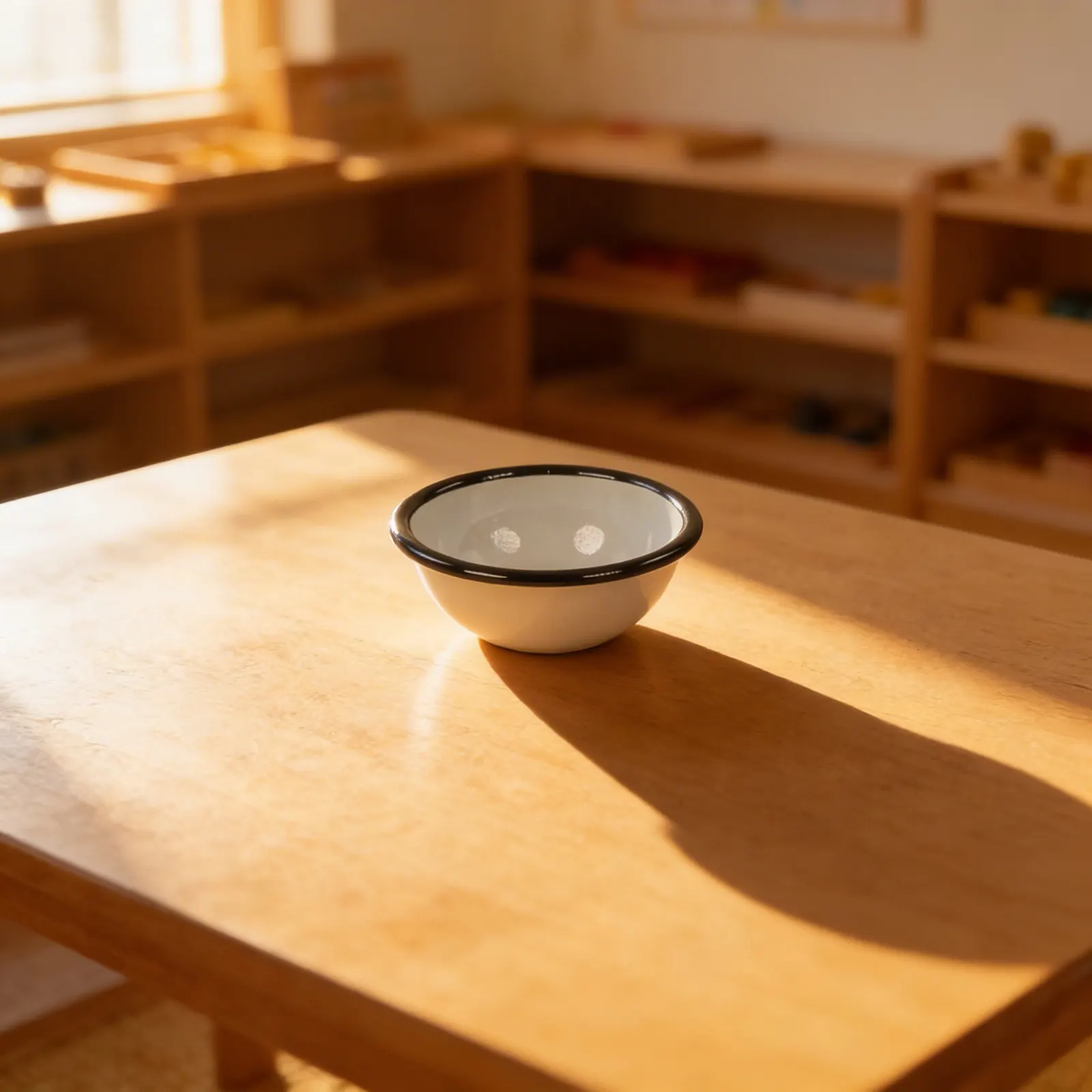
Enamel Finger Bowl
The first photo is the maker's own. The other shots are illustrative.
Inv. no. NIE-400604
- Maker
- Nienhuis Montessori, since 1929
- Primary Material
- Enamel-coated metal
- Rim
- Black enamel edge
- EAN
- 8719924059729
Final price incl. VAT. Delivery €5.90, €135.10 to go for free delivery.
Advice, warranty and returns are handled by us.
Enamel Finger Bowl in a child's hands
A finger bowl in enamel, 11,5 cm across, for food preparation and for washing hands at the table. It is the small courtesy vessel of practical life: a child who has handled fruit puts their fingers in it and dries them, and the sequence is finished properly rather than on a sleeve. The maker gives the robust enamel surface as the reason for simple care and hygiene, which on a bowl refilled several times a day is the specification that matters. Diameter 11,5 cm.
Fine Motor Control
Carrying and pouring water develops wrist strength and hand-eye coordination essential for writing preparation.
Practical Life Skills
Learning proper hand washing technique builds independence and reinforces daily hygiene routines.
Concentration
Water activities require focused attention and careful movements, strengthening the child's ability to concentrate.
How to present it
Place the enamel bowl on a tray with a small pitcher containing water tinted with food coloring. Include a sponge for spills. Position materials left to right on the child's work mat.
- 1Demonstrate holding the bowl with both hands, thumbs on rim
- 2Pour water slowly from pitcher into bowl, stopping at halfway
- 3Lift bowl carefully and pour water back into pitcher
- 4Use sponge to wipe any drops from bowl's rim
- 5Invite child to repeat the sequence independently
3 tips for parents
- Let your child use the bowl during practical tasks like rinsing berries or washing paintbrushes
- Practice pouring in the bathtub first if your child seems hesitant about spills
- Notice and comment when your child controls their movements: 'You poured without splashing!'

If you are not sure it suits your child, we answer in person.
Norbert Kovalčín, founder of Faborino · write to him
There is no review here yet. We will ask you for one after you buy. Write the first review
What's in the Box
- Enamel Finger Bowl: 12cm diameter with black rim
Size and material
| Packaging | 12 × 11 × 4 cm |
| Primary Material | Enamel-coated metal |
| Rim | Black enamel edge |
| Recommended Age | 3-6 years |
Care
Hand wash with mild soap, dry thoroughly
Frequently Asked Questions
What size is the enamel finger bowl and is it appropriate for small hands?
This finger bowl features a shallow depth design specifically chosen for children ages 3-6, allowing their small hands to easily reach in and manipulate water during practical life activities. The size is perfectly proportioned for developing fine motor control and pouring precision.
Is the enamel coating safe for children and how durable is it?
The enamel coating is completely safe for children and highly durable for classroom use. The smooth, non-porous surface is easy to clean and sanitize between activities, while the enamel finish resists chips and scratches better than ceramic alternatives.
What specific Montessori activities can be done with this bowl?
This versatile bowl supports numerous practical life exercises including hand washing, water transferring with sponges or pipettes, floating and sinking experiments, flower arranging, and precise pouring practice. It's also ideal for sensory activities involving temperature exploration.
Why does the bowl have a black rim and how does this help children?
The contrasting black rim provides important visual definition that helps children judge water levels and develop spatial awareness. This visual boundary supports concentration and precision when pouring, preventing spills and building confidence in water-based activities.
How do I introduce this bowl to a child who has never used one before?
Start by demonstrating slow, deliberate movements when carrying the bowl with two hands. Show how to fill it partially with water at a child-height water source, then guide them through simple transferring exercises using a sponge or small pitcher, emphasizing careful movements and spill cleanup procedures.
Product safety
Manufacturer: Nienhuis Montessori, Anders Celsiusstraat 15, 7442 PB Nijverdal, Netherlands
Enamel Finger Bowl