
Equivalent Figure Material
The first photo is the maker's own. The other shots are illustrative.
Inv. no. NIE-012200
- Maker
- Nienhuis Montessori, since 1929
- Approval
- AMI
- Material
- Metal
- Colour
- Green (frames), red (insets)
- EAN
- 8719924006846
Final price incl. VAT. Free delivery.
Advice, warranty and returns are handled by us.
Why it costs €805.90
Behind the price of the original are things you can check yourself.
AMI approval
The material is approved by the Association Montessori Internationale (AMI). Nienhuis has made Montessori materials since 1929.
A verifiable original
The EAN 8719924006846 is on the box. It is the maker's number, not ours.
Equivalent Figure Material in a child's hands
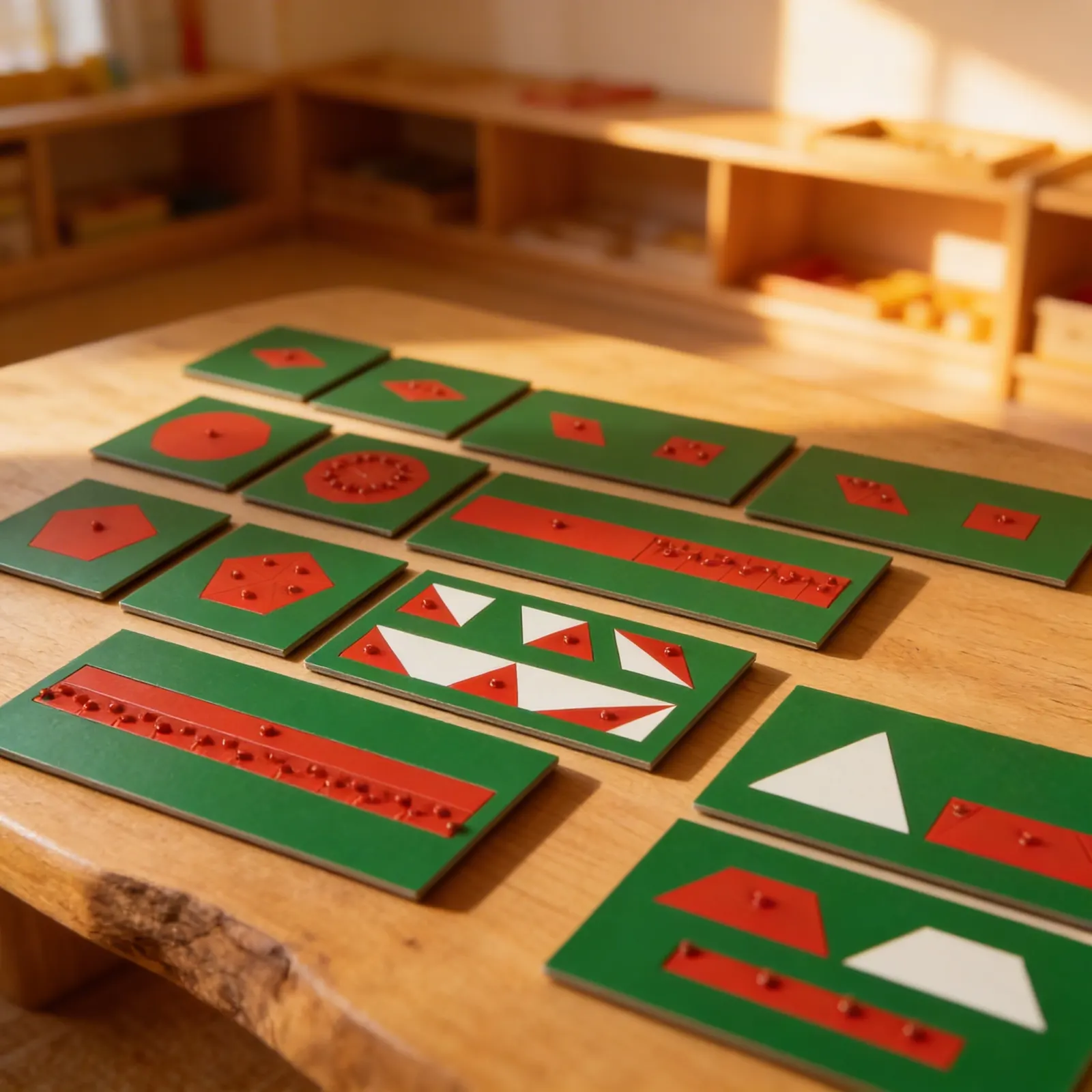
Equivalent Figure Material: a set of 13 green metal frames with bottoms and red insets for studying the relationship of equivalent figures, that is, figures with a different shape and the same area. It is one of the few things in geometry that children refuse to believe until they see it: a triangle and a rectangle do not look equally large, and yet they are. From there the path leads to the discovery of area and geometric theorems. Metal, for ages 6 to 12.
Mathematical Reasoning
Develops understanding of geometric relationships and equivalence through visual comparison and pattern recognition.
Abstract Thinking
Bridges concrete geometric shapes to abstract mathematical concepts of area and geometric theorems.
Visual Discrimination
Enhances ability to analyze and compare complex geometric patterns and their relationships.
Problem-Solving Skills
Encourages systematic thinking through equivalence challenges.
How to present it
3 tips for parents
- Look for equivalent shapes in everyday life - floor tiles, quilt patterns, or garden designs
- Support mathematical vocabulary by using terms like 'equivalent' and 'congruent' accurately
- Celebrate the process of discovery rather than rushing to memorize equivalences

If you are not sure it suits your child, we answer in person.
Norbert Kovalčín, founder of Faborino · write to him
There is no review here yet. We will ask you for one after you buy. Write the first review
What's in the Box
- Metal frames: 13 green frames with bottoms
- Insets: Red insets
Size and material
| Packaging | 35 × 16 × 22 cm |
| Material | Metal |
| Colour | Green (frames), red (insets) |
| Recommended Age | 6-12 years |
Care
Wipe clean with damp cloth, dry immediately
Frequently Asked Questions
What geometric concepts does the Equivalent Figure Material teach?
This material teaches geometric equivalence and area comparison. Children discover how different geometric figures can have equivalent areas despite different forms, building foundational understanding for geometry.
How does this material support the elementary mathematics curriculum?
The Equivalent Figure Material bridges concrete and abstract mathematical concepts crucial for ages 6-12. It leads to the discovery of area and geometric theorems and prepares children for more advanced geometry studies while maintaining the hands-on Montessori approach.
What is included in the Equivalent Figure Material?
The material consists of 13 green metal frames with bottoms and red insets.
Product safety
Manufacturer: Nienhuis Montessori, Anders Celsiusstraat 15, 7442 PB Nijverdal, Netherlands
Equivalent Figure Material