
EuropePolitical (50)
The first photo is the maker's own. The other shots are illustrative.
Inv. no. NIE-552500
- Maker
- Nienhuis Montessori, since 1929
- Approval
- AMI
- Primary Material
- Paper
- Finish
- Matte surface for writing/coloring
- EAN
- 8719924029234
Final price incl. VAT. Delivery €5.90, €125.10 to go for free delivery.
Advice, warranty and returns are handled by us.
Why it costs €23.90
Behind the price of the original are things you can check yourself.
AMI approval
The material is approved by the Association Montessori Internationale (AMI). Nienhuis has made Montessori materials since 1929.
A verifiable original
The EAN 8719924029234 is on the box. It is the maker's number, not ours.
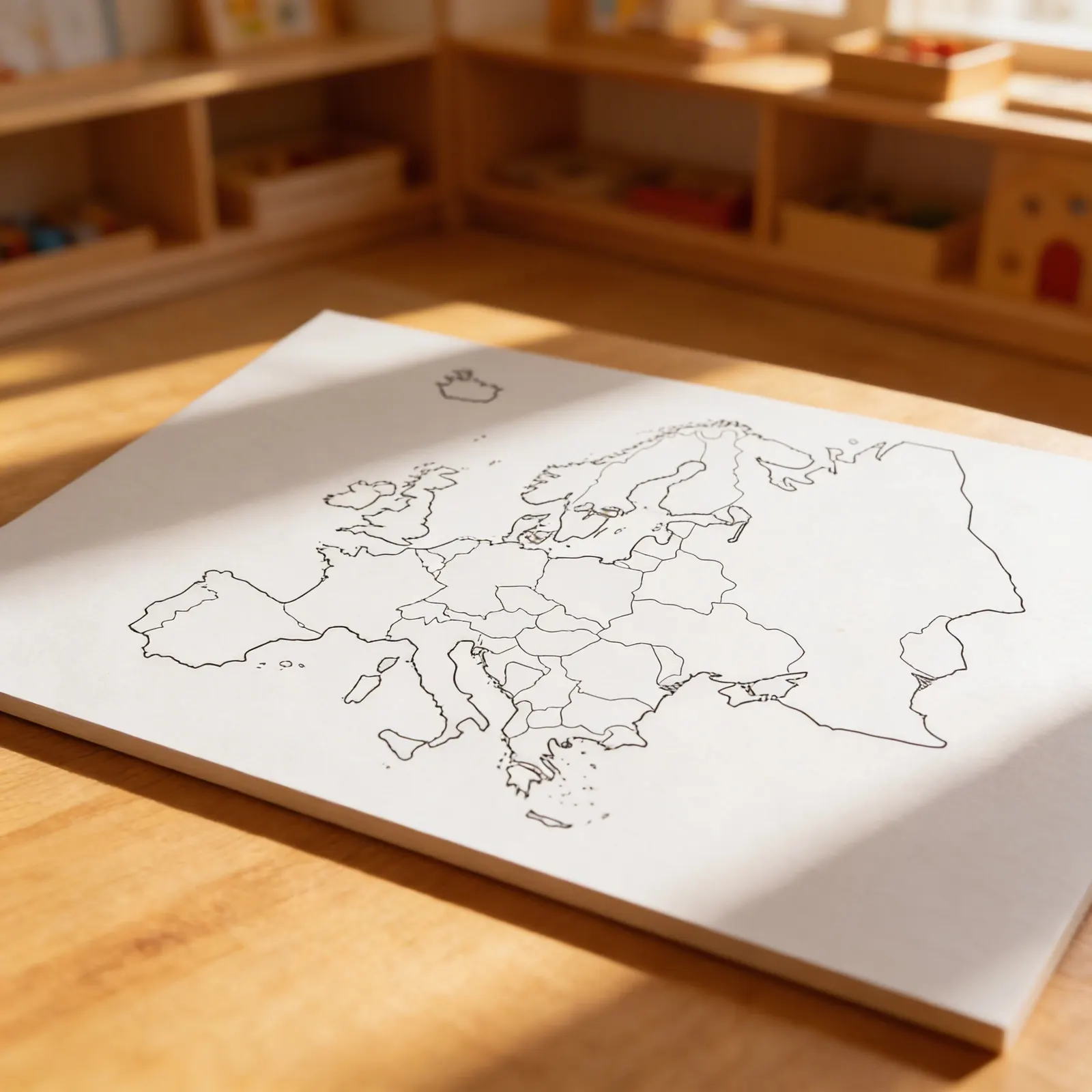
Europe in a child's hands
Fifty political maps of Europe, showing the countries. Europe packs more borders into less space than anywhere else, which makes it the political map children find hardest and adults find most out of date: the map a parent learned is not the map their child is learning, and the countries that changed are within living memory. That is a rare chance to show that geography has a history. Paper and cardstock, for ages 3 to 12.
Geographic Awareness
Children develop understanding of European countries, their shapes, sizes, and relative positions through hands-on exploration.
Fine Motor Skills
Tracing borders and placing labels refines pencil control and hand-eye coordination essential for writing preparation.
Cultural Understanding
Introduces concepts of nations and boundaries, laying groundwork for cultural studies and global awareness.
Visual Discrimination
Recognizing and differentiating between country shapes and sizes enhances visual perception and spatial intelligence.
How to present it
Place the map on a work mat with colored pencils, country labels (if available), and a control map showing labeled European countries for reference.
- 1Invite the child to trace the outline of Europe with their finger, noting how water surrounds much of the continent
- 2Choose one country to trace with a colored pencil, following its borders carefully
- 3Color the traced country, staying within the borders
- 4If using labels, match country names to their locations on the map
- 5Repeat with additional countries as interest continues
3 tips for parents
- Look for European elements in your daily life - foods, products, or news - and locate their countries on the map
- Share family heritage connections to European countries while working with the map together
- Create simple matching games using country shapes cut from paper

If you are not sure it suits your child, we answer in person.
Norbert Kovalčín, founder of Faborino · write to him
There is no review here yet. We will ask you for one after you buy. Write the first review
What's in the Box
- Europe Political Map: 50 × 40 cm blank outline map
Size and material
| Packaging | 44 × 28 × 1 cm |
| Primary Material | Paper |
| Finish | Matte surface for writing/coloring |
| Recommended Age | 3-6 years |
Care
| Cleaning | Wipe gently with dry cloth |
| Storage | Store flat in map cabinet or portfolio |
Frequently Asked Questions
What age group is this political map of Europe designed for?
This map is specifically designed for children ages 3-6 years old, with simple, clear boundaries that are appropriate for early learners beginning to explore geography.
Does this map come with country labels or is it blank?
The map comes in a blank, unlabeled format, allowing children to add their own labels, trace borders, or color different countries as part of their learning activities.
What materials or activities can be used with this political map?
Children can use this map for various activities including placing country label cards, tracing national borders, coloring different regions, and learning to identify European countries through hands-on exploration.
What size is the Europe political map and what is it made of?
While specific dimensions aren't listed, Montessori maps are typically made of durable materials suitable for repeated handling by young children. Please contact us for exact specifications.
How does this political map support Montessori geography learning?
This map follows Montessori principles by providing a concrete, hands-on material that allows children to explore abstract concepts of political boundaries through sensorial experiences like tracing, coloring, and labeling.
Product safety
Manufacturer: Nienhuis Montessori, Anders Celsiusstraat 15, 7442 PB Nijverdal, Netherlands
Europe