
EuropeWaterways (50)
The first photo is the maker's own. The other shots are illustrative.
Inv. no. NIE-552400
- Maker
- Nienhuis Montessori, since 1929
- Approval
- AMI
- Primary Material
- Paper
- Finish
- Matte print surface
- EAN
- 8719924029227
Final price incl. VAT. Delivery €5.90, €125.10 to go for free delivery.
Advice, warranty and returns are handled by us.
Why it costs €23.90
Behind the price of the original are things you can check yourself.
AMI approval
The material is approved by the Association Montessori Internationale (AMI). Nienhuis has made Montessori materials since 1929.
A verifiable original
The EAN 8719924029227 is on the box. It is the maker's number, not ours.
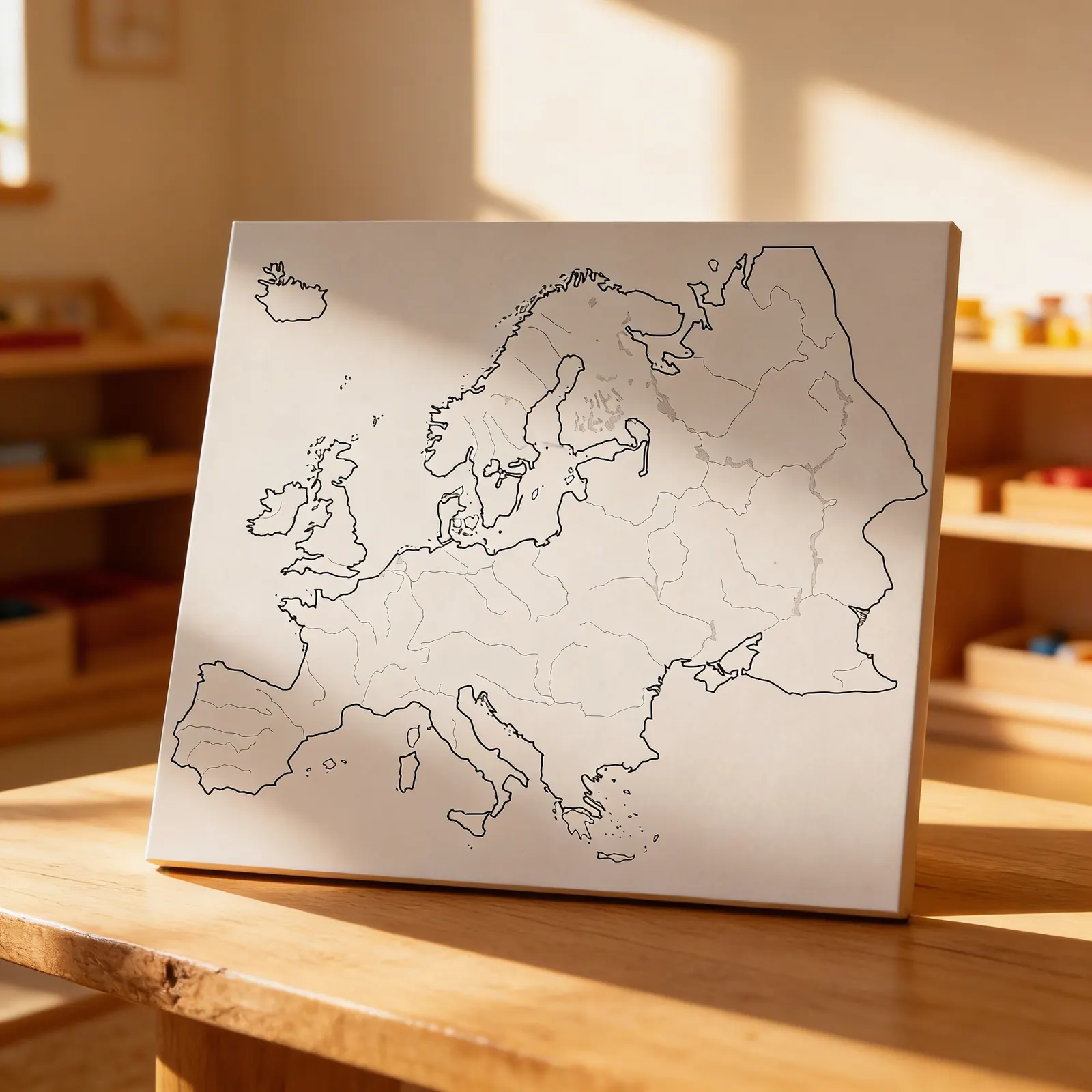
Europe in a child's hands
Europe: Waterways (50) puts a map of the waterways of Europe on fifty sheets. The child follows the rivers with a coloured pencil, sees where they run and where they end, and can compare one waterway with another. The paper is white, and Nienhuis lists the sheets for indoor use; the pack weighs 600 g. Beside each river the child can write its name, and with fifty sheets a whole group can work on the same map, each child on a sheet of their own. For ages 3 to 6.
Geographic Awareness
Develops understanding of Europe's physical geography through visual recognition of waterways and their relationship to countries.
Visual Discrimination
Strengthens ability to distinguish between different types of geographic features through careful observation of rivers, lakes, and seas.
Spatial Reasoning
Builds comprehension of how water systems connect regions and influence human settlement patterns.
Language Development
Enriches vocabulary with geographic terms while discussing rivers, tributaries, deltas, and water-related features.
How to present it
Place the waterways map on a work mat at child height. Have blue yarn or ribbon available for tracing rivers. Keep a pitcher of water and small dish nearby for concrete connections.
- 1Invite the child to find the longest line on the map, introducing the Danube River
- 2Trace the river's path with your finger slowly from source to mouth
- 3Lay blue yarn along the river's path on the map
- 4Pour water slowly into the dish while discussing how rivers flow downhill
- 5Find where two rivers meet and explore what happens at confluences
3 tips for parents
- Look for rivers and waterways during travels or outings to connect map work to reality
- Share simple stories about rivers your family has visited or crossed
- Support map work at home by finding the same rivers in picture books or photographs

If you are not sure it suits your child, we answer in person.
Norbert Kovalčín, founder of Faborino · write to him
There is no review here yet. We will ask you for one after you buy. Write the first review
What's in the Box
- Europe Waterways Map: pack of 50 sheets
Size and material
| Packaging | 44 × 28 × 1 cm |
| Primary Material | Paper |
| Finish | Matte print surface |
| Recommended Age | 3-6 years |
Care
Wipe gently with dry cloth; avoid moisture
Frequently Asked Questions
What waterways are included on this European map?
The map features major European rivers like the Rhine, Danube, Volga, and Thames, plus significant canals and water systems. The minimalist design clearly shows how these waterways connect different countries and regions across the continent.
How does the grayscale design benefit young learners?
The grayscale format with outlined borders eliminates color distractions, allowing children to focus purely on water features. This simplified visual approach helps 3-6 year olds better recognize and trace river paths without overwhelming sensory input.
What activities can children do with this waterways map?
Children can trace rivers with their fingers, identify where waters begin and end, discuss which countries share waterways, and explore how people use rivers for transportation. It's perfect for introducing concepts like flow direction and water connections.
Is this map suitable for children who can't read yet?
Yes, the visual nature makes it ideal for pre-readers. The clear river lines and country outlines allow children to explore geography through observation and discussion rather than reading, building spatial awareness through visual learning.
How does this support Montessori geography learning?
This map aligns with Montessori's concrete-to-abstract approach, providing a clear visual foundation for understanding water systems. It encourages independent exploration, sensorial learning, and helps children understand the interconnectedness of European geography through waterways.
Product safety
Manufacturer: Nienhuis Montessori, Anders Celsiusstraat 15, 7442 PB Nijverdal, Netherlands
Europe