
First Set Of Botany Cards
The first photo is the maker's own. The other shots are illustrative.
Inv. no. NIE-019500
- Maker
- Nienhuis Montessori, since 1929
- Approval
- AMI
- Cards
- Laminated cardstock
- Finish
- Protective laminate coating
- EAN
- 8719924010355
Final price incl. VAT. Delivery €5.90, €107.10 to go for free delivery.
Advice, warranty and returns are handled by us.
Why it costs €41.90
Behind the price of the original are things you can check yourself.
AMI approval
The material is approved by the Association Montessori Internationale (AMI). Nienhuis has made Montessori materials since 1929.
A verifiable original
The EAN 8719924010355 is on the box. It is the maker's number, not ours.
First Set Of Botany Cards in a child's hands
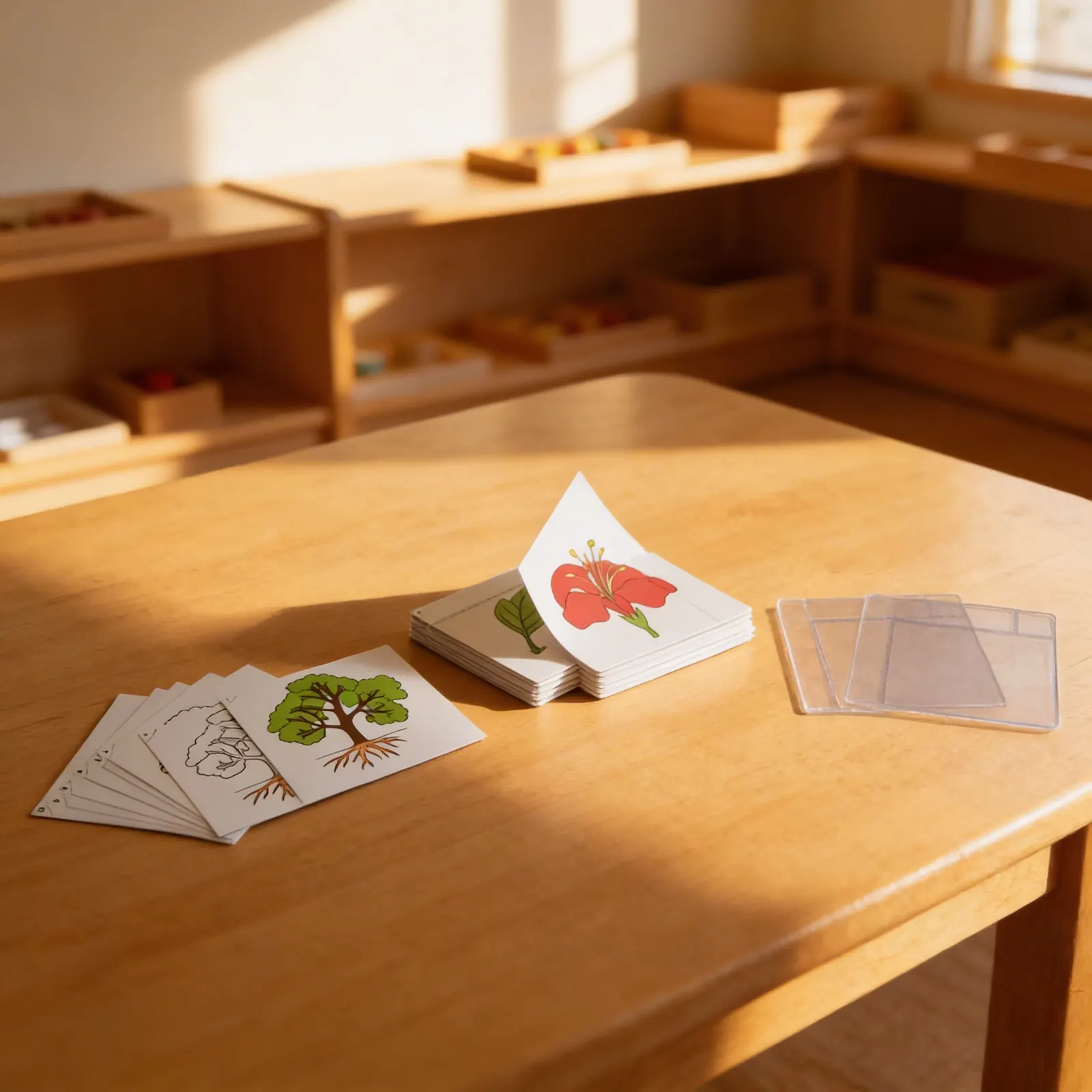
Part of the Botany collection, this First Set of Botany Cards introduces young children to the fundamental parts of plants through clear, isolated illustrations. The three-part card format supports vocabulary development and reading preparation while building a starting point for botanical study. Each laminated card features realistic botanical drawings that help children identify and name the basic structures of trees and flowers.
Scientific Vocabulary
Introduces precise botanical terminology through visual association, building the foundation for scientific classification and observation skills.
Reading Preparation
Three-part card format supports pre-reading skills as children match pictures to labels and practice visual discrimination.
Nature Connection
Realistic botanical illustrations help children recognize plant parts in their environment, fostering observation skills and appreciation for nature.
Classification Skills
Sorting and matching activities develop logical thinking and the ability to categorize information systematically.
How to present it
Lay out a work mat and bring one set of cards (tree or flower) in a basket. Start with just the picture cards for initial presentations.
- 1Present 3-4 picture cards, naming each plant part clearly: 'This is the trunk'
- 2Invite the child to match duplicate picture cards, working left to right
- 3Once matching is mastered, introduce the label cards for reading practice
- 4Show how to use the control card to check their work independently
3 tips for parents
- Point out plant parts during nature walks using the same vocabulary from the cards
- Let your child match real leaves or flowers to their corresponding card images
- Create a small garden space where your child can observe plant parts directly

If you are not sure it suits your child, we answer in person.
Norbert Kovalčín, founder of Faborino · write to him
There is no review here yet. We will ask you for one after you buy. Write the first review
What's in the Box
- Picture Cards: Approx. 6 botanical illustrations without labels
- Label Cards: Approx. 6 corresponding name labels
- Control Cards: Approx. 6 cards with pictures and labels combined
Size and material
| Packaging | 14 × 14 × 2 cm |
| Cards | Laminated cardstock |
| Finish | Protective laminate coating |
| Recommended Age | 6-12 years |
Care
Wipe with slightly damp cloth, dry immediately
Frequently Asked Questions
What plant parts are included in the First Set of Botany Cards?
The set includes fundamental plant parts such as roots, stem, leaves, flowers, and seeds for trees and flowering plants. Each part is clearly illustrated with realistic botanical drawings that help children identify and name these basic structures.
How does the three-part card format work for learning?
The three-part cards consist of a picture card, a label card, and a control card (picture with label). Children first match pictures to pictures, then add labels as they develop reading skills. This progression supports vocabulary development and early reading preparation.
What age is most appropriate for these botany cards?
These cards are designed for children ages 3-6 years. Three-year-olds can begin with picture matching and vocabulary building, while older children can progress to reading labels and creating their own botanical observations.
Are the cards durable for classroom use?
Yes, the cards are laminated for durability, making them suitable for repeated handling by young children in both home and classroom environments. The lamination protects the realistic botanical illustrations from wear and tear.
How do these cards support Montessori biology curriculum?
These cards align with the Montessori approach to biology by presenting isolated, clear concepts that build from simple to complex. They introduce scientific vocabulary early, support classification skills, and prepare children for more advanced botanical studies in elementary years.
Product safety
Manufacturer: Nienhuis Montessori, Anders Celsiusstraat 15, 7442 PB Nijverdal, Netherlands
First Set Of Botany Cards