
Five Classes Of Vertebrates Sorting Cards
The first photo is the maker's own. The other shots are illustrative.
Inv. no. NIE-EC0405
- Maker
- Nienhuis Montessori, since 1929
- Material
- Durable plastic
- Finish
- Pre-cut with rounded corners
- EAN
- 8719924042707
Final price incl. VAT. Delivery €5.90, €94.10 to go for free delivery.
Advice, warranty and returns are handled by us.
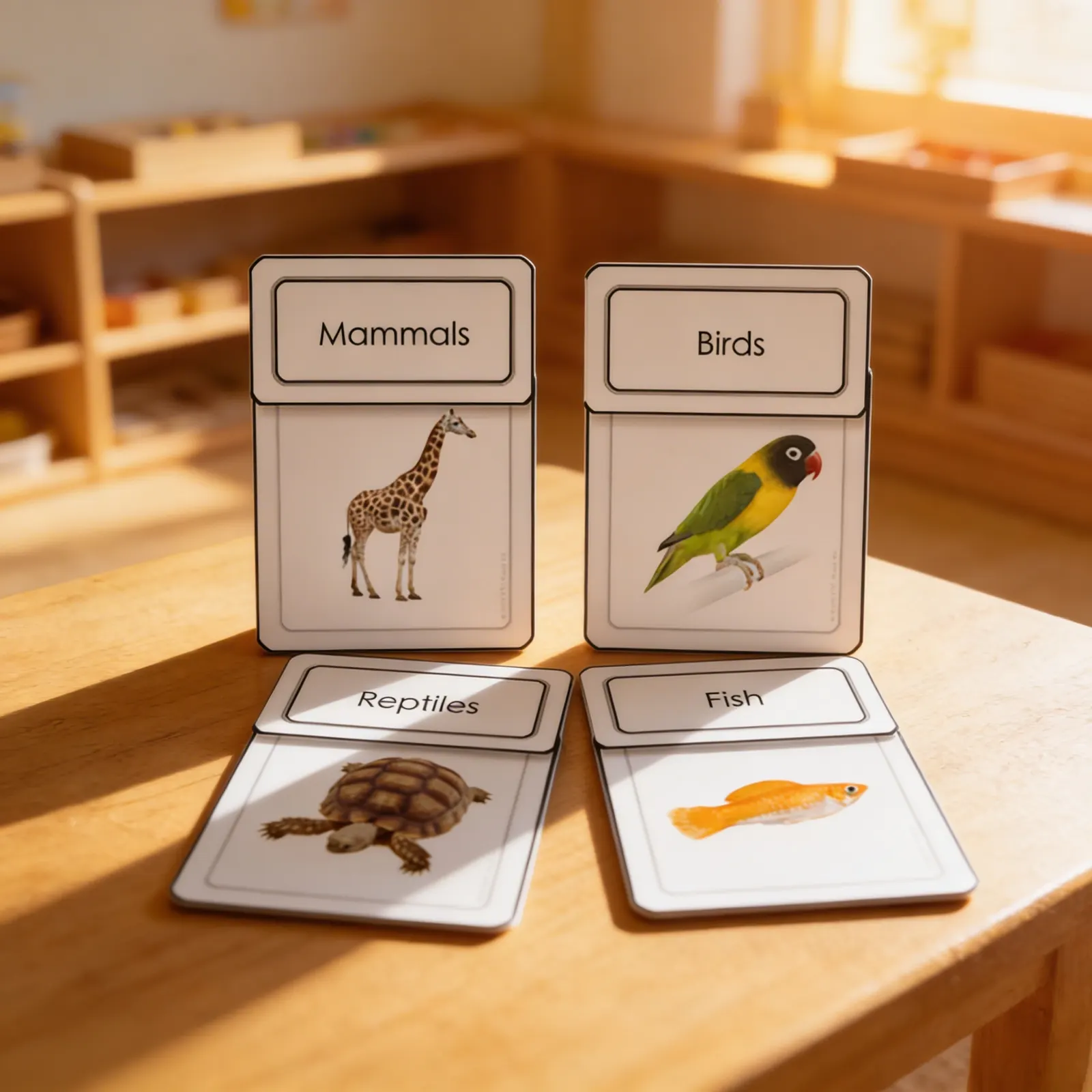
Five Classes Of Vertebrates Sorting Cards in a child's hands
Sorting cards for the five classes of vertebrates: mammals, birds, fish, amphibians and reptiles, with real pictures. Five piles is the right number for this work, because a child can hold five categories in mind at once and will meet animals that argue with all five: a whale that is not a fish, a bat that is not a bird. Those arguments are the lesson. Durable plastic, pre cut with rounded corners. In English.
Scientific Classification
Introduces fundamental zoology concepts and vertebrate characteristics through hands-on sorting activities.
Visual Discrimination
Develops ability to identify and categorize animals based on observable features and characteristics.
Language Development
Builds scientific vocabulary including vertebrate class names and specific animal terminology.
Logical Thinking
Strengthens classification skills and understanding of how living things are organized into groups.
How to present it
Lay out the header cards for each vertebrate class (mammals, birds, reptiles, amphibians, fish) in a row on a mat. Place the animal cards in a basket to the left.
- 1Introduce one class at a time, showing 2-3 example cards and discussing key features
- 2Invite the child to select a card and examine the animal's characteristics
- 3Guide placement under the appropriate header card based on observed features
- 4Continue sorting remaining cards, discussing each animal's traits
- 5Review completed sorting, naming each class and its key characteristics
3 tips for parents
- Visit zoos or aquariums and practice identifying which vertebrate class each animal belongs to
- Create a family pet journal documenting the characteristics that make your pet fit its class
- Read non-fiction books about animals and pause to identify the vertebrate group

If you are not sure it suits your child, we answer in person.
Norbert Kovalčín, founder of Faborino · write to him
There is no review here yet. We will ask you for one after you buy. Write the first review
What's in the Box
- Category Cards: 5 vertebrate class labels
- Animal Cards: Multiple examples per category
- Total Cards: Approx. 8 cards
Size and material
| Packaging | 15 × 15 × 1 cm |
| Material | Durable plastic |
| Finish | Pre-cut with rounded corners |
| Recommended Age | 3-6 years |
Care
Wipe with damp cloth, dry immediately
Frequently Asked Questions
How many cards are included in the set and what animals are represented?
The set includes multiple cards for each of the five vertebrate classes, featuring a diverse selection of animals from each category. Each class (mammals, birds, reptiles, amphibians, and fish) is represented with several common and recognizable species, providing children with a comprehensive introduction to animal classification.
What makes these cards suitable for ages 3-6?
These cards feature realistic photographs rather than cartoons, which aligns with Montessori principles of presenting reality to young children. The clear, simple labels and visual sorting format make the material accessible to pre-readers, while the classification concept provides appropriate challenge for older children developing their scientific understanding.
How do children use these sorting cards in a Montessori environment?
Children begin by exploring the cards freely, then learn to sort animals into their five classes. Activities progress from simple matching to discussing characteristics of each vertebrate class, creating their own classification books, or researching additional animals. The cards support both individual work and small group lessons.
Are the cards durable enough for classroom use?
Yes, the cards are professionally laminated to withstand frequent handling by young children. The sturdy construction ensures they remain in excellent condition through repeated sorting activities, making them a lasting investment for home or classroom use.
How do these cards support the Montessori science curriculum?
These cards directly support the Montessori zoology curriculum by introducing scientific classification in a concrete, hands-on way. They help children develop observation skills, understand relationships in nature, build scientific vocabulary, and lay the foundation for more advanced biological studies in elementary years.
Product safety
Manufacturer: Nienhuis Montessori, Anders Celsiusstraat 15, 7442 PB Nijverdal, Netherlands
Five Classes Of Vertebrates Sorting Cards