
Five Yellow Prisms: Grid-Marked Geometric Exploration Set
Made by Nienhuis Montessori · shipped by Heutink International (Netherlands) About the maker
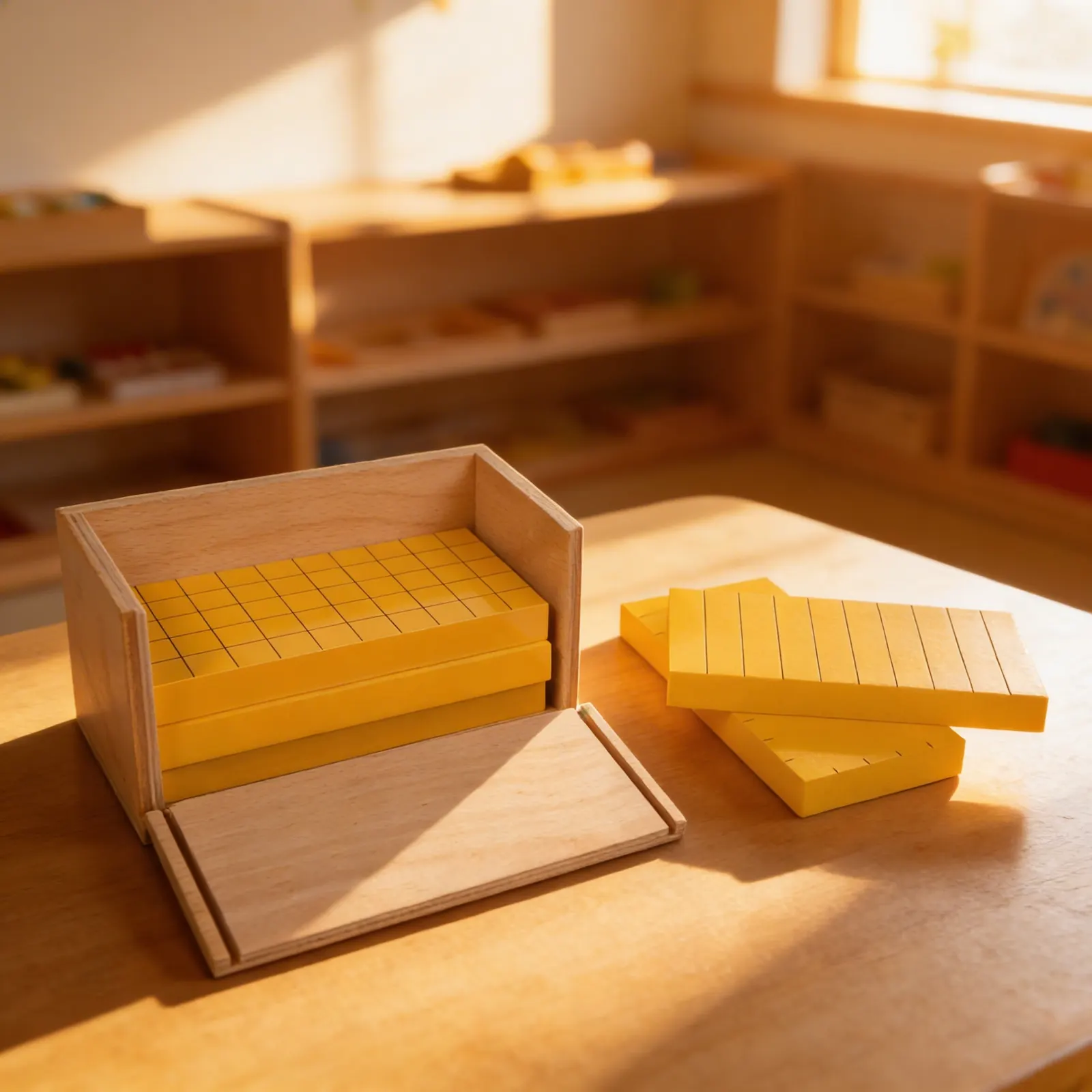
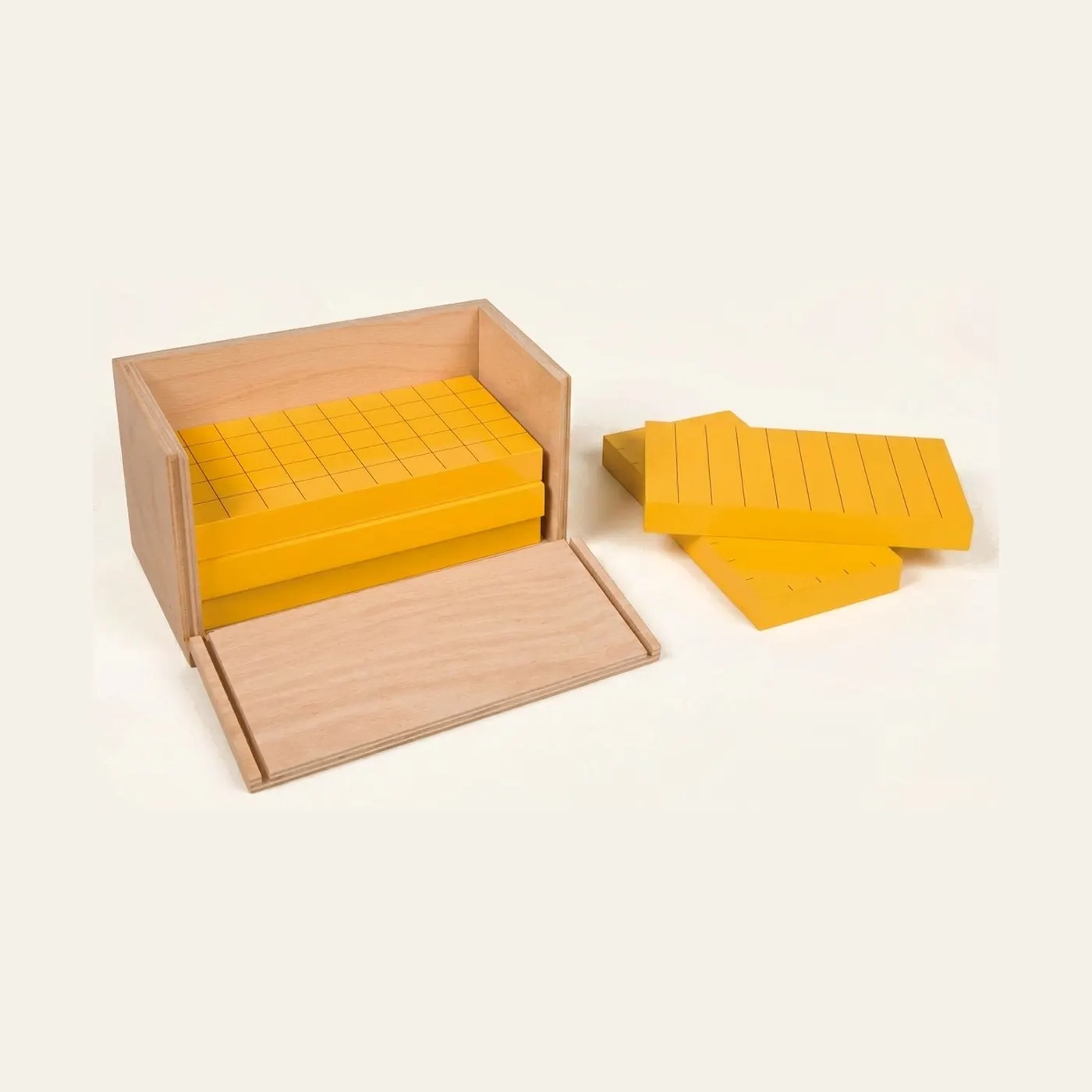
Five wooden prisms of 20 x 10 x 2 cm, painted yellow and ruled in lines and squares, used to work out the volume of a rectangular prism. The ruling is what does the teaching: a child counts squares on a face, counts the layers, and arrives at volume as multiplication rather than as a formula handed down. Because the prisms are identical, they can be stacked and rearranged to show that the same volume survives a change of shape. Stored in a hinged wooden box with lid, for ages 6 to 12.
“The greatest sign of success for a teacher is to be able to say, 'The children are now working as if I did not exist.'”
The Five Yellow Prisms embody Montessori's principle of materialized abstraction, bridging the concrete sensorial experiences of the Primary years with the abstract mathematical reasoning of Elementary.
- Understanding the relationship between linear, square, and cubic measurements through concrete manipulation
- Developing spatial reasoning and visualization skills for complex geometric relationships
- Discovering algebraic formulas for area and volume through independent exploration
- Building foundation for understanding powers and exponents through physical representation
Read More
This material exemplifies the spiral curriculum, allowing children to revisit geometric concepts with increasing sophistication. The precise grid markings transform sensorial exploration into mathematical discovery, enabling children to independently verify algebraic formulas through manipulation. By providing concrete representations of abstract concepts like area and volume, the material honors the Elementary child's reasoning mind while maintaining the hands-on approach essential to deep understanding. This progression from sensorial to abstract demonstrates Montessori's insight that mathematical concepts are best internalized through purposeful manipulation of scientifically designed materials.
How to present it
Follow the Montessori method of presentation for optimal child development.
Place the wooden box on a large work mat. Ensure adequate space for arranging prisms. Have graph paper and colored pencils available for recording discoveries.
- 1
Remove prisms systematically, examining grid markings and comparing dimensions
Guide child to notice the mathematical relationships between prism sizes - 2
Arrange prisms to show progression of linear dimensions
Use the grid markings to count and verify measurements precisely - 3
Build squares and cubes using the grid as a guide to explore area and volume
Encourage recording of discoveries using mathematical notation - 4
Discover the formula for (a+b)² by arranging prisms to form larger squares
Let the child manipulate freely before suggesting specific arrangements - 5
Explore (a+b)³ by building three-dimensional arrangements
Use multiple prisms to create visual proof of algebraic expansions
Every Child Is a Little Creator

Heritage
Since 1929

In classrooms
Around the world

European brands
Nienhuis, GAM, Educo

AMI approved
To the association standard
Five Yellow Prisms: Grid-Marked Geometric Exploration Set
