
Flag Stand of Europe: Wooden Display for European Geography
Made by Nienhuis Montessori · shipped by Heutink International (Netherlands) About the maker
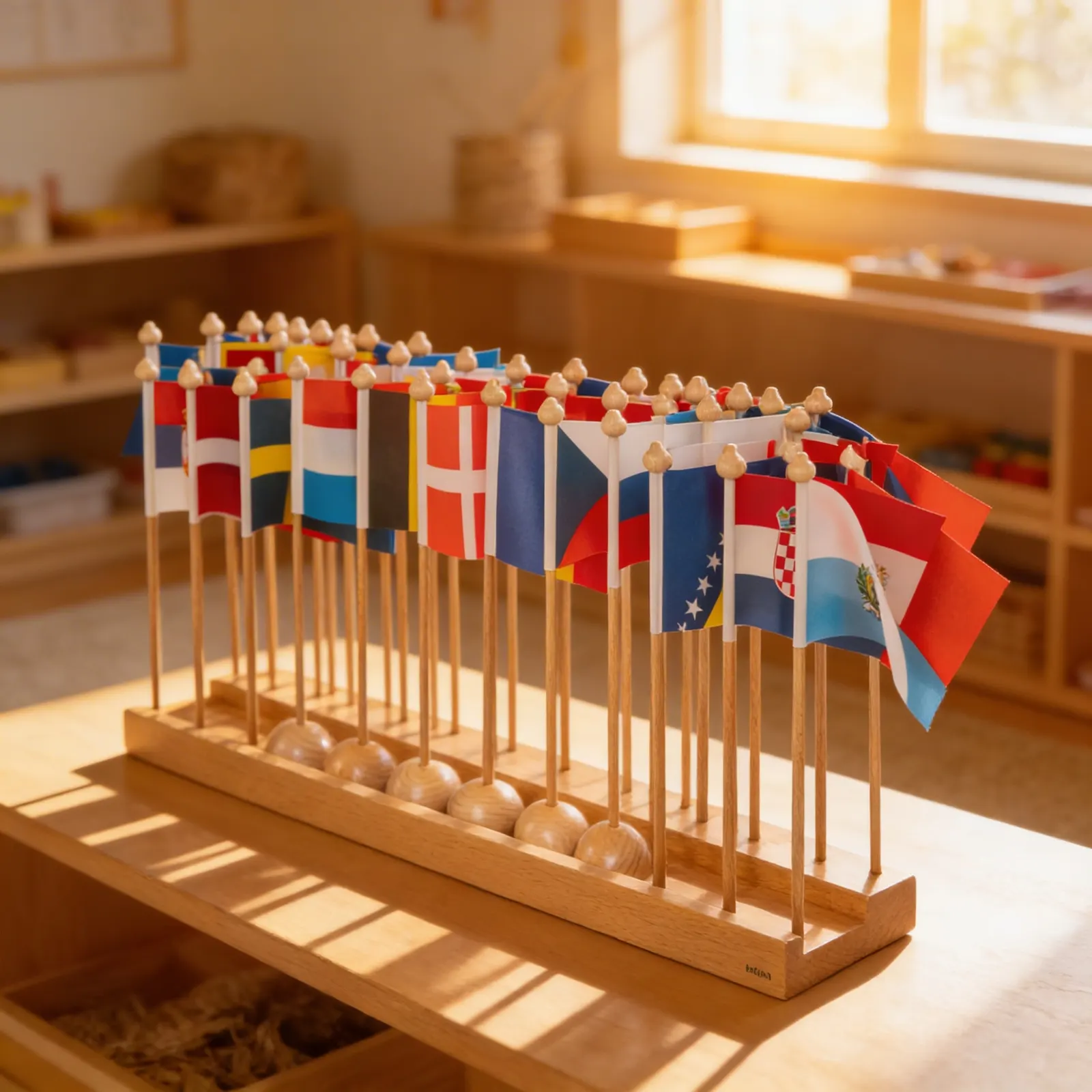
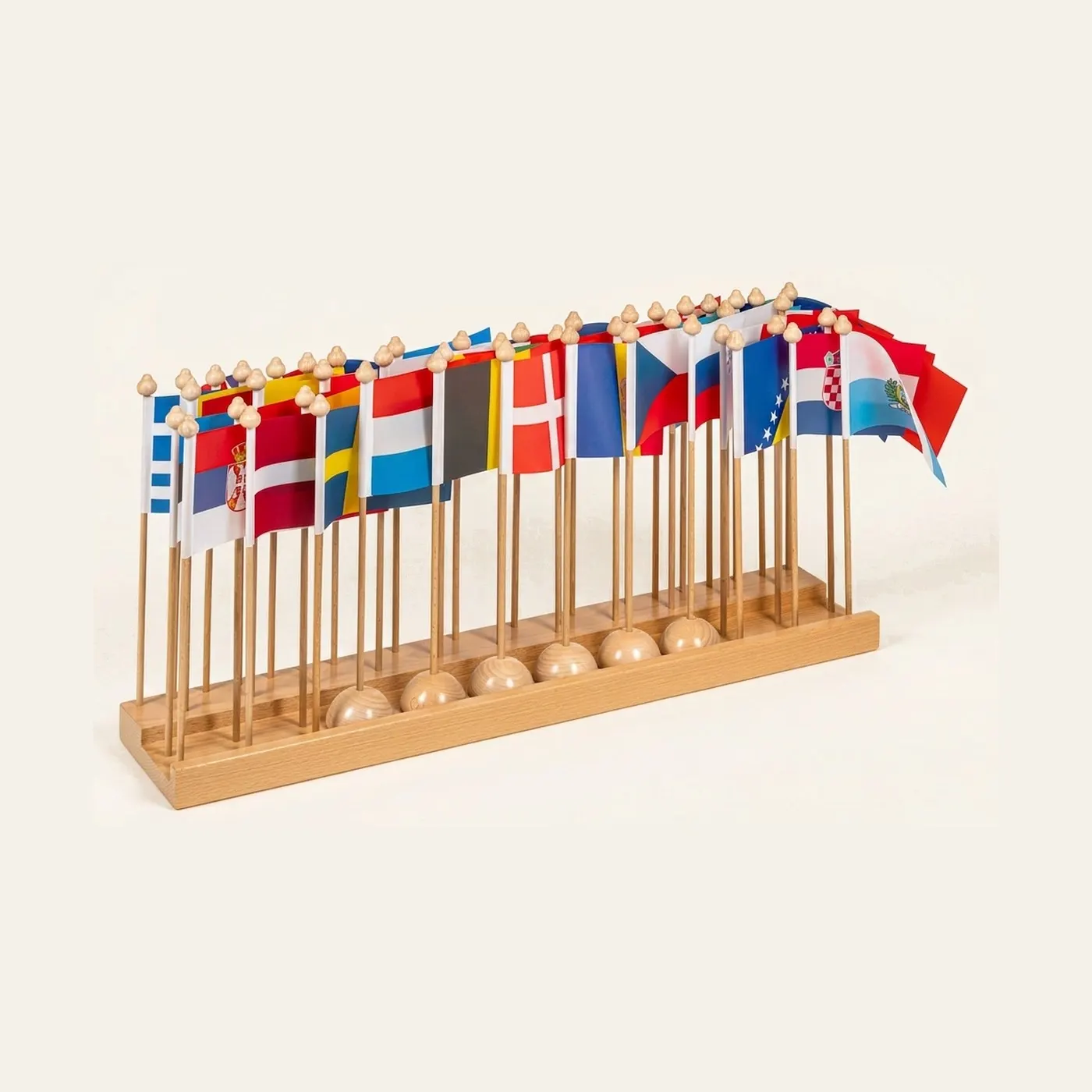
A wooden stand holding the national flag of each European country on its own pole. Europe is where flag work usually starts in a Montessori environment, because the countries are many, small and adjacent, which is exactly the situation a map alone handles badly. Placing a flag is a decision the child can check: either it goes in the hole that matches, or it does not. Pairing the stand with the Europe puzzle map ties an outline to an emblem. Hardwood stand with fabric flags, for ages 3 to 6.
“Free the child's potential, and you will transform him into the world.”
The Flag Stand of Europe addresses the young child's natural fascination with symbols and colors while building foundational geographic awareness. Dr. Montessori recognized that children between ages 3-6 possess an extraordinary capacity for absorbing cultural knowledge when presented through concrete, manipulative materials. The Flag Stand of Europe transforms abstract geographic concepts into tangible experiences through its collection of fabric flags representing European nations. Each flag serves as a concrete representation of a country, allowing children to form mental associations between visual symbols and geographic locations. The hardwood construction of the Flag Stand of Europe provides stability for independent exploration, while the fabric flags offer tactile experiences that engage multiple senses simultaneously.
- Recognizes and identifies flags of European countries through visual memory
- Develops fine motor coordination through handling and arranging fabric flags
- Builds foundational geographic vocabulary by associating country names with flag symbols
- Strengthens visual discrimination skills by distinguishing colors, patterns, and flag designs
Read More
This material satisfies the child's need for order and classification by organizing European countries into a systematic display. The Flag Stand of Europe cultivates early appreciation for cultural diversity by presenting each nation's unique symbolic identity in an accessible format. Through repeated interaction with the flags, children develop visual discrimination skills essential for later map work and geographic studies.
How to present it
Follow the Montessori method of presentation for optimal child development.
Place the flag stand on a stable surface with adequate workspace. Arrange flags randomly beside the stand, ensuring all are visible and accessible.
- 1
Invite the child to examine the empty stand and observe its structure and arrangement
Allow time for natural curiosity to emerge before introducing the flags - 2
Present one flag at a time, naming the country and inviting the child to place it in the corresponding position
Start with flags that have distinctive, easily recognizable patterns or colors - 3
Encourage the child to continue placing flags independently, offering minimal guidance
Step back and observe, intervening only when the child seeks help or becomes frustrated - 4
Once complete, invite the child to walk around the display and observe the collection from different angles
This movement helps integrate the visual information and creates lasting memory connections
Every Child Is a Little Creator

Heritage
Since 1929

In classrooms
Around the world

European brands
Nienhuis, GAM, Educo

AMI approved
To the association standard
Flag Stand of Europe: Wooden Display for European Geography
