
Flag Stand Americas: North & South America Without Caribbean
Made by Nienhuis Montessori · shipped by Heutink International (Netherlands) About the maker
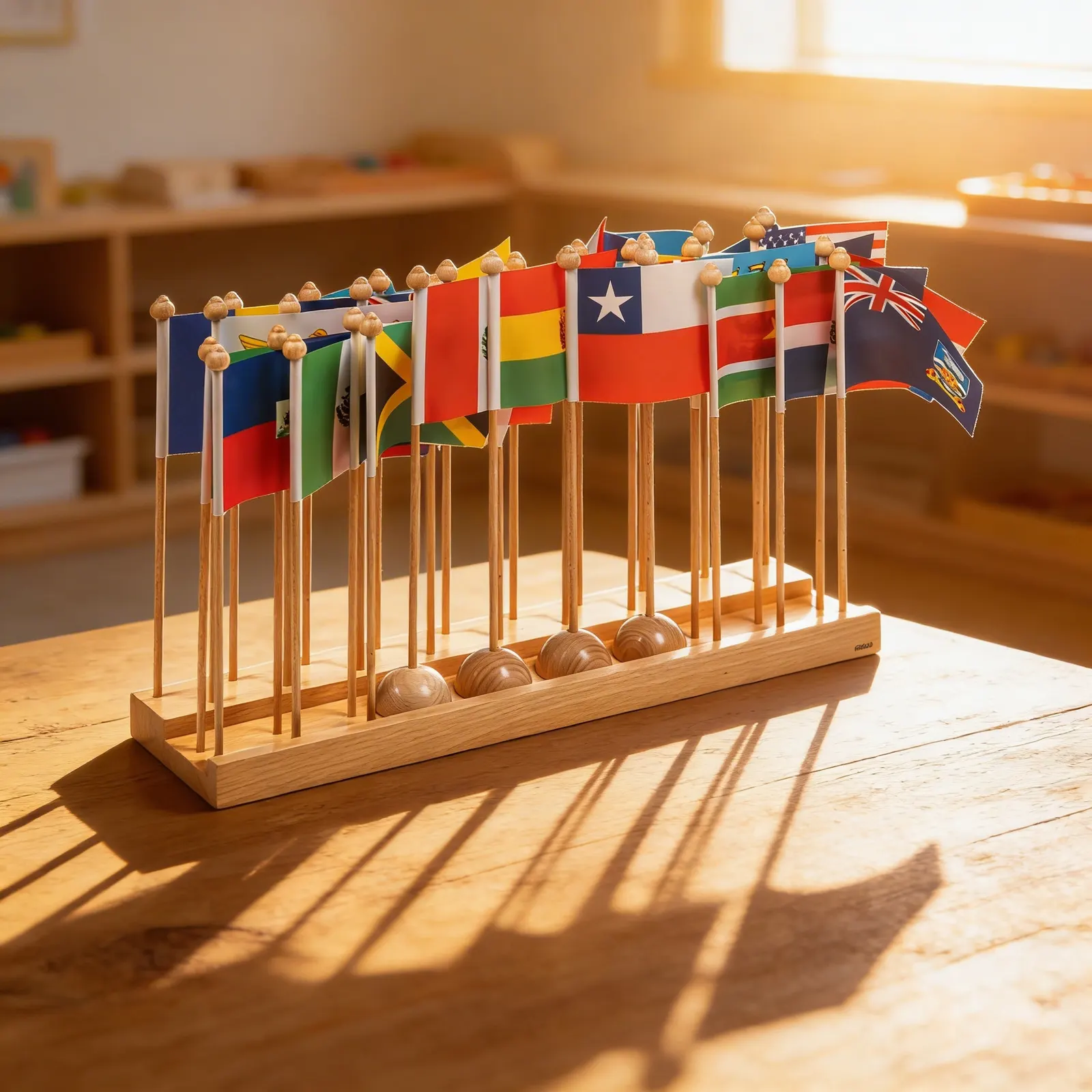
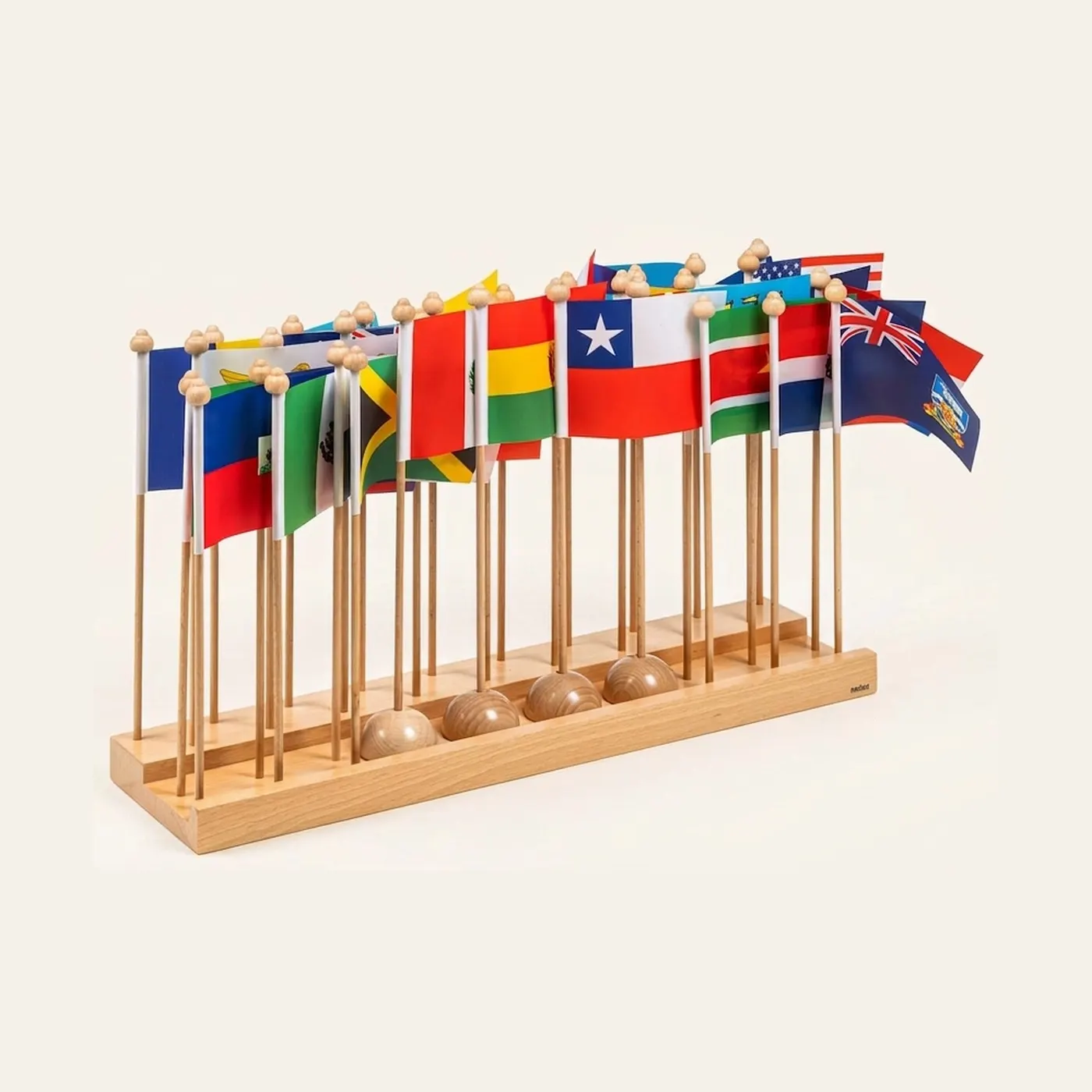
A wooden stand holding the national flag of each country of North and South America, the Caribbean states excepted. Two continents on one stand is useful precisely because children rarely think of them as two: sharing a landmass and a name makes the Americas the place where the distinction between a continent and a hemisphere first has to be made. Placing the flags and matching them to the Americas puzzle map does that work without a lecture. Hardwood stand with cotton flags, for ages 3 to 6.
“The child is both a hope and a promise for mankind.”
This Flag Stand of North and South America perfectly embodies the Montessori principle of concrete to abstract learning, allowing children to physically manipulate tangible representations before developing abstract geographical concepts. The self-correcting nature of the material - each flag has its designated place - supports independence and builds confidence through successful completion.
- Development of geographical awareness and spatial understanding
- Cultural appreciation and recognition of national symbols
- Fine motor skill refinement through flag manipulation
- Visual discrimination and matching abilities
Read More
The hands-on exploration satisfies the child's natural curiosity about the world while developing cultural awareness during the sensitive period for language and cultural learning. The quality hardwood construction and cotton flags provide authentic sensory experiences, engaging multiple senses simultaneously. By organizing flags geographically, children unconsciously absorb spatial relationships and develop a foundation for future map work. This material honors the child's innate desire to understand their place in the world, fostering global citizenship and respect for diversity from an early age.
How to present it
Follow the Montessori method of presentation for optimal child development.
Place the flag stand on a child-sized table in a quiet area of the geography corner. Ensure flags are mixed but accessible in a basket nearby.
- 1
Invite the child to carry the flag stand carefully to their workspace
Demonstrate proper carrying technique with both hands to model respect for materials - 2
Show the child how to select one flag and examine its colors and design
Encourage observation by asking 'What do you notice?' rather than giving information immediately - 3
Demonstrate finding the corresponding knob on the stand and placing the flag gently
Move slowly and deliberately to allow the child to internalize the precise movements - 4
Allow the child to continue independently, placing remaining flags at their own pace
Resist the urge to correct immediately; let the child self-correct through exploration
Every Child Is a Little Creator

Heritage
Since 1929

In classrooms
Around the world

European brands
Nienhuis, GAM, Educo

AMI approved
To the association standard
Flag Stand Americas: North & South America Without Caribbean
