
Flags Of Africa
The first photo is the maker's own. The other shots are illustrative.
Inv. no. NIE-076001
- Maker
- Nienhuis Montessori, since 1929
- Approval
- AMI
- Cards
- Laminated cardstock
- Storage Box
- Natural wood with dividers
- EAN
- 8719924014872
Final price incl. VAT. Delivery €5.90, €46.10 to go for free delivery.
Advice, warranty and returns are handled by us.
Why it costs €102.90
Behind the price of the original are things you can check yourself.
AMI approval
The material is approved by the Association Montessori Internationale (AMI). Nienhuis has made Montessori materials since 1929.
A verifiable original
The EAN 8719924014872 is on the box. It is the maker's number, not ours.
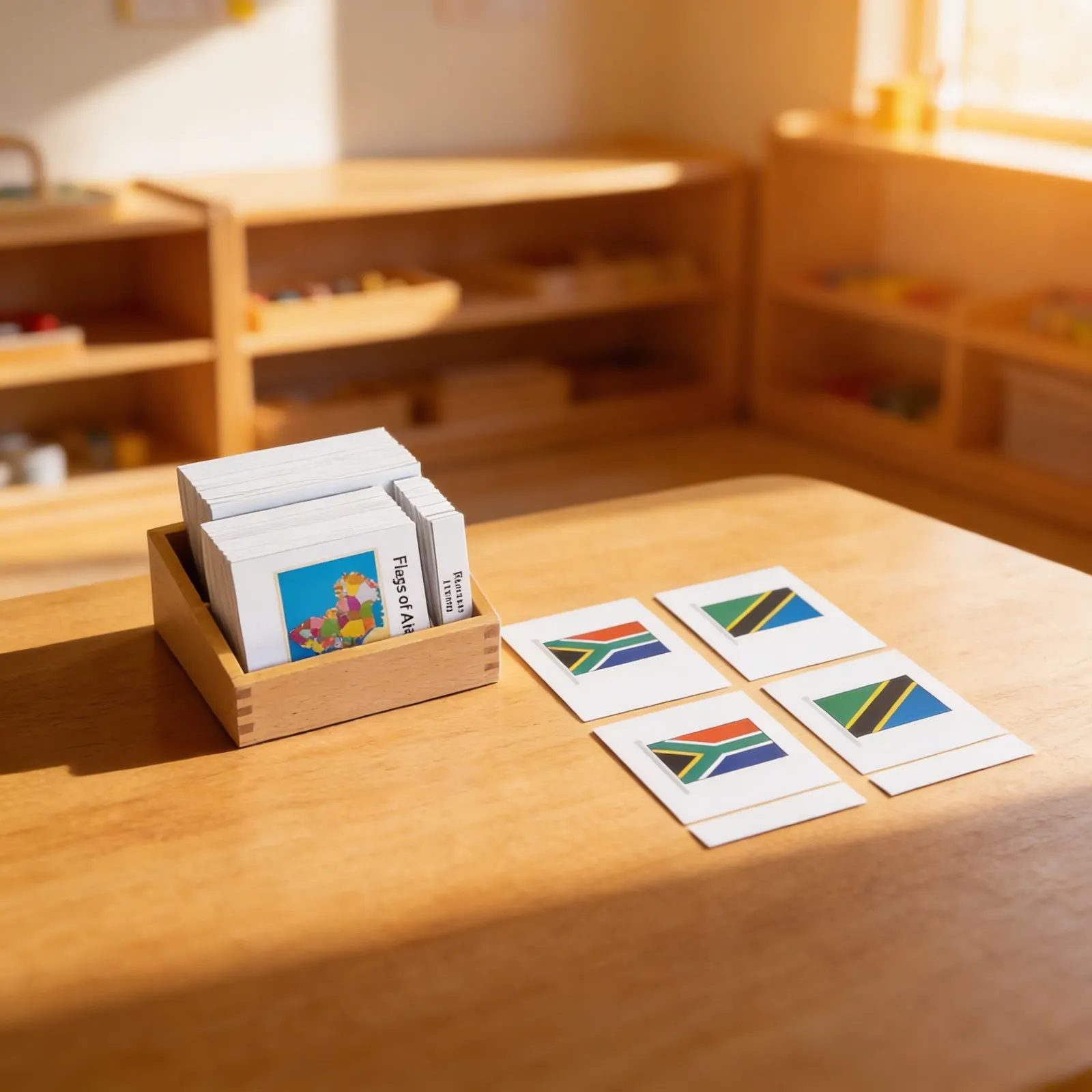
Flags Of Africa in a child's hands
Two sets of full colour nomenclature cards for the flags of Africa: one with separate labels for the child to match, and one control set labelled at the bottom for teaching and for checking. The separate labels are what turn looking into work, since a card and its name only come together if the child puts them there. Cards are plastic, chosen for durability, which matters for a set handled by a whole class. Plastic, for ages 3 to 6.
Cultural Awareness
Introduces children to African nations, fostering global consciousness and respect for diverse cultures through visual recognition.
Visual Discrimination
Distinguishing between flag designs develops visual perception skills and attention to detail essential for reading preparation.
Language Development
Learning country names expands vocabulary while matching activities strengthen reading and word recognition abilities.
Classification Skills
Organizing and categorizing flags by features or regions develops logical thinking and systematic organization abilities.
How to present it
Place the wooden box on a mat or table at the child's workspace. Remove 5-6 flag cards initially, keeping the country name labels separate. Arrange the selected flags in a row with space between each card.
- 1Invite the child to examine one flag card, noting its colors and design elements
- 2Introduce the country name label, reading it clearly and placing it below the corresponding flag
- 3Continue with remaining flags, allowing the child to match previously introduced labels independently
- 4Invite the child to return materials to the wooden box, organizing cards as desired
3 tips for parents
- When your child mentions a flag at home, locate that country on a globe or map together
- Share family connections to African countries if applicable, making geography personally meaningful
- Support flag exploration by checking out library books featuring African folktales or photographs

If you are not sure it suits your child, we answer in person.
Norbert Kovalčín, founder of Faborino · write to him
There is no review here yet. We will ask you for one after you buy. Write the first review
What's in the Box
- Flag Cards: Approx. 50 laminated African country flags
- Storage Box: Wooden box with organized dividers
- Country Labels: Matching name cards for each flag
Size and material
| Packaging | 31 × 17 × 15 cm |
| Cards | Laminated cardstock |
| Storage Box | Natural wood with dividers |
| Recommended Age | 3-6 years |
Care
Wipe cards with damp cloth, dry immediately
Frequently Asked Questions
How many African country flags are included in this set?
This comprehensive set includes all 54 recognized African nations' flags, providing complete continental coverage for your child's geography studies.
What size are the flag cards and how are they stored?
The laminated flag cards are perfectly sized for small hands and come organized in a durable wooden storage box that keeps the materials protected and easily accessible for independent work.
How do children use these flags in Montessori activities?
Children match flags to country name labels, sort by colors or patterns, create continental maps, play memory games, and use them alongside puzzle maps and other cultural materials to build geographic knowledge.
Are the flag cards durable enough for daily classroom use?
Yes, each flag card is professionally laminated for durability, making them resistant to tears and spills while maintaining vibrant colors through years of hands-on learning.
What skills do children develop using this material?
Children develop visual discrimination, cultural awareness, reading readiness through label matching, memory skills, and foundational geography knowledge while fostering respect for world diversity.
Product safety
Manufacturer: Nienhuis Montessori, Anders Celsiusstraat 15, 7442 PB Nijverdal, Netherlands
Flags Of Africa