
Flat Bead Frame Activity SetMultiplication Practice Cards
The first photo is the maker's own. The other shots are illustrative.
Inv. no. NIE-060801
- Maker
- Nienhuis Montessori, since 1929
- Approval
- AMI
- Cards
- Laminated paper or cardstock
- Storage Box
- Natural wood
- EAN
- 8719924013219
Final price incl. VAT. Delivery €5.90, €94.10 to go for free delivery.
Advice, warranty and returns are handled by us.
Why it costs €54.90
Behind the price of the original are things you can check yourself.
AMI approval
The material is approved by the Association Montessori Internationale (AMI). Nienhuis has made Montessori materials since 1929.
A verifiable original
The EAN 8719924013219 is on the box. It is the maker's number, not ours.
Flat Bead Frame Activity Set in a child's hands
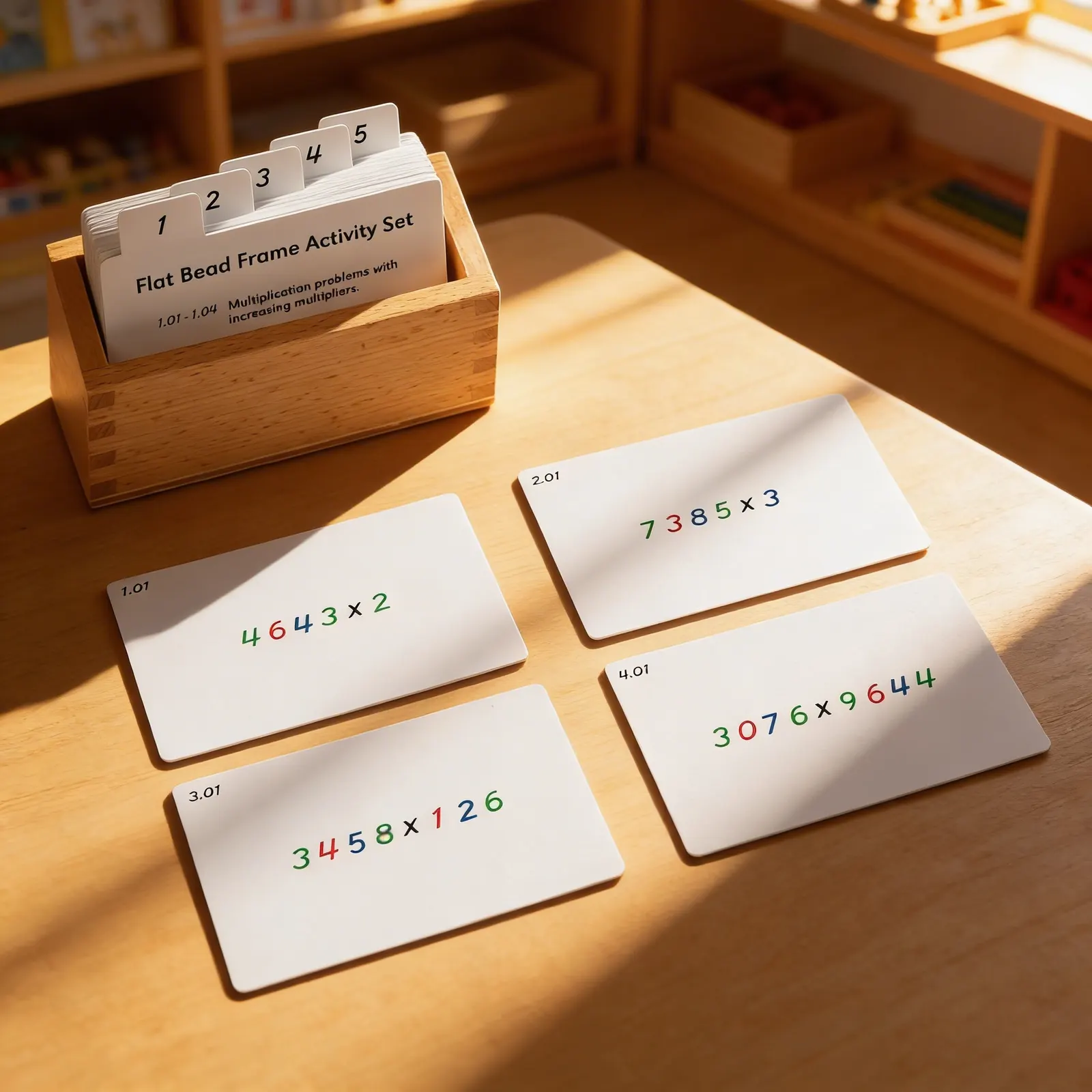
Exercise cards with divider tabs in a wooden box, extending the flat bead frame. Nine columns of hierarchies is more than anyone can track by attention alone, so what a child needs here is not more understanding but more mileage: the point at which the eye finds the right column without searching for it. These cards are the mileage, and until it has been done, long multiplication stays slow enough to be abandoned. Flat bead frame sold separately. Laminated cardstock and hardwood, for ages 3 to 12.
Mathematical Foundation
Color-coded multiplication cards create visual patterns that help children understand mathematical relationships and prepare for abstract thinking.
Sequential Learning
Numbered progression from 1-5 allows children to build confidence gradually while mastering increasingly complex multiplication concepts.
Organization Skills
The divided storage system teaches children to maintain order in their work environment, supporting concentration and independent learning.
How to present it
Place the Flat Bead Frame on a mat with the storage box to the right. Select the first divider section of cards. Ensure beads move smoothly on wires. Have a small tray for completed cards.
- 1Show the child how to read the problem card (e.g., 3 x 4)
- 2Demonstrate moving 3 beads on the first wire, then repeat on 3 more wires for '4 times'
- 3Count all moved beads together to find the product
- 4Record the answer if using recording sheets, or simply state it
- 5Clear the frame by sliding all beads back to starting position
3 tips for parents
- Avoid correcting errors immediately - let your child discover mistakes through counting
- Practice skip counting during everyday activities to reinforce multiplication concepts
- Celebrate the process of working through problems rather than speed or accuracy

If you are not sure it suits your child, we answer in person.
Norbert Kovalčín, founder of Faborino · write to him
There is no review here yet. We will ask you for one after you buy. Write the first review
What's in the Box
- Sequence Cards 1-5: For progressive skill building
- Multiplication Problem Cards: Color-coded for visual learning
- Wooden Storage Box: With divider tabs for organization
Size and material
| Packaging | 14 × 11 × 7 cm |
| Cards | Laminated paper or cardstock |
| Storage Box | Natural wood |
| Recommended Age | 6-12 years |
Care
Wipe cards with slightly damp cloth; dust wooden box with dry cloth
Frequently Asked Questions
What age is the Flat Bead Frame Activity Set appropriate for?
This activity set is designed for children ages 3-6 years. It's typically introduced after children have worked with golden beads and are ready to explore multiplication concepts through concrete manipulation.
What's included in this Flat Bead Frame Activity Set?
The set includes a wooden storage box with divider tabs, color-coded problem cards organized by difficulty level, and instructional materials. The bead frame itself is sold separately and pairs with these activity cards.
How does this differ from regular multiplication teaching methods?
Unlike abstract number memorization, this Montessori approach uses concrete bead manipulation and color-coded visual patterns. Children physically move beads to understand multiplication as repeated addition, building deep conceptual understanding before moving to abstract work.
Do I need prior Montessori math materials before introducing this?
Yes, children should first work with number rods, sandpaper numerals, and golden bead materials. This ensures they understand quantity, symbols, and place value before beginning multiplication work with the bead frame.
How are the problem cards organized for progression?
The cards are color-coded and stored in divider tabs by difficulty level. Children begin with simple single-digit multiplication and progressively work through more complex problems, allowing self-paced learning and easy tracking of progress.
Product safety
Manufacturer: Nienhuis Montessori, Anders Celsiusstraat 15, 7442 PB Nijverdal, Netherlands
Flat Bead Frame Activity Set