
Flowers 3 Part Cards
The first photo is the maker's own. The other shots are illustrative.
Inv. no. NIE-EC0469A
- Maker
- Nienhuis Montessori, since 1929
- Product size
- 9.5 × 12.7 cm
- Material
- Durable plastic
- Finish
- Pre-cut with rounded corners
- EAN
- 8719924042905
Final price incl. VAT. Delivery €5.90, €104.10 to go for free delivery.
Advice, warranty and returns are handled by us.
Flowers 3 Part Cards in a child's hands
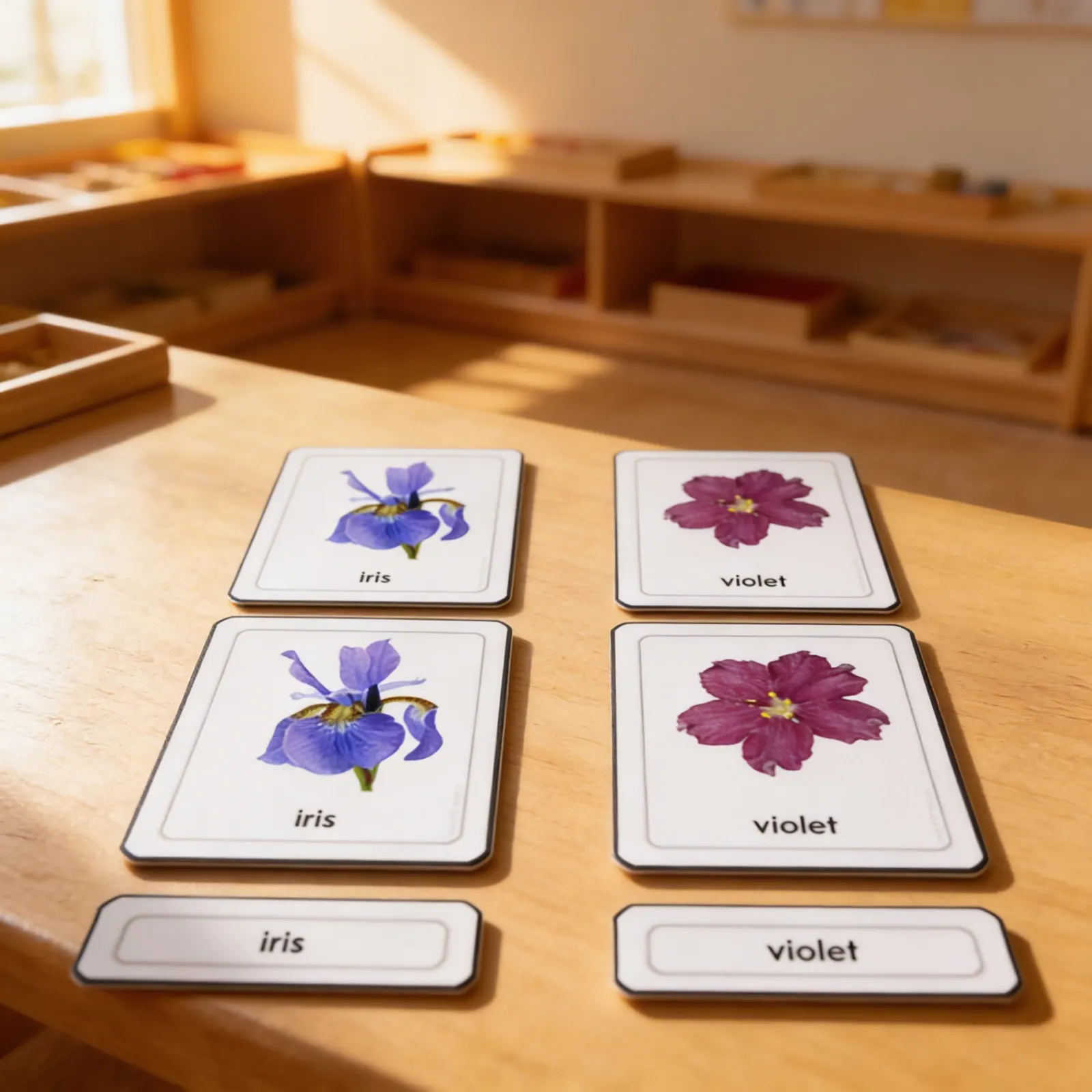
Three part cards for flowers, with a real photograph of each. Flowers are the subject where naming pays off fastest: a child who learns six names starts seeing those six everywhere, in gardens, on walks and in the hedge outside, and the seventh name gets asked for rather than given. Picture, label and control card in each set of three. Durable plastic with rounded corners. In English. The matching card set is a separate item.
Language Development
Builds botanical vocabulary through visual association and repetition of flower names.
Visual Discrimination
Develops ability to notice details and differences between flower species through careful observation.
Classification Skills
Introduces scientific thinking by categorizing and naming specimens from the natural world.
Reading Preparation
Supports early literacy through matching pictures to text labels and word recognition.
How to present it
Lay out a work mat. Start with just the iris cards - place the control card (picture with label) at the top left, picture cards in a column below, and text labels in a separate pile.
- 1Show the child the iris control card, pointing to the picture while saying 'iris'
- 2Match the iris picture card below its control card
- 3Read the iris text label and place it under the matched picture
- 4Repeat the process with violet cards
- 5Mix both sets for sorting practice
3 tips for parents
- Point out irises and violets during neighborhood walks
- Visit a garden center to see flower varieties in person
- Create a photo collection of flowers from your area to make personal cards

If you are not sure it suits your child, we answer in person.
Norbert Kovalčín, founder of Faborino · write to him
There is no review here yet. We will ask you for one after you buy. Write the first review
What's in the Box
- Control Cards: Picture cards with integrated text labels
- Picture Cards: Matching pictures without labels
- Label Cards: Separate text labels for matching
- Total Cards: Approx. 6 cards including iris and violet flowers
Size and material
| Product size | 9.5 × 12.7 cm |
| Packaging | 15 × 15 × 1 cm |
| Material | Durable plastic |
| Finish | Pre-cut with rounded corners |
| Recommended Age | 3-6 years |
Care
Wipe with damp cloth, dry immediately
Frequently Asked Questions
What exactly are 3-part cards and how do they work?
3-part cards consist of three components: a control card showing the picture with label, a picture-only card, and a separate label card. Children first match the picture card to the control card, then add the corresponding label, gradually progressing to matching pictures and labels independently without the control card.
What flowers are included in this set?
This set features high-quality photographs of iris and violet specimens. Each flower is presented in multiple cards showing clear, detailed images that help children recognize distinguishing characteristics of these common garden flowers.
How do these cards support Montessori botany learning?
These nomenclature cards introduce botanical vocabulary and classification skills fundamental to the Montessori science curriculum. They prepare children for more advanced botany work like flower dissection, parts of a flower studies, and botanical drawing by building familiarity with real flower specimens.
Are the cards durable enough for classroom use?
Yes, the cards are made from laminated cardstock specifically designed to withstand repeated handling by young children. The lamination protects the photographic images from fingerprints and spills while maintaining color vibrancy over years of classroom use.
What is the recommended presentation sequence for these cards?
Begin with a three-period lesson using 2-3 control cards. Once the child knows these flower names, introduce matching exercises with picture cards, then progress to reading and matching separate labels. Advanced work includes sorting flowers by characteristics or creating their own flower books.
Product safety
Manufacturer: Nienhuis Montessori, Anders Celsiusstraat 15, 7442 PB Nijverdal, Netherlands
Flowers 3 Part Cards