
Four Maps Of Europe
The first photo is the maker's own. The other shots are illustrative.
Inv. no. NIE-017901
- Maker
- Nienhuis Montessori, since 1929
- Approval
- AMI
- Frame
- Natural wood
- Map Surface
- Printed paper
- EAN
- 8719924009656
Final price incl. VAT. Free delivery.
Advice, warranty and returns are handled by us.
Why it costs €208.90
Behind the price of the original are things you can check yourself.
AMI approval
The material is approved by the Association Montessori Internationale (AMI). Nienhuis has made Montessori materials since 1929.
A verifiable original
The EAN 8719924009656 is on the box. It is the maker's number, not ours.
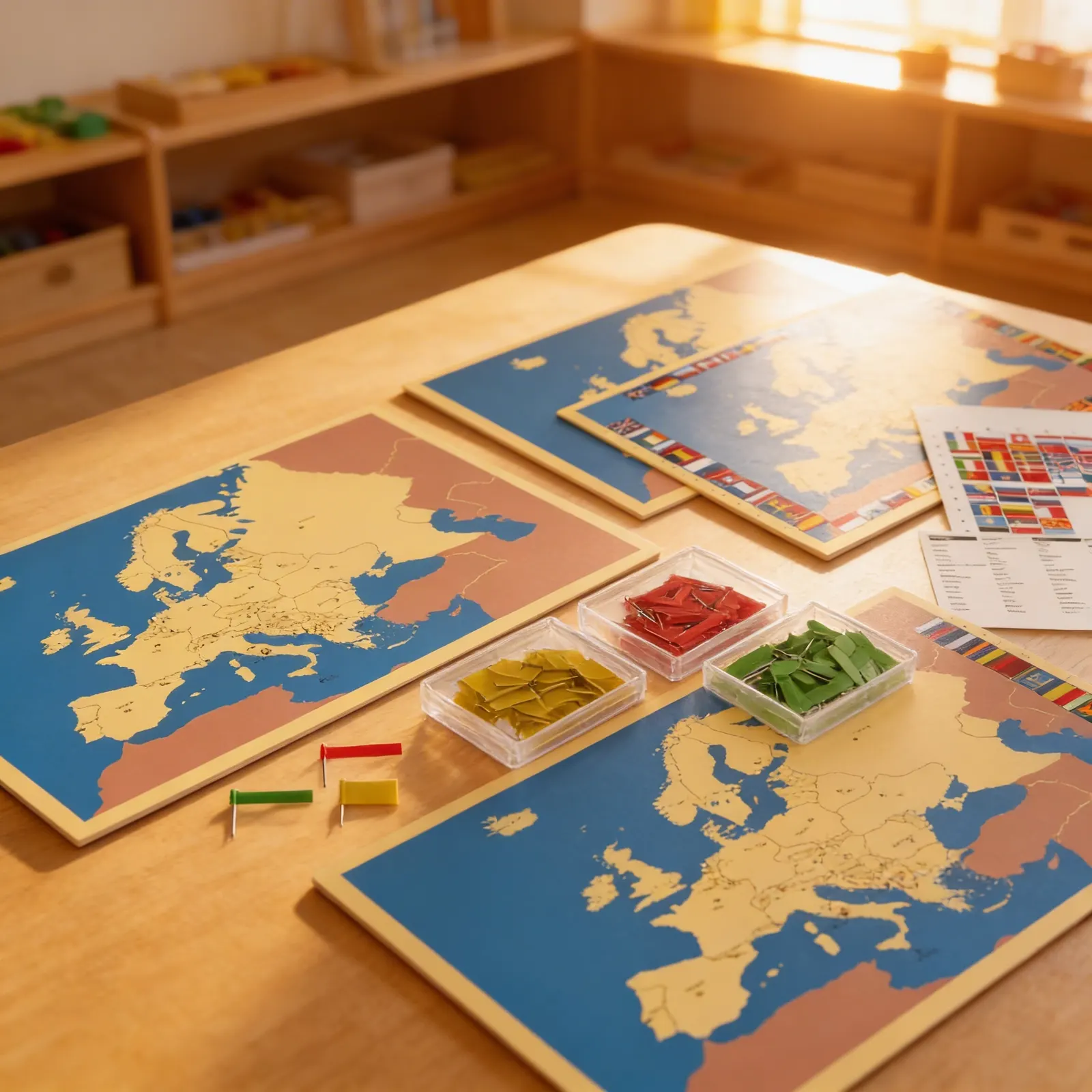
Four Maps Of Europe in a child's hands
The same four map structure for Europe: three control maps carrying country names, capitals and national flags, and one working map drilled for pin flags. Europe rewards this treatment more than most continents because the countries are small and crowded, so a child who can place them from memory has genuinely learned something a glance at an atlas would not give. Green pins for countries, red for capitals, and the control map settles every disagreement without an adult. Wood, paper and plastic, for ages 3 to 6.
Cultural Geography
Builds understanding of European countries, their locations, and relationships through hands-on exploration.
Visual Discrimination
Develops ability to recognize shapes, boundaries, and spatial relationships between countries.
Fine Motor Control
Strengthens pincer grip and hand-eye coordination through precise placement of puzzle pieces and flag pins.
Sequential Learning
Progressive maps allow children to advance from simple to complex geographical concepts at their own pace.
How to present it
Place the first unlabeled puzzle map on a work mat. Keep control maps nearby but initially out of sight. Arrange flag materials in order if using.
- 1Invite the child to remove all pieces from the unlabeled map, placing them randomly on the mat
- 2Select one piece and trace its outline with your finger, then find its home in the puzzle frame
- 3Continue until all pieces are replaced, allowing the child to work at their own pace
- 4Introduce the labeled map only after mastery of the unlabeled version
- 5Present control maps for independent checking once the child shows readiness
3 tips for parents
- When your child mentions a European country, reference their puzzle work: 'You know where France is on your map!'
- Display a simple political map of Europe at home to reinforce classroom learning
- Share family heritage connections to European countries when natural opportunities arise

If you are not sure it suits your child, we answer in person.
Norbert Kovalčín, founder of Faborino · write to him
There is no review here yet. We will ask you for one after you buy. Write the first review
What's in the Box
- Wooden Puzzle Maps: Four progressive Europe maps
- Control Maps: Reference maps with country flags
- Flag Pins: Color-coded pins in containers
- Reference Materials: Supporting geography sheets
Size and material
| Packaging | 42 × 31 × 6 cm |
| Frame | Natural wood |
| Map Surface | Printed paper |
| Pieces | Wood with printed details |
| Flag Pins | Plastic |
| Recommended Age | 3-6 years |
Care
Wipe wooden surfaces with damp cloth; handle paper elements carefully
Frequently Asked Questions
What maps are included in this Four Maps of Europe set?
This set includes four progressive maps: an unlabeled puzzle map with removable country pieces, a labeled control map for reference, a political map showing boundaries and capitals, and flag materials for each European country to enhance cultural learning.
How do children use the removable country pieces?
Children remove individual country puzzle pieces to trace, color, or study their shapes. They can match pieces to control maps, practice placing countries in correct positions, and use the pieces for creating their own maps or geographical activities.
Is this material suitable for a 3-year-old?
Yes, younger children can begin with simple activities like removing and replacing large country pieces and matching colors. As they develop, they progress to learning country names, capitals, and flags, making this material useful throughout the 3-6 age range.
What skills does this map set develop?
This material develops spatial awareness, fine motor control through puzzle manipulation, visual discrimination, memory skills, cultural awareness, and foundational geography knowledge including country recognition, capital cities, and national flags.
How does this connect to other Montessori geography materials?
This European map set follows the continent puzzle maps and precedes more detailed country studies. It coordinates with the globe materials, continent folders, and cultural studies, providing a systematic approach to understanding world geography from concrete to abstract.
Product safety
Manufacturer: Nienhuis Montessori, Anders Celsiusstraat 15, 7442 PB Nijverdal, Netherlands
Four Maps Of Europe