
Fraction CabinetTen Drawers with Systematic Fraction Insets
The first photo is the maker's own. The other shots are illustrative.
Inv. no. NIE-176500
- Maker
- Nienhuis Montessori, since 1929
- Approval
- AMI
- Product size
- 49 × 34 × 41 cm
- Primary Material
- Premium Hardwood
- Lining
- Green Felt
- EAN
- 8719924016999
Final price incl. VAT. Delivery €5.90 (heavy item).
Advice, warranty and returns are handled by us.
Why it costs €768.90
Behind the price of the original are things you can check yourself.
AMI approval
The material is approved by the Association Montessori Internationale (AMI). Nienhuis has made Montessori materials since 1929.
A verifiable original
The EAN 8719924016999 is on the box. It is the maker's number, not ours.
Fraction Cabinet in a child's hands
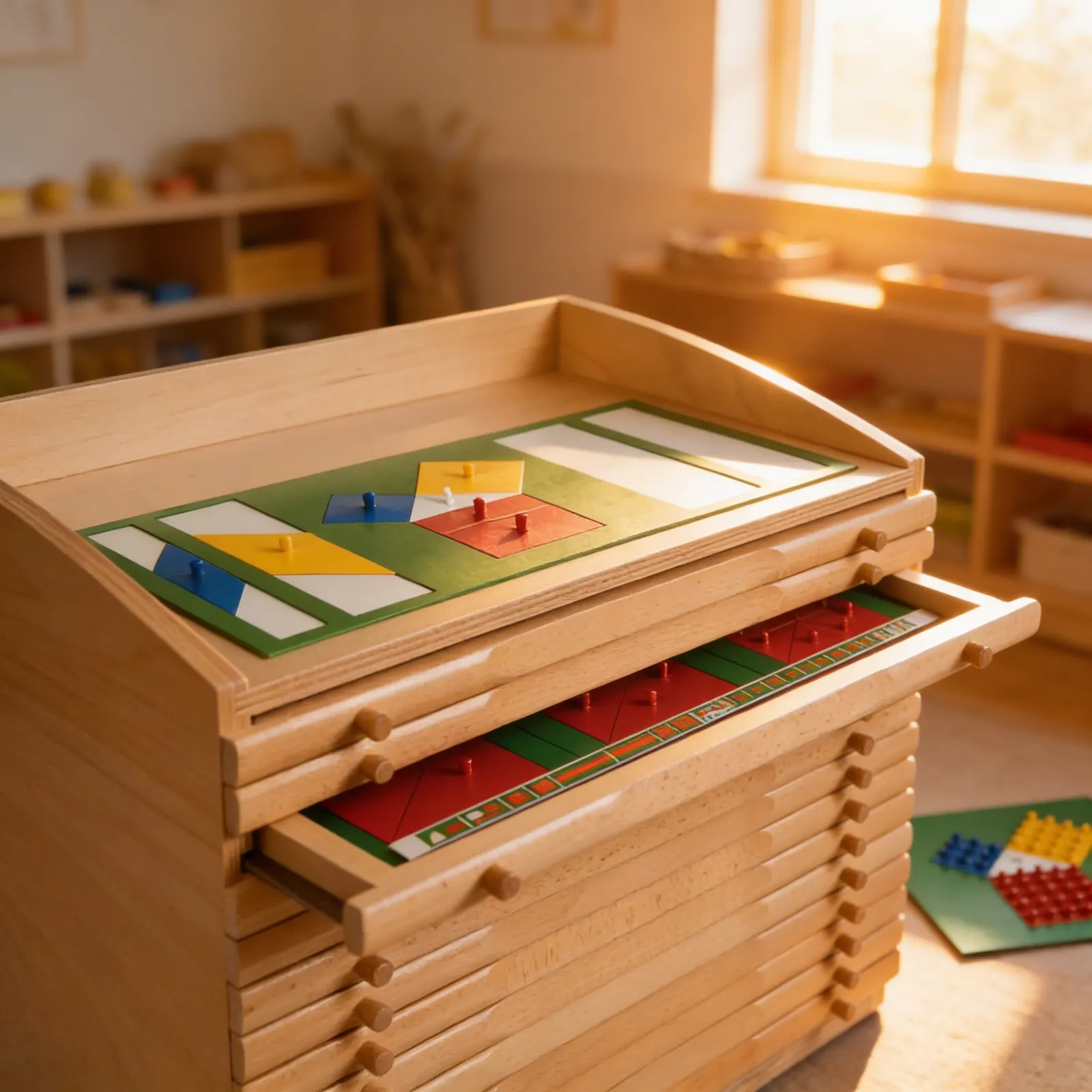
Ten drawers, each holding one fraction circle divided into equal parts, from the whole through to tenths. A child takes out the fifths, feels that five identical pieces fill the same frame as one whole, and then discovers that two of the tenths sit exactly where one fifth was. Equivalence is seen and handled before it is written as a rule. The set carries a child from naming fractions in the early elementary years through to addition, subtraction and equivalence work. Hardwood cabinet with felt lined drawers, for ages 6 to 12.
Concrete Understanding of Fractions
Physical manipulation of fraction pieces allows children to see and feel mathematical relationships, building genuine understanding before moving to abstract fraction work.
Visual Discrimination of Proportions
The systematic organization and color-coding help children develop precise visual perception skills needed for understanding part-to-whole relationships.
Mathematical Reasoning Skills
Through hands-on exploration, children discover equivalencies, compare fractions, and understand addition and subtraction of fractions through concrete experience.
Order and Sequence Development
The organized drawer system reinforces mathematical thinking patterns while developing skills in classification, ordering, and systematic exploration of mathematical concepts.
How to present it
Place the Fraction Cabinet at child's height. Lay out a work mat. Begin with drawer 1 (whole circle) and drawer 2 (halves).
- 1Remove the whole circle from drawer 1, trace it with your finger, and name it 'one whole'
- 2Remove the two halves from drawer 2, demonstrate how they fit together perfectly to recreate the whole
- 3Have the child trace each fraction piece, emphasizing the relationship between parts and whole
- 4Compare different fractions by overlaying pieces, discovering equivalencies like 2/4 = 1/2
3 tips for parents
- Reinforce fraction concepts during cooking by dividing recipes or sharing portions
- Point out fractions in everyday contexts like pizza slices or clock faces
- Allow plenty of uninterrupted exploration time with the material at home

If you are not sure it suits your child, we answer in person.
Norbert Kovalčín, founder of Faborino · write to him
There is no review here yet. We will ask you for one after you buy. Write the first review
What's in the Box
- Fraction Cabinet with 10 Drawers: Premium hardwood construction with metal drawer slides
- Complete Set of Fraction Inlays: Approx. 90+ precision-cut colored fraction pieces
- Work Mats: Separate mats for fraction exploration activities
Size and material
| Product size | 49 × 34 × 41 cm |
| Packaging | 54 × 41 × 45 cm |
| Primary Material | Premium Hardwood |
| Lining | Green Felt |
| Recommended Age | 6-12 years |
| Skill Level | Intermediate to Advanced |
Care
Dust with soft, dry cloth
Frequently Asked Questions
What age is the Fraction Cabinet appropriate for?
The Fraction Cabinet is designed for children ages 6-12, corresponding to the Elementary level in Montessori education. At age 6, children have typically mastered basic number concepts and are ready for abstract mathematical thinking. The material grows with the child - younger children explore basic fraction concepts like halves and thirds, while older children work with complex equivalencies, operations, and fraction relationships. The concrete-to-abstract progression respects each child's developmental readiness.
Can the Fraction Cabinet be used effectively in a home environment?
Absolutely. While originally designed for Montessori classrooms, the Fraction Cabinet works beautifully in home settings. Parents should present the material systematically, starting with simple concepts like exploring whole versus parts, then progressing to equivalencies. The key is following the child's interest and not rushing through lessons. Many homeschooling families find this material invaluable for building deep fraction understanding that surpasses traditional textbook methods.
What materials is the Fraction Cabinet made from and why does quality matter?
Our Fraction Cabinet is crafted from premium hardwood with precision-cut fraction inlays that fit perfectly within their frames. The quality matters enormously - imprecise cuts would undermine the mathematical concepts, while durable construction ensures the material lasts for generations. The smooth finish and exact proportions support the child's developing mathematical mind by providing reliable, beautiful materials that invite repeated exploration and manipulation.
How should I present the Fraction Cabinet to my child?
Begin with the drawer containing the whole circle, then introduce halves, demonstrating how two halves make one whole. Progress systematically through thirds, fourths, and so on, always allowing ample time for exploration. Show equivalencies (like 2/4 = 1/2) using the actual pieces. Let the child discover patterns and relationships through manipulation before introducing mathematical notation. The concrete experience must come first - this builds the foundation for all future fraction work.
What makes AMI-standard Fraction Cabinets superior to other fraction materials?
AMI-certified Fraction Cabinets meet Dr. Montessori's exact specifications for proportions, materials, and design. Every detail serves the child's learning - from the systematic organization in ten drawers to the precise mathematical relationships between pieces. Generic fraction materials often lack this scientific approach, missing key elements like proper color coding, exact proportional relationships, or the complete scope of fractions from 1 whole to 1/10. This comprehensive, scientifically-designed approach is what makes the difference in building genuine mathematical understanding.
Product safety
Manufacturer: Nienhuis Montessori, Anders Celsiusstraat 15, 7442 PB Nijverdal, Netherlands
Fraction Cabinet