
Fruits 3 Part Cards
The first photo is the maker's own. The other shots are illustrative.
Inv. no. NIE-EC0467A
- Maker
- Nienhuis Montessori, since 1929
- Product size
- 9.5 × 12.7 cm
- Material
- Durable plastic
- Finish
- Pre-cut with rounded corners
- EAN
- 8719924042868
Final price incl. VAT. Delivery €5.90, €106.10 to go for free delivery.
Advice, warranty and returns are handled by us.
Fruits 3 Part Cards in a child's hands
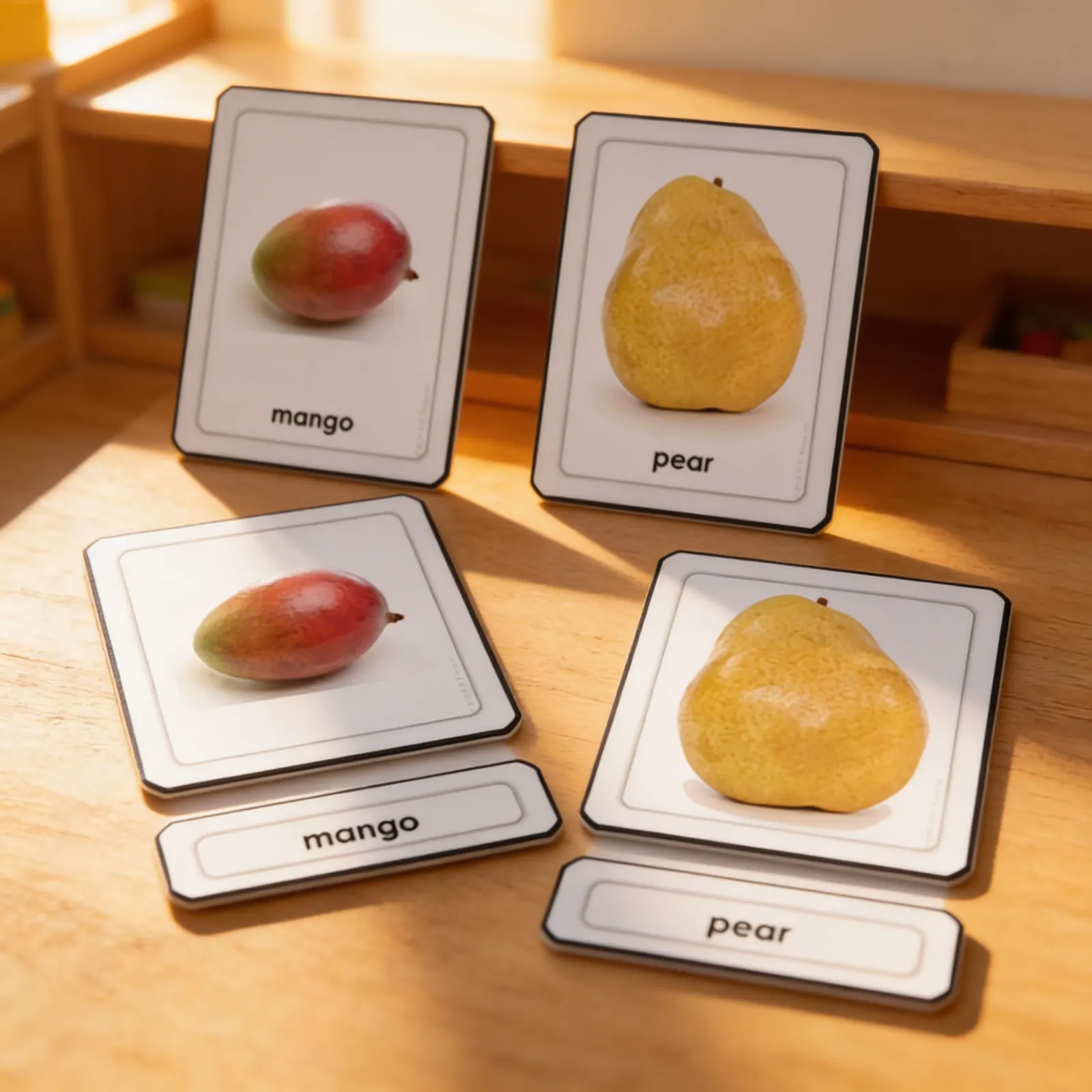
Three part cards for fruits, with a real photograph of each. Fruit is the best possible subject for first nomenclature, because the control is in the kitchen: a child who has met a pomegranate on a card and then in a bowl has had the card confirmed by the world, which is a stronger lesson than any correction. Picture, label and control card. Durable plastic with rounded corners. In English. The matching set is a separate item.
Language Development
Builds vocabulary through visual-word association and supports early reading skills through matching activities.
Classification Skills
Introduces botanical concepts and helps children categorize fruits as part of the natural world.
Visual Discrimination
Enhances ability to distinguish between similar items and match corresponding elements.
Independence
Self-correcting format allows children to work autonomously and build confidence in language work.
How to present it
Place the picture cards in a column on the left side of the work mat. Stack the label cards in a basket. Keep control cards separate for self-correction.
- 1Examine each fruit photograph carefully, naming known fruits aloud
- 2Match label cards to corresponding fruit pictures
- 3Use control cards to verify correct matches
- 4Read each fruit name while pointing to its picture
3 tips for parents
- Connect card work to grocery shopping by finding matching fruits in the produce section
- Create homemade fruit cards using photos from magazines or family fruit-picking trips
- Practice fruit vocabulary during meal preparation and snack times

If you are not sure it suits your child, we answer in person.
Norbert Kovalčín, founder of Faborino · write to him
There is no review here yet. We will ask you for one after you buy. Write the first review
What's in the Box
- Picture Cards: Approx. 6 photographic fruit images
- Label Cards: Matching text labels for each fruit
- Control Cards: Combined image and label cards
Size and material
| Product size | 9.5 × 12.7 cm |
| Packaging | 15 × 15 × 2 cm |
| Material | Durable plastic |
| Finish | Pre-cut with rounded corners |
| Recommended Age | 3-6 years |
Care
Wipe with damp cloth, dry immediately
Frequently Asked Questions
What exactly are 3 part cards and how do they work?
3 part cards consist of three components: a control card showing the image and label together, a separate image card, and a separate label card. Children match the image to the word label, then use the control card to check their work, building reading skills and vocabulary through self-correction.
How many fruit cards are included in this set?
This set typically includes 12-18 different common fruits with realistic photographic images. Each fruit has three corresponding cards (control, image, and label), providing extensive vocabulary practice and matching opportunities for young learners.
What specific language skills do these cards develop?
These cards build vocabulary recognition, reading readiness, visual discrimination, and word-object association. Children progress from matching identical images, to pairing images with labels, and eventually reading labels independently, supporting the natural progression of language development.
Are the cards durable enough for classroom use?
Yes, the cards are professionally laminated for durability and daily classroom use. The lamination protects against spills, tears, and frequent handling by young children, ensuring long-lasting educational value and easy cleaning with a damp cloth.
Can these cards be used for activities beyond basic matching?
Absolutely! Beyond matching, children can sort fruits by color, create categories (citrus, berries, tropical), practice writing fruit names, discuss healthy eating, explore where fruits grow, or use them for vocabulary games and oral language development activities.
Product safety
Manufacturer: Nienhuis Montessori, Anders Celsiusstraat 15, 7442 PB Nijverdal, Netherlands
Fruits 3 Part Cards