
Geometric Form Cards TrayBasic Shapes Visual Presentation
The first photo is the maker's own. The other shots are illustrative.
Inv. no. NIE-0039A0
- Maker
- Nienhuis Montessori, since 1929
- Approval
- AMI
- Frame
- Natural wood
- Card
- Laminated cardstock
- EAN
- 8719924002312
Final price incl. VAT. Delivery €5.90, €105.10 to go for free delivery.
Advice, warranty and returns are handled by us.
Why it costs €43.90
Behind the price of the original are things you can check yourself.
AMI approval
The material is approved by the Association Montessori Internationale (AMI). Nienhuis has made Montessori materials since 1929.
A verifiable original
The EAN 8719924002312 is on the box. It is the maker's number, not ours.
Geometric Form Cards Tray in a child's hands
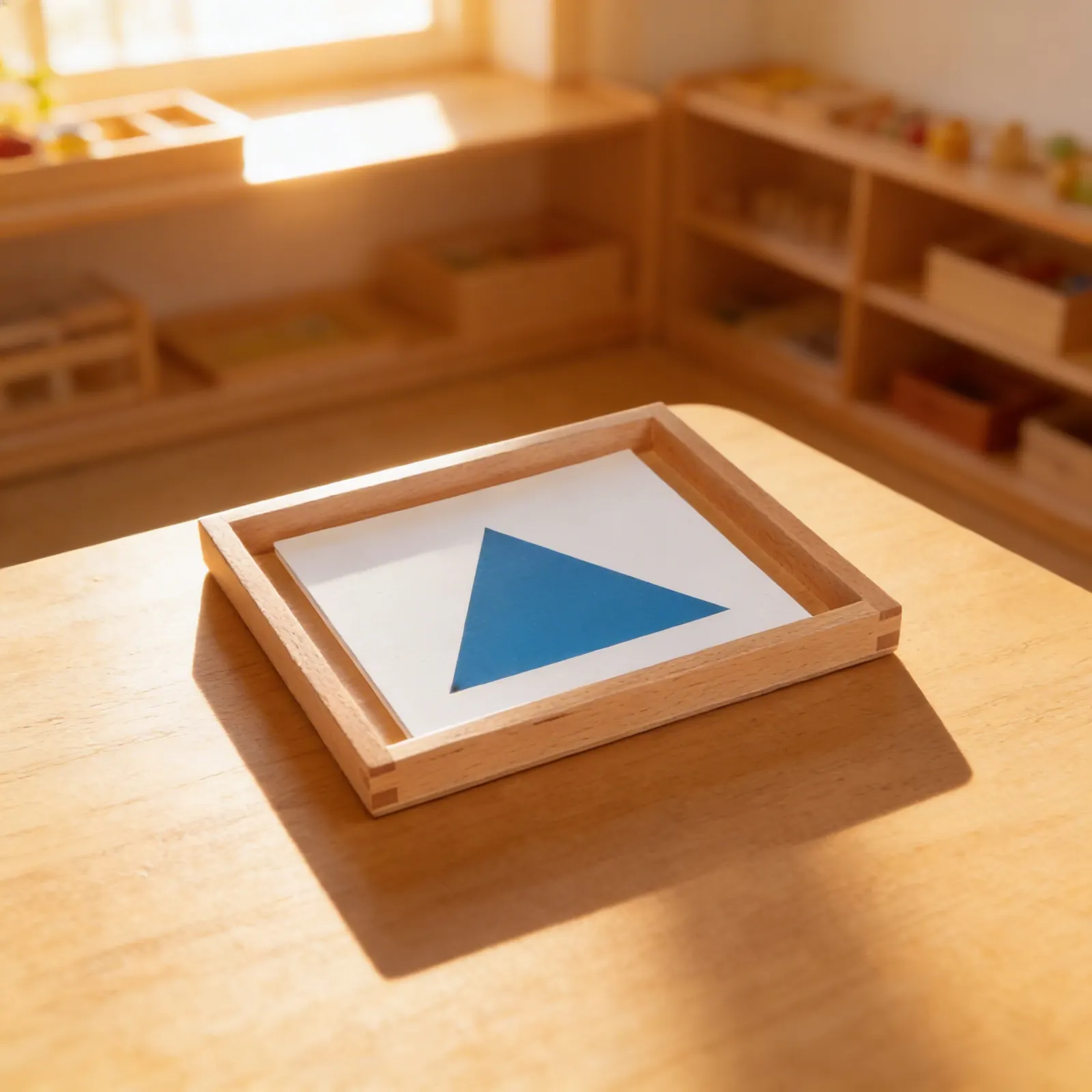
A wooden tray holding nine geometric form cards for the three basic shapes of the demonstration tray: each shape as a solid, a thick lined and a thin lined card. Nine cards is the whole progression in miniature, small enough to be laid out at once and compared. Meeting the three degrees of abstraction side by side on three familiar shapes is what makes the full set of a hundred and five cards intelligible later. Wood with cards, for ages 3 to 6.
Visual Discrimination
Isolated presentation of geometric forms develops the child's ability to distinguish shapes and their properties
Mathematical Mind Preparation
Early exposure to geometric forms lays the foundation for later mathematical concepts and spatial reasoning
Concentration Development
The simple, focused presentation encourages sustained attention and careful observation of form details
How to present it
Place the tray on a table mat at the child's dominant side. Ensure cards are clean and arranged by shape: solid card, thick lined card, thin lined card. Sit to the child's right if they are right-handed.
- 1Remove the first solid card slowly with a three-finger grip and place it in front of the child
- 2Trace around the blue form with your index finger, moving clockwise from the top
- 3Give a three-period lesson with the name of the shape: name it, have the child trace it, then 'Show me ...' and 'What is this?'
- 4Return the card to its place before introducing the next shape
- 5After all shapes are introduced, invite the child to work independently
3 tips for parents
- Point out these shapes in your home environment after your child has worked with the cards at school
- Avoid quizzing your child; instead, make observations like 'I notice our clock is a circle'
- Support vocabulary development by using shape names naturally in conversation

If you are not sure it suits your child, we answer in person.
Norbert Kovalčín, founder of Faborino · write to him
There is no review here yet. We will ask you for one after you buy. Write the first review
What's in the Box
- Wooden tray: With nine geometric form cards
- Geometric form cards: Three basic shapes, each as a solid card, a thick lined card and a thin lined card
Size and material
| Packaging | 16 × 18 × 2 cm |
| Frame | Natural wood |
| Card | Laminated cardstock |
| Recommended Age | 3-6 years |
Care
Wipe wooden frame with damp cloth, clean card with dry cloth
Frequently Asked Questions
What cards are in this tray?
The wooden tray contains 9 geometric form cards for the Demonstration Tray: three basic shapes, each as a solid card, a thick lined card and a thin lined card. The shapes are blue on white backgrounds.
What is the recommended presentation sequence for these cards?
Start with the three basic shapes, introducing one at a time with a three-period lesson. Always present from simple to complex.
How do these cards prepare children for later geometry work?
These cards develop visual discrimination of shapes, preparing children for the geometric cabinet, constructive triangles, and eventually formal geometry studies by building a strong foundation in shape recognition and vocabulary.
Can these cards be used with other Montessori materials?
Yes, they complement the geometric cabinet, metal insets, and shape sorting activities. Children can match the cards to concrete geometric solids or use them for language enrichment and classification exercises.
Product safety
Manufacturer: Nienhuis Montessori, Anders Celsiusstraat 15, 7442 PB Nijverdal, Netherlands
Geometric Form Cards Tray