
Geometric Plane Figures: Flat Shapes for Tactile Discrimination
Made by Nienhuis Montessori · shipped by Heutink International (Netherlands) About the maker
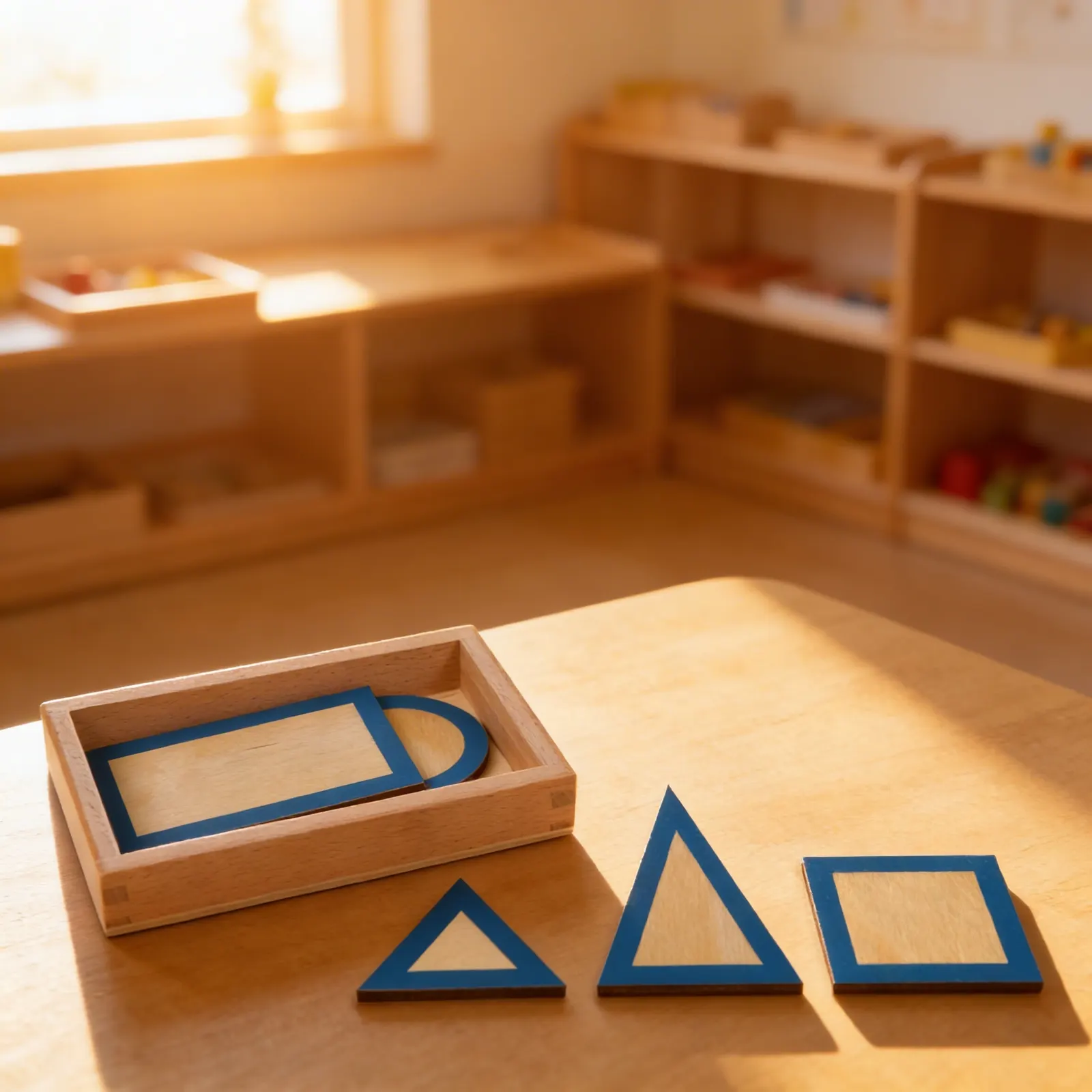
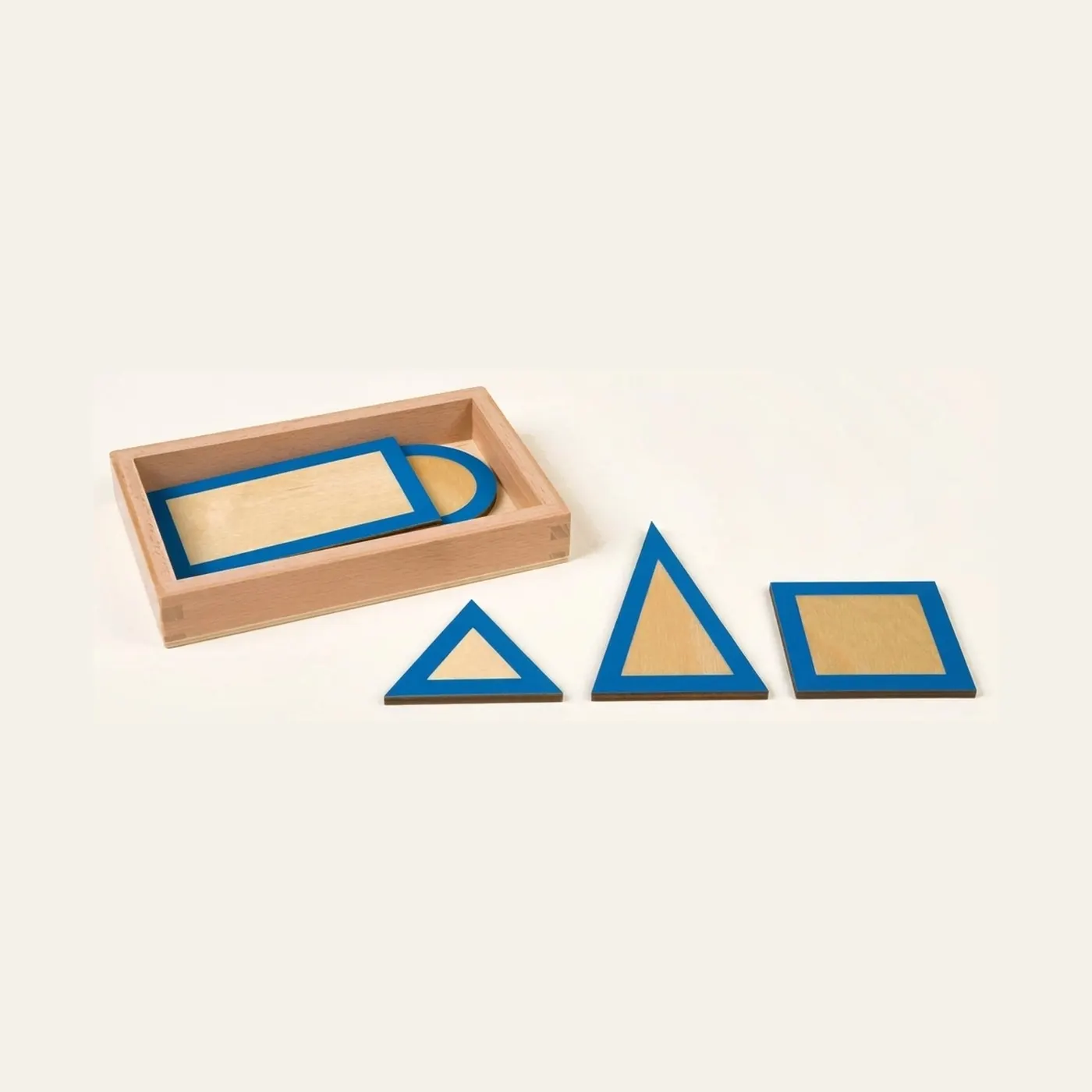
Five flat plane figures with a box, used to link the geometric solids to the two dimensional shapes that correspond to them. It is a harder connection than it sounds: a cylinder is a circle from above and a rectangle from the side, and a child who only knows it as a solid has no reason to expect either. Setting the flat figure beside the solid is what makes a drawn shape readable as a thing. Natural wood with paint, for ages 3 to 6.
“Free the child's potential, and you will transform him into the world.”
The Geometric Plane Figures embody Montessori's principle of isolating difficulty by presenting three distinct shapes that differ only in form.
- Visual discrimination of basic geometric shapes
- Development of pincer grip and hand control for writing preparation
- Vocabulary acquisition: triangle, square, circle, sides, vertices, curved, straight
- Spatial awareness and shape recognition in the environment
Read More
This material bridges the child's sensorial exploration with mathematical concepts, preparing the mathematical mind through concrete manipulation. The blue frames create visual boundaries that help children perceive the essence of each shape, while the natural wood centers provide tactile feedback. Through repeated handling and tracing, children develop muscle memory that supports later writing movements. This work satisfies the child's need for order through the storage box and precise presentation, while the beauty and simplicity of the materials attract the child's attention and invite exploration. The material serves as indirect preparation for geometry while directly refining visual discrimination and manual dexterity.
How to present it
Follow the Montessori method of presentation for optimal child development.
Place the box on a tray. Choose a work mat in a quiet area. Invite the child, naming the material. Carry the tray with two hands to the mat.
- 1
Remove each figure slowly from the box, placing them randomly on the mat
Handle each piece with care, demonstrating respect for the material - 2
Select one figure and trace around the frame with your index and middle fingers together
Move slowly and deliberately, allowing the child to absorb the movement - 3
Lift the frame and trace the inset piece in the same manner
Use the same two fingers, maintaining consistent pressure - 4
Replace the inset in the frame, demonstrating the exact fit
Show satisfaction when pieces fit perfectly together - 5
Invite the child to trace each figure
Observe without correcting, allowing self-discovery - 6
Introduce vocabulary through a three-period lesson once child is familiar with tracing
Start with contrasting shapes like circle and triangle
Every Child Is a Little Creator

Heritage
Since 1929

In classrooms
Around the world

European brands
Nienhuis, GAM, Educo

AMI approved
To the association standard
Geometric Plane Figures: Flat Shapes for Tactile Discrimination
