
Globe Of Land And WaterPainted
The first photo is the maker's own. The other shots are illustrative.
Inv. no. NIE-022600
- Maker
- Nienhuis Montessori, since 1929
- Approval
- AMI
- Globe
- Painted plastic with textured continents
- Base
- Natural wood
- EAN
- 8719924011000
Final price incl. VAT. Delivery €5.90, €31.10 to go for free delivery.
Advice, warranty and returns are handled by us.
Why it costs €117.90
Behind the price of the original are things you can check yourself.
AMI approval
The material is approved by the Association Montessori Internationale (AMI). Nienhuis has made Montessori materials since 1929.
A verifiable original
The EAN 8719924011000 is on the box. It is the maker's number, not ours.
Globe Of Land And Water in a child's hands
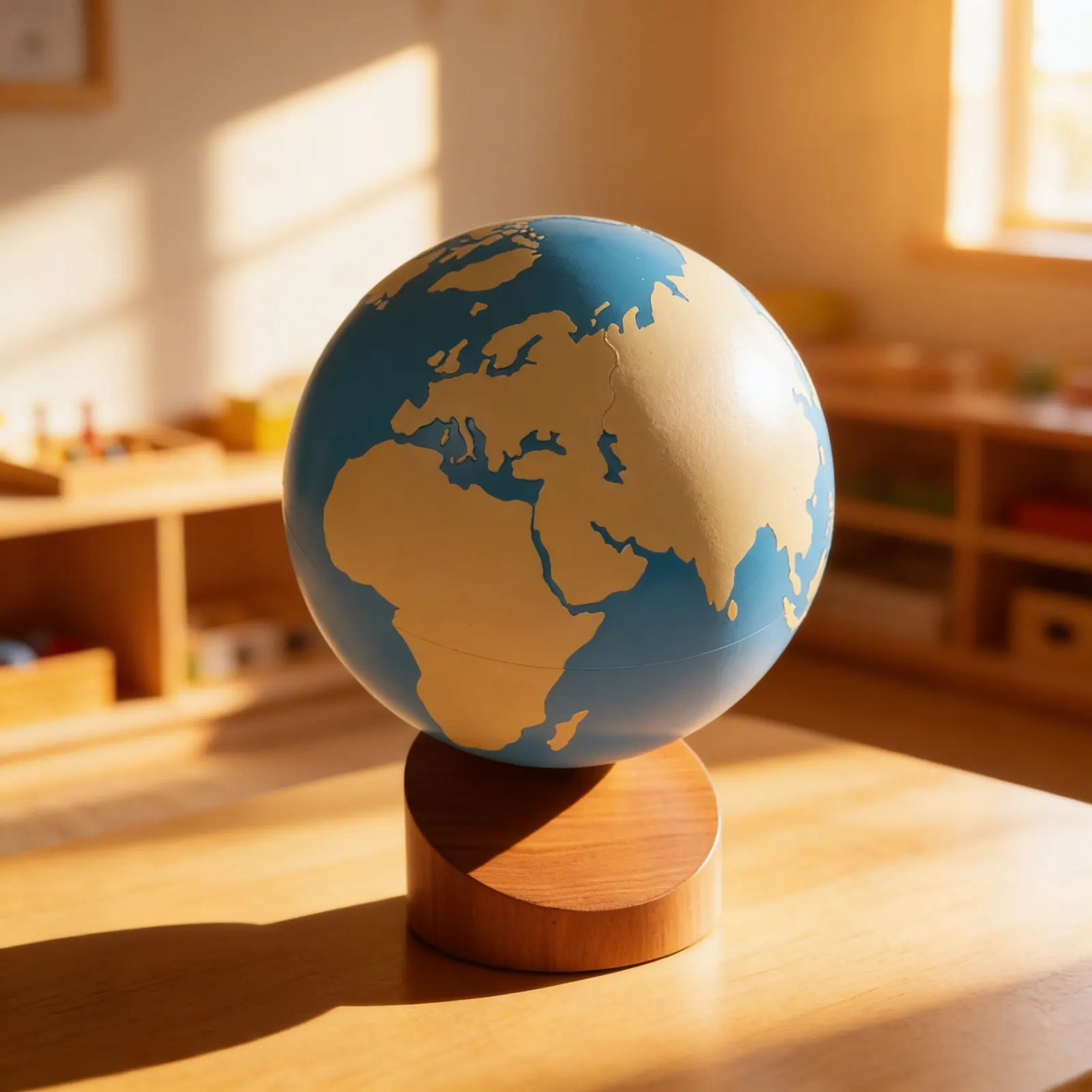
A globe with an entirely smooth surface, beige for land and blue for water, and nothing else at all. Removing every border, name and colour code is the whole design: the first thing a child should know about the planet is that it is mostly water, and any other information at this stage competes with that. The wooden base holds it at 23 degrees, so the tilt that causes the seasons is present from the first encounter without being explained. Plastic on a wooden base, for ages 6 to 12.
Geographic Understanding
Builds foundational knowledge of Earth's land and water distribution through visual and tactile exploration.
Spatial Awareness
Develops understanding of continents, oceans, and their relationships on a spherical surface.
Scientific Thinking
Introduces concepts of physical geography and prepares for advanced studies of specific continents and countries.
Fine Motor Skills
Rotating and examining the globe refines hand movements and coordination.
How to present it
Place the Globe of Land and Water on a stable surface at child's eye level when seated. Ensure adequate lighting and space for children to walk around the globe. Have a small pitcher of water and cloth nearby for sensorial extension.
- 1Introduce the globe by inviting the child to observe the two colors, asking what they might represent
- 2Demonstrate gentle rotation of the globe on its axis, showing how land and water appear on all sides
- 3Trace the outline of one continent with your finger, then invite the child to trace others
- 4Introduce vocabulary by pointing: 'This is land' (beige areas), 'This is water' (blue areas)
- 5Explore the proportion of water to land by rotating the globe to find the 'water hemisphere' (Pacific Ocean view)
3 tips for parents
- Reference the globe concept during daily life: 'The sun shines on different parts of our round Earth'
- Use a regular ball to reinforce spherical Earth concept during play
- When discussing travel or news events, refer back to the land/water distinction learned with the globe

If you are not sure it suits your child, we answer in person.
Norbert Kovalčín, founder of Faborino · write to him
There is no review here yet. We will ask you for one after you buy. Write the first review
What's in the Box
- Painted Globe: Land masses in beige, water in blue
- Wooden Stand: Natural finish with brand marking
Size and material
| Packaging | 17 × 17 × 23 cm |
| Globe | Painted plastic with textured continents |
| Base | Natural wood |
| Recommended Age | 6-12 years |
Care
Wipe globe with damp cloth, dust wooden base regularly
Frequently Asked Questions
What is the purpose of the Globe of Land and Water in Montessori education?
The Globe of Land and Water is the first globe presented to children in Montessori geography. It introduces the fundamental concept that Earth is made up of land and water, providing a concrete, tactile way for children to understand this basic geographical distinction before moving on to more complex concepts like continents and countries.
How does this globe differ from the Sandpaper Globe?
While both globes show land and water, the Painted Globe has smooth surfaces with land areas painted in beige and water in blue. The Sandpaper Globe has textured surfaces - rough sandpaper for land and smooth paint for water - allowing children to feel the difference. The Painted Globe is typically introduced after the sandpaper version.
What activities can children do with this globe?
Children can identify and trace land and water areas, match the globe to flat maps, create their own land and water forms with clay or paint, discuss which is more prevalent on Earth, and use it as a reference for lessons about continents, oceans, and geographical features. It also serves as an introduction to more detailed geography work.
What are the dimensions and materials of this globe?
The globe features a painted sphere with continents in natural beige tones and oceans in blue, mounted on a sturdy wooden base. The size is appropriate for children ages 6-12 to handle comfortably. The smooth painted surface allows for easy cleaning and durability in classroom use.
How does this globe support the Montessori geography curriculum?
This globe follows the Montessori principle of moving from simple to complex. After sensorial work with the Sandpaper Globe, children use this Painted Globe to reinforce land/water concepts before progressing to the Continent Globe and political globes. It provides a visual reference for discussions about Earth's surface and prepares children for more detailed geographical studies.
Product safety
Manufacturer: Nienhuis Montessori, Anders Celsiusstraat 15, 7442 PB Nijverdal, Netherlands
Globe Of Land And Water