
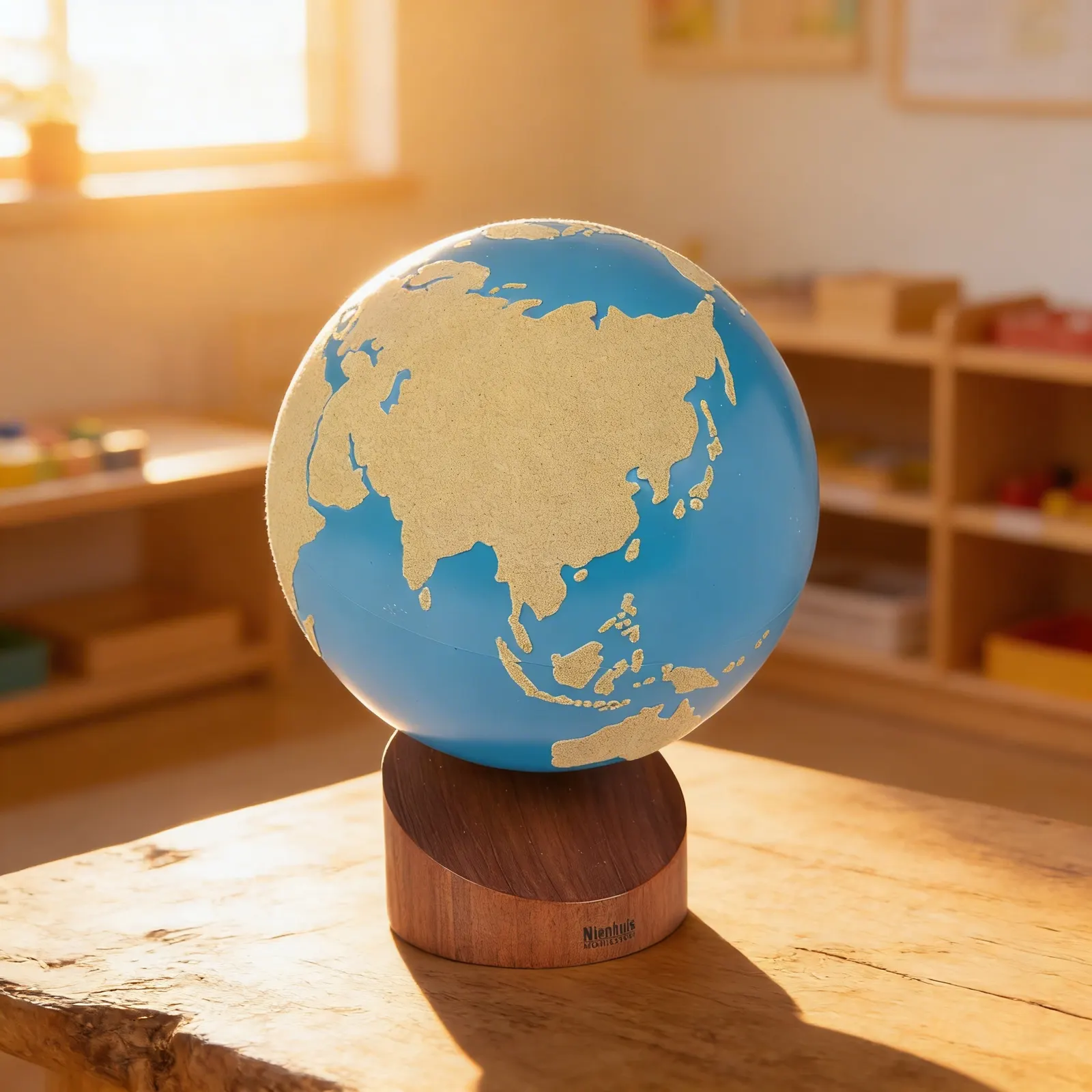
Globe Of Land And WaterSandpaper
The first photos are the maker's own. The other shots are illustrative.
Inv. no. NIE-023000
- Maker
- Nienhuis Montessori, since 1929
- Approval
- AMI
- Water Areas
- Smooth painted surface
- Stand
- Natural wood with curved support
- EAN
- 8719924011055
Final price incl. VAT. Delivery €5.90, €56.10 to go for free delivery.
Advice, warranty and returns are handled by us.
Why it costs €92.90
Behind the price of the original are things you can check yourself.
AMI approval
The material is approved by the Association Montessori Internationale (AMI). Nienhuis has made Montessori materials since 1929.
A verifiable original
The EAN 8719924011055 is on the box. It is the maker's number, not ours.
Globe Of Land And Water in a child's hands
The land and water globe in its sandpaper version, where land is rough and water is smooth. This is the one to give first, because a child can meet the planet with their eyes closed and still know which is which. Touch settles the distinction in a way colour cannot, and the painted globe that follows then adds the visual layer onto something the hands already know. The wooden base holds the globe at 23 degrees, the same angle as the earth's axis. Sandpaper over a painted surface, for ages 3 to 6.
Sensorial Geography
Children develop geographic concepts through touch, creating strong sensory memories of Earth's land and water distribution.
Language Preparation
Builds concrete understanding for geographic vocabulary including continents, oceans, islands, and peninsulas.
Fine Motor Control
Tracing coastlines with fingertips refines hand movements essential for later writing activities.
Abstract Thinking
Bridges concrete tactile experience with abstract geographic concepts, supporting cognitive development.
How to present it
Place the globe on a mat at the child's eye level when seated. Have a small pitcher of water and cloth nearby for the water pouring extension.
- 1Invite the child to explore the globe with both hands, rotating it slowly
- 2Guide fingers to trace the rough sandpaper continents, naming 'land'
- 3Move fingers to smooth blue areas, stating 'This is water'
- 4Invite the child to close eyes and identify land or water by touch alone
- 5Introduce three-period lesson: 'Show me land,' 'Show me water,' 'What is this?'
3 tips for parents
- At bath time, discuss how water moves around islands (washcloths) just like oceans surround continents
- During nature walks, connect rough tree bark or sandy soil to the globe's land texture
- Create simple land and water sorting games with natural materials from your environment

If you are not sure it suits your child, we answer in person.
Norbert Kovalčín, founder of Faborino · write to him
There is no review here yet. We will ask you for one after you buy. Write the first review
What's in the Box
- Sandpaper Globe: With textured continents and smooth oceans
- Wooden Stand: With curved support for stable rotation
Size and material
| Packaging | 17 × 17 × 23 cm |
| Water Areas | Smooth painted surface |
| Stand | Natural wood with curved support |
| Recommended Age | 3-6 years |
Care
Dust gently with soft brush, avoid moisture on sandpaper
Frequently Asked Questions
What makes this globe different from a regular globe?
This Montessori globe uses sandpaper for continents and smooth paint for oceans, allowing children to feel the difference between land and water through touch. This tactile approach helps young children understand geographic concepts before they can read maps.
How do children use this sandpaper globe?
Children explore the globe by running their fingers over the surfaces, feeling the rough sandpaper continents and smooth water areas. Teachers typically present it by demonstrating the tactile difference, introducing vocabulary like 'land' and 'water,' and encouraging independent exploration.
What age is most appropriate for this material?
While designed for ages 3-6, children as young as 2.5 can benefit from the sensory experience. Most children are ready when they show interest in touching different textures and can handle materials gently. It remains useful through age 6 as children develop more complex geographic understanding.
What skills does the sandpaper globe develop?
This material develops tactile discrimination, geographic awareness, vocabulary (land/water, continent/ocean), fine motor control, and prepares children for more advanced geography work. It also supports sensory integration and spatial understanding.
How durable is the sandpaper surface?
High-quality Montessori sandpaper globes are designed for classroom use with durable, firmly adhered sandpaper that withstands years of touching. The sandpaper should maintain its texture without peeling or wearing smooth with proper care and gentle handling.
Product safety
Manufacturer: Nienhuis Montessori, Anders Celsiusstraat 15, 7442 PB Nijverdal, Netherlands
Globe Of Land And Water