
Grammar Symbol PaperPronoun (100)
The first photo is the maker's own. The other shots are illustrative.
Inv. no. NIE-0111H0
- Maker
- Nienhuis Montessori, since 1929
- Approval
- AMI
- Primary Material
- Paper
- Color
- Purple (Montessori standard)
- EAN
- 8719924006433
Final price incl. VAT. Delivery €5.90, €145.60 to go for free delivery.
Advice, warranty and returns are handled by us.
Why it costs €3.40
Behind the price of the original are things you can check yourself.
AMI approval
The material is approved by the Association Montessori Internationale (AMI). Nienhuis has made Montessori materials since 1929.
A verifiable original
The EAN 8719924006433 is on the box. It is the maker's number, not ours.
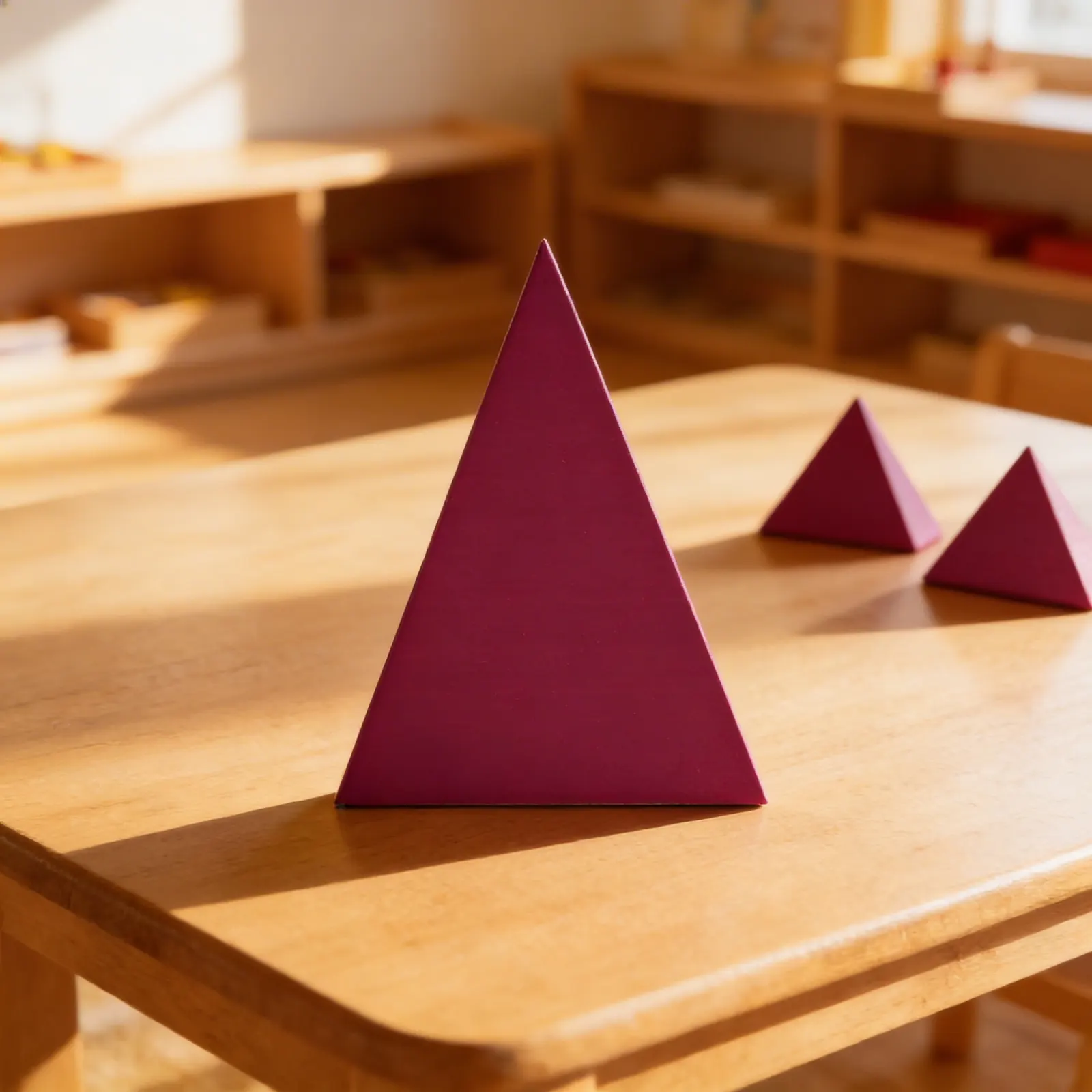
Grammar Symbol Paper in a child's hands
One hundred paper pronoun symbols, the purple triangle. A pronoun stands in the place of a noun, so it keeps the triangle and changes colour: the shape says what job it does, the colour says it is not the noun itself. That single decision is why children stop asking what a pronoun is and start finding them. Sold in hundreds, for sticking above words in a notebook. The other parts of speech are separate items.
Grammar Classification
Children learn to identify pronouns as noun substitutes through visual symbol association and hands-on sentence analysis.
Abstract Thinking
Concrete symbols help children understand abstract grammatical relationships between pronouns and the nouns they replace.
Visual Discrimination
The distinctive purple triangle shape strengthens visual memory and pattern recognition for grammar concepts.
Language Analysis Skills
Systematic symbol placement develops analytical thinking and understanding of sentence structure and word functions.
How to present it
Prepare a work tray with pronoun symbols, prepared sentence strips, and a small container for used symbols. Select sentences containing clear pronoun examples.
- 1Read the first sentence aloud, emphasizing each word clearly
- 2Identify the nouns in the sentence first, placing black triangle symbols above them
- 3Find words that replace or refer to the nouns, placing purple triangles above these pronouns
- 4Read the sentence again, touching each symbol as you read the corresponding word
- 5Remove symbols and invite the child to repeat the process independently
3 tips for parents
- Practice identifying pronouns in favorite storybooks by pointing them out during reading time
- Play 'pronoun replacement' games where you substitute names with pronouns in everyday conversation
- Create simple sentences about family members using pronouns for at-home practice

If you are not sure it suits your child, we answer in person.
Norbert Kovalčín, founder of Faborino · write to him
There is no review here yet. We will ask you for one after you buy. Write the first review
What's in the Box
- Purple Pronoun Triangles: 100 pieces
Size and material
| Packaging | 12 × 8 × 1 cm |
| Primary Material | Paper |
| Color | Purple (Montessori standard) |
| Finish | Smooth, die-cut |
| Recommended Age | 3-6 years |
Care
| Cleaning | Keep dry; store flat in protective container |
| Storage | Store away from moisture and direct sunlight |
Frequently Asked Questions
What size are these pronoun grammar symbols?
These pronoun symbols are precision-cut in the standard Montessori size of approximately 1 inch (2.5 cm) per side, making them easy for small hands to manipulate during grammar analysis activities.
Why are pronoun symbols purple triangles in Montessori?
The purple isosceles triangle represents pronouns because they 'stand in place of' nouns - the triangle shape shows they are related to nouns (black triangles) but different, while purple distinguishes them as a unique part of speech.
How many pronoun symbols come in this pack of 100?
You receive 100 purple isosceles triangle symbols, providing enough for multiple children to work simultaneously or for extensive sentence analysis work with pronouns like he, she, it, they, we, and others.
Are these suitable for children who haven't learned about nouns yet?
Children should first be familiar with noun symbols (black triangles) before introducing pronoun symbols, as pronouns are taught as words that replace nouns in the Montessori language sequence.
Can these paper symbols be laminated for durability?
Yes, many teachers laminate these paper symbols to increase durability for repeated classroom use, though the paper quality is designed to withstand regular handling by young children.
Product safety
Manufacturer: Nienhuis Montessori, Anders Celsiusstraat 15, 7442 PB Nijverdal, Netherlands
Grammar Symbol Paper