
Greenboards With Double Lines And SquaresSet Of 2 (Nienhuis)
The first photo is the maker's own. The other shots are illustrative.
Inv. no. NIE-006800
- Maker
- Nienhuis Montessori, since 1929
- Approval
- AMI
- Surface
- Painted writing surface
- Base
- Laminated board
- EAN
- 8719924004248
€56.90
Final price incl. VAT. Delivery €5.90, €92.10 to go for free delivery.
✓ In Stock. Delivery in 5 to 9 working days.
1
30 daysto return
Advicebefore and after
Invoicefor companies
Advice, warranty and returns are handled by us.
The original
Why it costs €56.90
Behind the price of the original are things you can check yourself.
AMI approval
The material is approved by the Association Montessori Internationale (AMI). Nienhuis has made Montessori materials since 1929.
A verifiable original
The EAN 8719924004248 is on the box. It is the maker's number, not ours.
What the child does
Greenboards With Double Lines And Squares in a child's hands
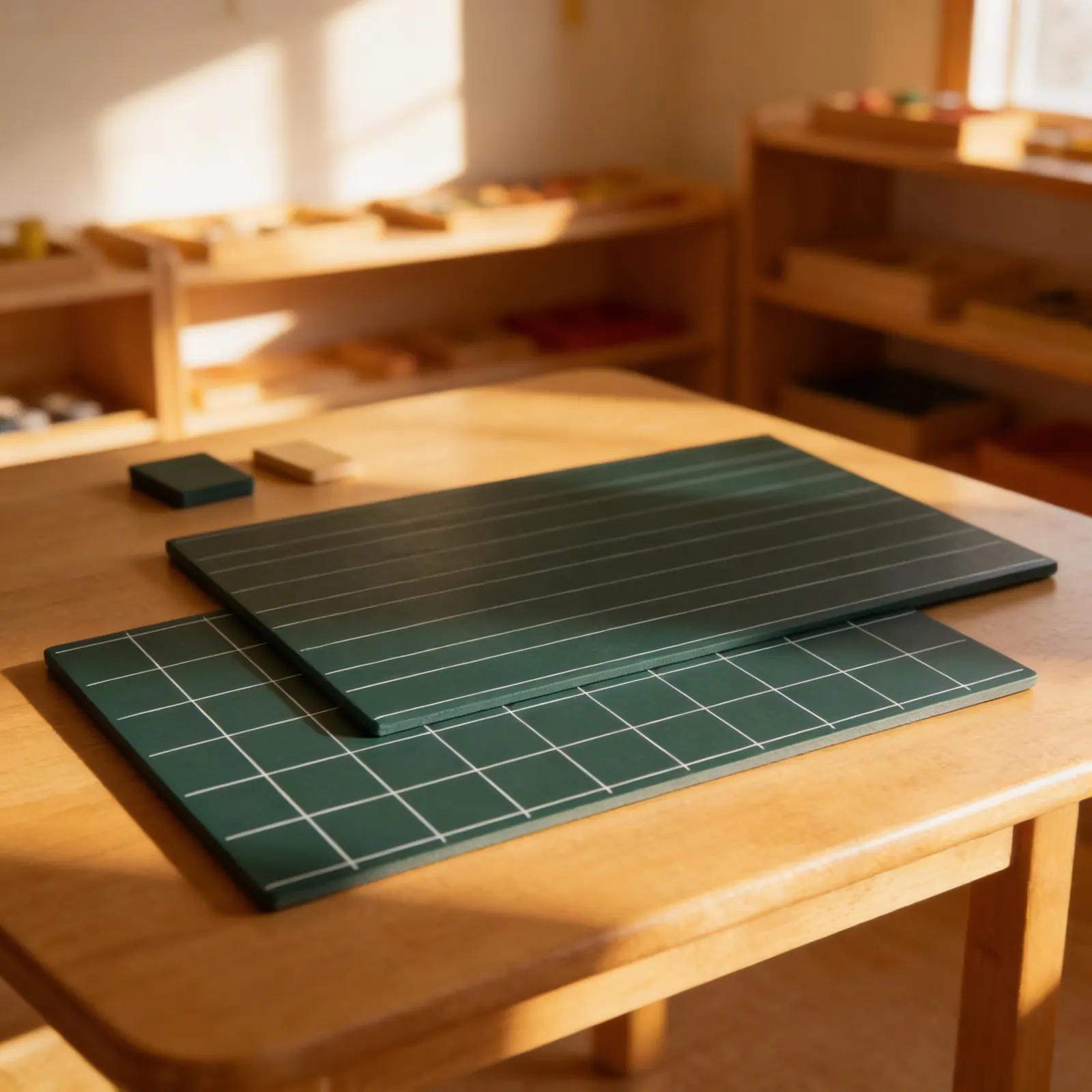
Two green writing boards, each ruled on one side to guide the placement of ascending and descending letters and on the other side in squares. The double lines answer the question a child cannot answer alone: how far above the line does a letter go, and how far below. Turning the board over for squares moves the same hand to arithmetic without changing anything about how it is held. Chalk wipes off, so a mistake costs nothing. Laminated board with a painted surface, for ages 3 to 6.
Writing Readiness
Double lines guide proper letter formation, teaching children the relationship between uppercase and lowercase letter heights.
Spatial Organization
Grid patterns develop understanding of letter spacing and alignment essential for legible handwriting.
Fine Motor Control
Chalk writing on vertical surfaces strengthens hand muscles and develops proper pencil grip.
Visual-Motor Integration
Structured writing surfaces help children coordinate eye movements with hand control for accurate letter formation.
Activity Guide
How to present it
Place the double-lined board on a low table with white chalk and a small damp sponge. Demonstrate proper chalk grip at 45-degree angle.
- 1Show the child how to trace the baseline with their finger, feeling where letters 'sit'
- 2Demonstrate writing a short letter like 'a' between the lines, emphasizing it stays between the boundaries
- 3Introduce a tall letter like 'l', showing how it touches the top line
- 4Practice letters with descenders like 'g', showing how they dip below the baseline
- 5Transition to the squared board for practicing letter spacing within individual squares
3 tips for parents
- Resist the urge to correct every imperfect letter - focus on effort and gradual improvement
- Create a special place at home for the greenboard where your child can practice without interruption
- Use the boards for fun activities like drawing simple pictures in the squares or playing tic-tac-toe to build positive associations
From the same makerNienhuis
Accessories
Why it is in our selection
If you are not sure it suits your child, we answer in person.
Norbert Kovalčín, founder of Faborino · write to him
There is no review here yet. We will ask you for one after you buy. Write the first review
Details
What's in the Box
- Double-lined greenboard: For letter height practice
- Grid-patterned greenboard: For character placement
Size and material
| Packaging | 51 × 33 × 2 cm |
| Surface | Painted writing surface |
| Base | Laminated board |
| Recommended Age | 3-6 years |
Care
Wipe with damp cloth, dry immediately
Frequently Asked Questions
What are the dimensions of each greenboard and what makes them suitable for young children?
Each greenboard measures approximately 30x40cm, providing ample writing space while remaining manageable for small hands. The boards feature smooth, matte surfaces that accept standard chalk without excessive dust, and sturdy wooden frames with rounded corners for safety. The size allows children to practice full arm movements essential for proper writing development.
How do the double lines and squares support different stages of writing development?
The double-lined board helps children understand letter proportions by providing guidelines for uppercase letters (touching both lines) and lowercase letters (staying within or extending beyond lines). The squared board supports precise letter spacing and alignment, particularly useful for practicing cursive connections and maintaining consistent letter size. Both formats prepare children for standard lined paper.
What is the recommended progression for using these boards in Montessori language work?
Begin with the double-lined board after children have mastered sandpaper letters, using it for single letter practice and simple words. Progress to the squared board as children develop better control, using it for word spacing and eventually sentence writing. Many teachers alternate between boards based on the specific skill being practiced, such as letter formation versus spacing.
How should these greenboards be cleaned and maintained for classroom use?
Clean boards daily with a slightly damp cloth, allowing them to dry completely before storage. For deeper cleaning, use a specialized chalkboard cleaner monthly. Store boards flat or hanging to prevent warping. Condition the surface periodically with chalk dust to maintain optimal writing texture. Replace boards when surfaces become too smooth or develop permanent marks.
Can these boards be used for activities beyond writing practice?
Yes, the squared board excellently supports mathematical concepts like place value, graphing, and geometric shapes. The double-lined board works well for music notation practice and pattern work. Both boards can be used for drawing exercises that develop hand control and visual discrimination. Many teachers also use them for collaborative group work and presentations.
Product safety
Manufacturer: Nienhuis Montessori, Anders Celsiusstraat 15, 7442 PB Nijverdal, Netherlands
Greenboards With Double Lines And Squares
€56.90