
Hexagonal Prism: Geometric Solid for Shape Exploration
Made by Nienhuis Montessori · shipped by Heutink International (Netherlands) About the maker
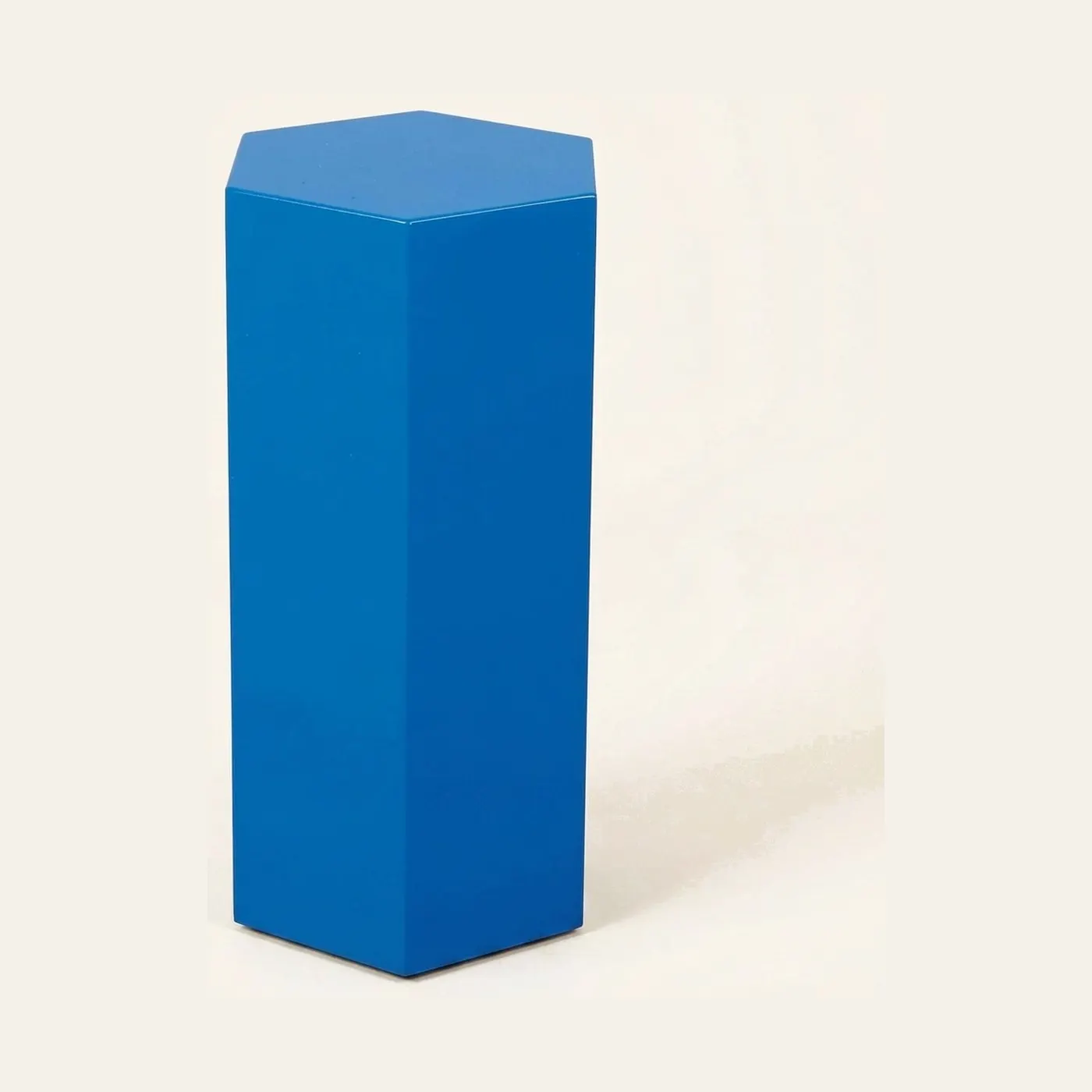
A prism on a hexagonal base, from the volume set derived from a base of 10 by 10 cm and a height of 20 cm. The hexagon is where a child runs out of shortcuts: you cannot get its area by multiplying two edges, you have to break it into triangles first, and only then does the familiar base times height finish the job. That is a real change in what is being asked, and it is the reason this solid sits later in the set than the square and the triangle. Sold individually, for ages 6 to 12.
“Children display a universal love of mathematics, which is par excellence the science of precision, order, and intelligence.”
The Hexagonal Based Prism exemplifies Montessori's principle of educating the senses as the foundation for intellectual development.
- Develops stereognostic sense through tactile exploration of the hexagonal prism's faces, edges, and vertices
- Builds vocabulary for geometric properties including base, lateral faces, edges, vertices, and parallel surfaces
- Strengthens spatial reasoning by mentally rotating and visualizing the solid from different perspectives
- Connects two-dimensional hexagons to their three-dimensional form, understanding face relationships
Read More
Through stereognostic exploration, children internalize geometric concepts by handling this solid, building what Montessori called 'muscular memory' of form. The material's precision and beauty respond to the child's natural mathematical mind, particularly during the second plane of development when abstraction becomes possible. The smooth lacquered surface isolates the geometric property, allowing focused attention on the hexagonal form's unique characteristics. This concrete manipulation prepares the child for later abstract geometric study, following Montessori's progression from concrete to abstract. The material serves as a key to understanding how two-dimensional shapes relate to three-dimensional forms, supporting the child's construction of spatial intelligence through sensorial impression rather than verbal explanation.
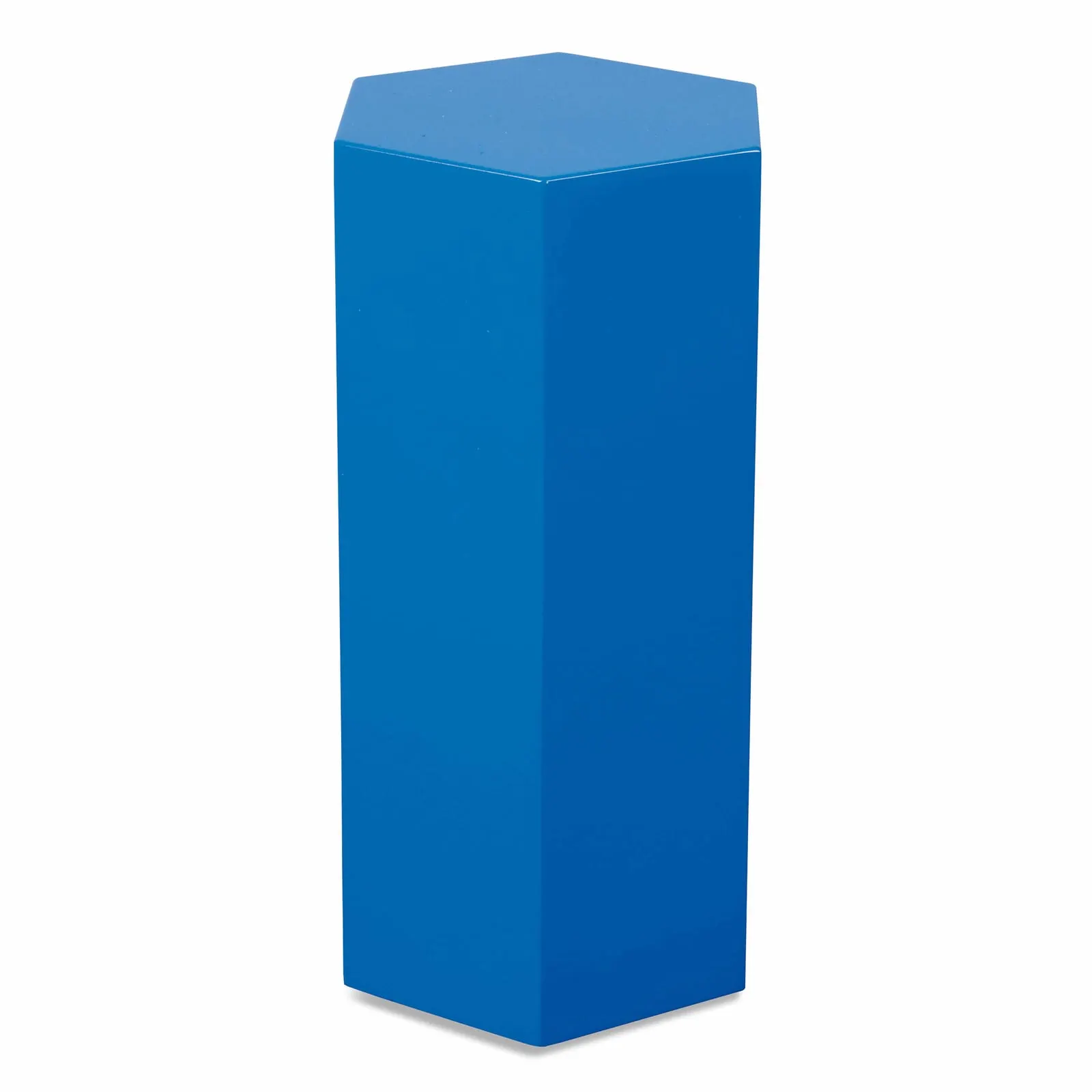
How to present it
Follow the Montessori method of presentation for optimal child development.
Place the Hexagonal Based Prism on a neutral-colored mat. Have the geometric solids bases nearby for tracing. Ensure hands are clean and dry for optimal tactile experience.
- 1
Invite the child to explore the prism with both hands, eyes closed, feeling all surfaces systematically
Model slow, deliberate movements that communicate respect for the material - 2
Open eyes and examine the hexagonal bases, counting vertices and edges while tracing with fingers
Use the three-period lesson for vocabulary: 'This is a hexagonal prism' - 3
Compare lateral faces to the bases, discovering all lateral faces are rectangles
Let the child discover rather than tell - ask 'What do you notice about these faces?' - 4
Trace around the base on paper, then stand the prism on the tracing to verify the match
This connects the 2D representation to the 3D form concretely - 5
Roll the prism on its lateral faces, observing how it moves differently than curved solids
This kinesthetic experience reinforces the concept of flat faces versus curved surfaces
Every Child Is a Little Creator

Heritage
Since 1929

In classrooms
Around the world

European brands
Nienhuis, GAM, Educo

AMI approved
To the association standard
Hexagonal Prism: Geometric Solid for Shape Exploration
