
Historia De Los Lenguajes (Spanish Edition)
The first photo is the maker's own. The other shots are illustrative.
Inv. no. NIE-ELCSP5086
- Maker
- Nienhuis Montessori, since 1929
- Primary Material
- Paper and cardstock
- Cover Design
- Islamic manuscript-style artwork
- EAN
- 8719924044473
Final price incl. VAT. Delivery €5.90, €107.10 to go for free delivery.
Advice, warranty and returns are handled by us.
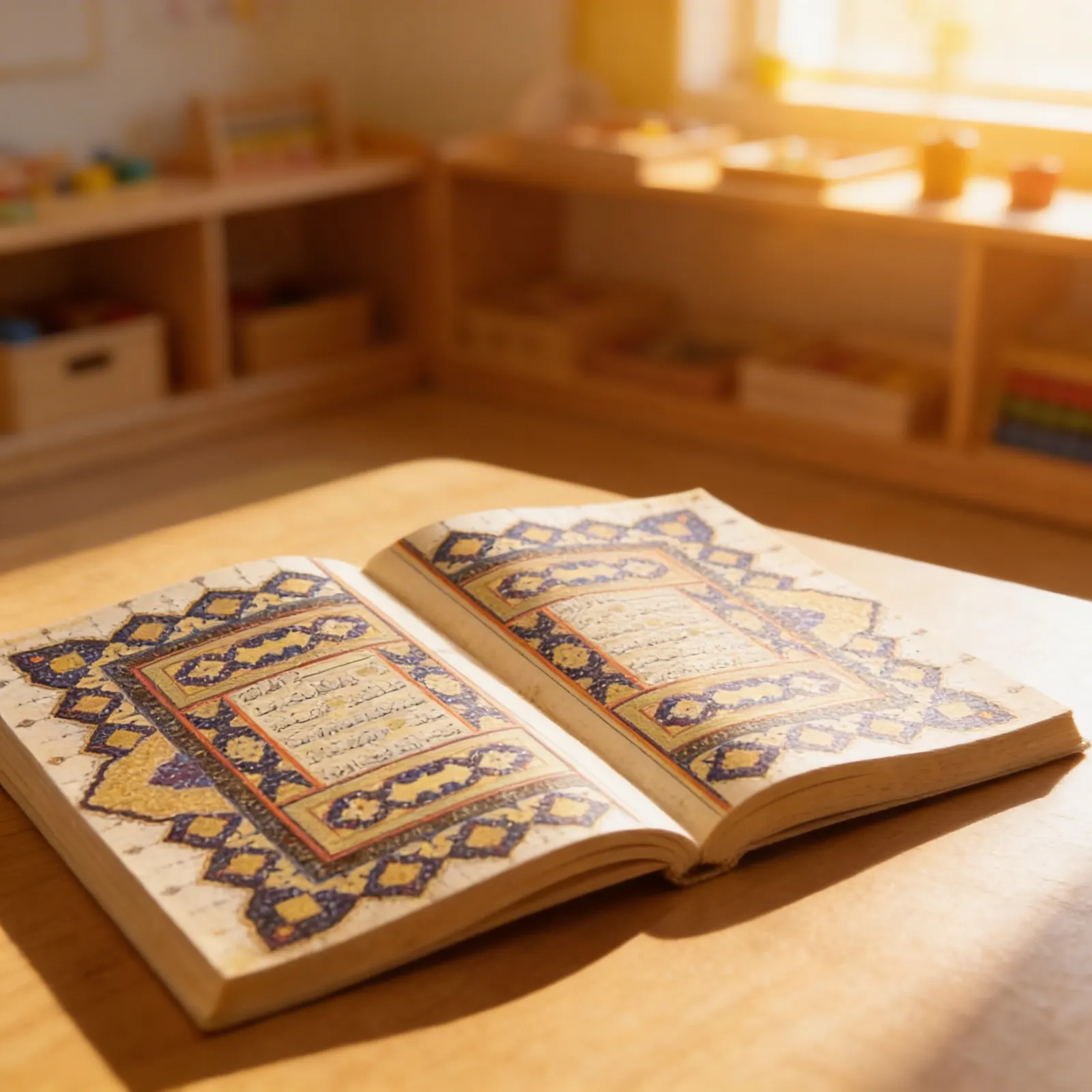
Historia De Los Lenguajes (Spanish Edition) in a child's hands
Historia De Los Lenguajes is an educational material exploring the historical development and cultural significance of written languages, featuring beautiful Islamic manuscript-inspired design with Arabic calligraphy and ornate geometric patterns. This Spanish-language resource puts children in direct contact with the rich heritage of human communication systems, supporting the Montessori approach to cultural studies and language appreciation through visual and textual exploration.
Cultural Appreciation
Introduces children to diverse writing systems and the artistic traditions of Islamic manuscript illumination.
Language Awareness
Develops understanding of how human languages evolved and spread across cultures throughout history.
Visual Discrimination
The intricate geometric patterns and calligraphy enhance visual perception and pattern recognition skills.
Historical Connection
Creates meaningful links between past and present communication methods, fostering respect for cultural heritage.
How to present it
Place Historia De Los Lenguajes on a low shelf at child's eye level. Prepare a quiet reading area with cushions and good lighting. Have tracing paper and colored pencils nearby for optional pattern work.
- 1Begin by examining the book's cover together, tracing geometric patterns with your finger
- 2Open to pages featuring Arabic calligraphy, observing how lines flow and connect
- 3Read selected Spanish passages that explain how people first began drawing symbols
- 4Invite the child to choose a favorite geometric pattern to trace or copy
3 tips for parents
- Look for Arabic calligraphy or geometric patterns in your community to make real-world connections
- Visit museums with manuscript collections when possible
- Encourage pattern-making at home using the book's designs as inspiration

If you are not sure it suits your child, we answer in person.
Norbert Kovalčín, founder of Faborino · write to him
There is no review here yet. We will ask you for one after you buy. Write the first review
What's in the Box
- Historia De Los Lenguajes Book: Educational manual with decorative Islamic design
Size and material
| Packaging | 28 × 22 × 1 cm |
| Primary Material | Paper and cardstock |
| Cover Design | Islamic manuscript-style artwork |
| Recommended Age | 6-12 years |
Care
Handle with clean, dry hands; store in dry location
Frequently Asked Questions
What age group is Historia De Los Lenguajes designed for?
This material is designed for children ages 3-6 years, aligning with the Montessori early childhood curriculum for cultural studies and language exploration.
Is this material available in languages other than Spanish?
Currently, Historia De Los Lenguajes is a Spanish-language resource. The content explores various world languages and writing systems, but the instructional text is in Spanish.
How does this material support Montessori cultural studies?
It introduces children to the diversity of human communication systems, featuring Arabic calligraphy and Islamic manuscript designs, helping develop cultural awareness and appreciation for different writing traditions.
What specific content is included in this educational material?
The material explores the historical development of written languages with visual examples of Arabic calligraphy, geometric patterns inspired by Islamic manuscripts, and age-appropriate explanations of how different cultures communicate.
Can children who don't speak Spanish use this material?
While the text is in Spanish, the visual elements including calligraphy examples and geometric patterns can be appreciated universally. However, adult guidance may be needed to translate the educational content for non-Spanish speakers.
Product safety
Manufacturer: Nienhuis Montessori, Anders Celsiusstraat 15, 7442 PB Nijverdal, Netherlands
Historia De Los Lenguajes (Spanish Edition)