
Hollow Letter Shapes: International Cursive
Made by Nienhuis Montessori · shipped by Heutink International (Netherlands) About the maker
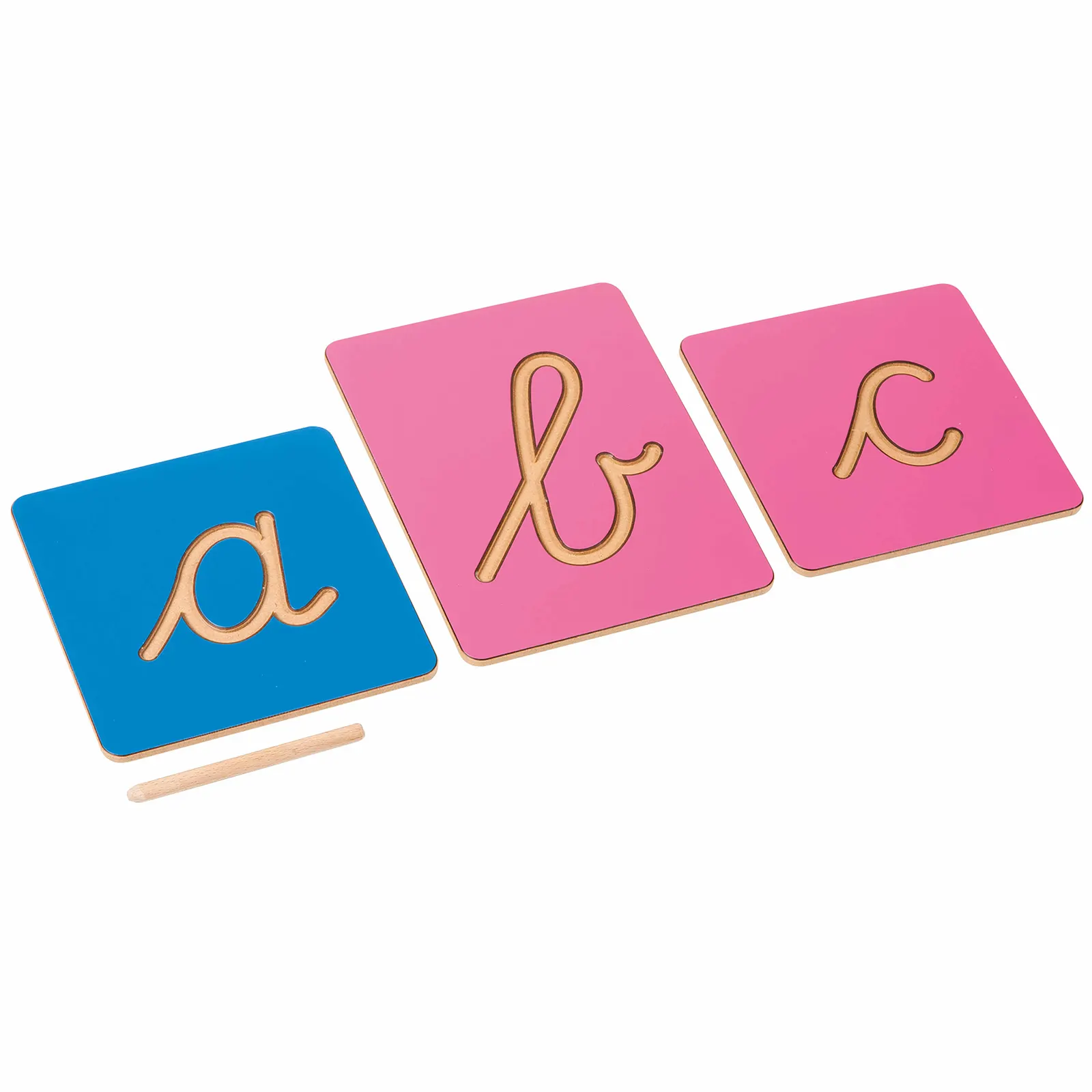
Hollow Letter Shapes, International Cursive give children a set of painted wooden letter outlines to trace with a writing tool, separating the two skills involved in handwriting: forming the correct letter shape and learning to control the instrument. By guiding a pencil around each hollow cursive letter, children ages 3 to 6 practice the precise, controlled movements that later carry over into writing on paper. It is a focused preparation step before children begin handwriting freely.
“Free the child's potential, and you will transform him into the world.”
The Hollow Letter Shapes for international cursive embody Maria Montessori's understanding that children learn writing through muscular memory before visual recognition.
- Develops muscle memory for international cursive letter formation
- Strengthens fine motor control and finger dexterity
- Establishes proper directionality and flow of cursive writing
- Builds connection between tactile sensation and letter shapes
Read More
These precisely routed wooden boards create a defined pathway for fingers to follow, establishing the flowing movements essential to cursive formation. The hollow grooves provide immediate tactile feedback when fingers stray from the correct path, allowing children to self-correct without adult intervention. By tracing within these carved channels, children develop the controlled hand movements necessary for fluid cursive writing. The pink and blue surfaces of the Hollow Letter Shapes connect directly to earlier work with sandpaper letters, creating a bridge between tactile exploration and actual writing. Unlike print letters that require lifting the pencil, these cursive boards teach the continuous flow that defines cursive script. The wooden construction ensures durability through thousands of tracings, while the smooth routed edges protect small fingers during repetitive practice.
How to present it
Follow the Montessori method of presentation for optimal child development.
Place the Hollow Letter Shapes on a table at child height. Select 3-4 boards beginning with letters the child knows from sandpaper letter work. Have a small tray nearby for completed boards.
- 1
Demonstrate tracing one letter slowly with your index and middle fingers together, starting at the correct point
Trace the letter three times while the child watches, emphasizing the smooth, continuous movement - 2
Invite the child to trace the same letter, watching as their fingers follow the groove
If fingers slip out of the groove, simply say 'let's start again' without correction - 3
Once comfortable, introduce the letter's sound while tracing
Say the phonetic sound, not the letter name, matching the child's sandpaper letter experience - 4
Progress to tracing with eyes closed to enhance muscle memory
This deepens the kinesthetic learning and reduces visual dependence - 5
When ready, offer chalk or pencil to trace the letter on paper immediately after finger tracing
Place paper directly next to the board to maintain the movement pattern
Every Child Is a Little Creator

Heritage
Since 1929

In classrooms
Around the world

European brands
Nienhuis, GAM, Educo

AMI approved
To the association standard
Hollow Letter Shapes: International Cursive
