
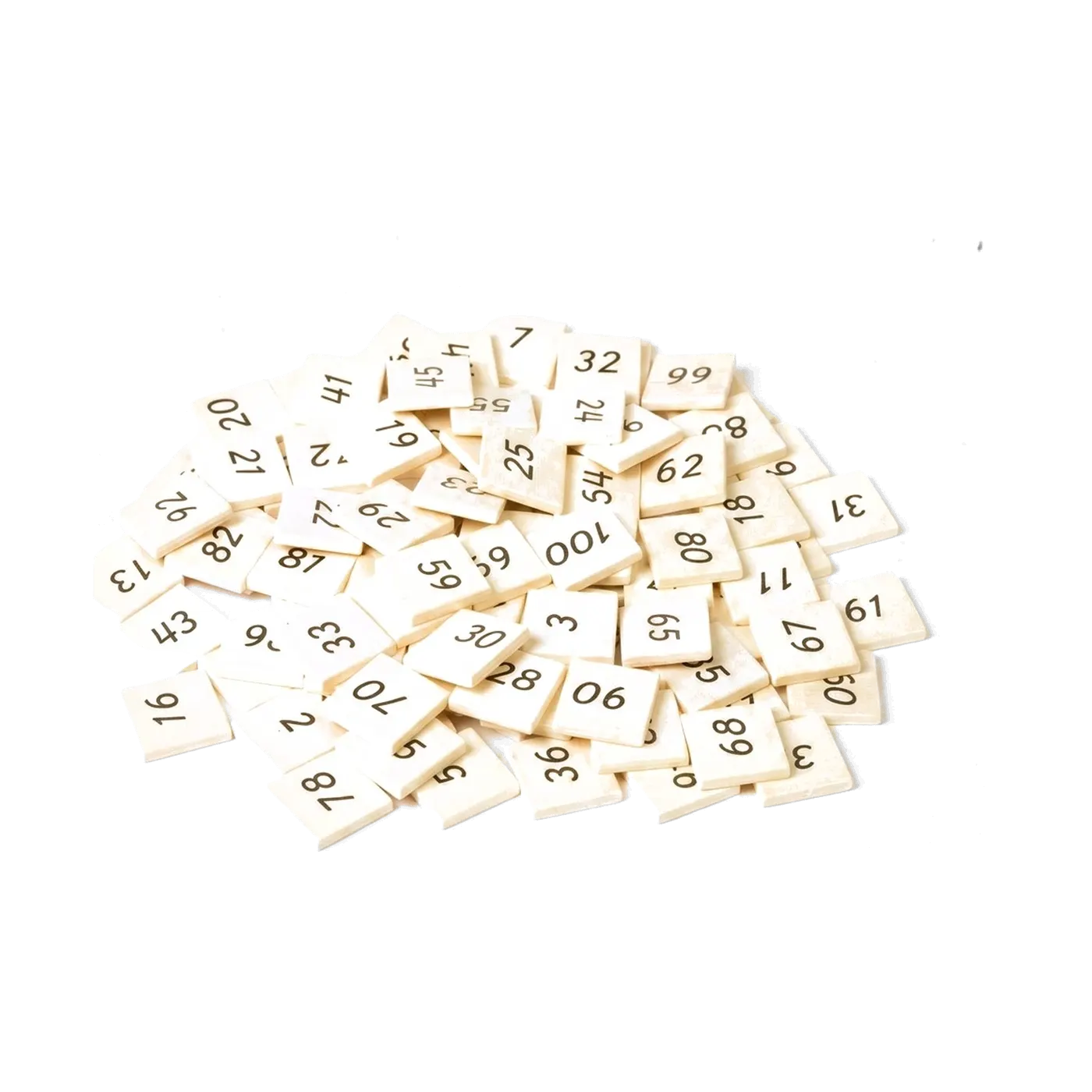
Hundred BoardNumber Sequencing
The first photo is the maker's own. The other shots are illustrative.
Inv. no. NIE-018000
- Maker
- Nienhuis Montessori, since 1929
- Approval
- AMI
- Board Frame
- Solid wood
- Grid Surface
- Laminated paper or cardboard
- EAN
- 8719924009694
€90.90
Final price incl. VAT. Delivery €5.90, €58.10 to go for free delivery.
✓ In Stock. Delivery in 5 to 9 working days.
1
30 daysto return
Advicebefore and after
Invoicefor companies
Advice, warranty and returns are handled by us.
The original
Why it costs €90.90
Behind the price of the original are things you can check yourself.
AMI approval
The material is approved by the Association Montessori Internationale (AMI). Nienhuis has made Montessori materials since 1929.
A verifiable original
The EAN 8719924009694 is on the box. It is the maker's number, not ours.
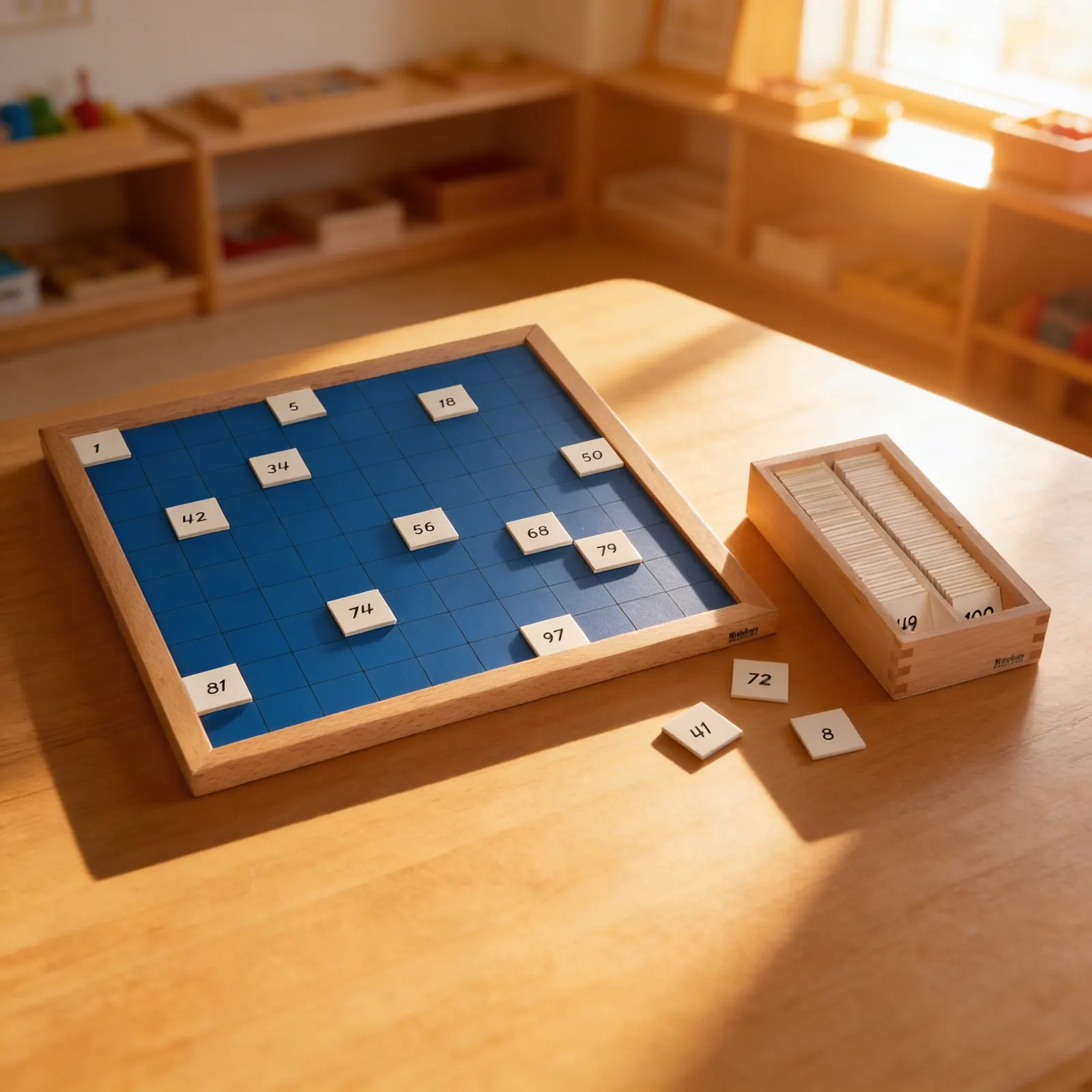
What the child does
Hundred Board in a child's hands
A wooden board printed with a hundred squares and a boxed set of chips numbered one to a hundred. The child fills the board in order, and the work is long enough that it usually spans several sittings, which is part of the point: a hundred is a quantity you have to commit to. Patterns start showing up unbidden around the fortieth chip, when a child notices the columns all end in the same digit. Wood with laminated paper, for ages 3 to 6.
Number Sequence Mastery
Building the hundred board reinforces counting skills and helps children internalize the base-ten system through hands-on placement of tiles.
Pattern Recognition
The visual grid layout reveals mathematical patterns including skip counting, multiples, and number relationships across rows and columns.
Concentration Development
Completing the hundred board requires sustained focus and systematic thinking, strengthening attention span and task persistence.
Mathematical Foundation
Prepares children for advanced concepts like addition, subtraction, and place value through concrete manipulation of numbers 1-100.
Activity Guide
How to present it
Place the wooden board on a work mat with the compartmented box of numbered tiles beside it. Ensure all tiles are facing up and organized in numerical order within the box compartments.
- 1Begin by placing tile 1 in the top left square of the grid
- 2Continue placing tiles sequentially, completing each row of 10
- 3When the board is complete, observe the vertical and horizontal patterns
- 4Remove specific tiles to create pattern exercises (every 5th tile, diagonal lines)
3 tips for parents
- Practice number recognition during everyday activities before introducing the full hundred board
- Start with smaller sections (1-20 or 1-50) if 100 tiles seem overwhelming
- Celebrate pattern discoveries rather than speed of completion
From the same maker
Spare parts
Why it is in our selection
If you are not sure it suits your child, we answer in person.
Norbert Kovalčín, founder of Faborino · write to him
There is no review here yet. We will ask you for one after you buy. Write the first review
Details
What's in the Box
- Hundred Board: Wooden frame with blue 10×10 grid
- Number Tiles: Complete set 1-100
- Storage Box: Wooden box with compartments
Size and material
| Packaging | 34 × 34 × 7 cm |
| Board Frame | Solid wood |
| Grid Surface | Laminated paper or cardboard |
| Number Tiles | Wood |
| Recommended Age | 3-6 years |
Care
Wipe with slightly damp cloth; avoid excess moisture on grid surface
Frequently Asked Questions
What skills does the Hundred Board develop in children?
The Hundred Board develops number recognition, counting skills, pattern recognition, and understanding of the decimal system. Children learn to sequence numbers 1-100, identify number relationships, skip count by 2s, 5s, and 10s, and develop a concrete understanding of place value and number order.
How do children use the Hundred Board in Montessori activities?
Children begin by placing numbered tiles in sequence on the grid, building from 1 to 100. They can practice filling in missing numbers, creating patterns, skip counting, and exploring mathematical relationships. Activities progress from simple sequencing to complex pattern work and mental math preparation.
What's included in the Hundred Board set?
The set includes a high-quality wooden board with a blue 10x10 grid, 100 individual numbered tiles (1-100), and a compartmented wooden storage box. The tiles fit perfectly into the grid squares, and the storage box keeps all pieces organized and easily accessible for repeated use.
Is the Hundred Board suitable for home use or just classrooms?
The Hundred Board is perfect for both home and classroom use. Its durable wooden construction and organized storage system make it ideal for daily use in any learning environment. Parents can easily guide activities at home using the same proven Montessori methods used in classrooms worldwide.
What age is most appropriate for introducing the Hundred Board?
While suitable for ages 3-6, most children are ready for the Hundred Board around age 4, after mastering numbers 1-20. The material grows with the child - younger children focus on sequencing and recognition, while older children explore advanced concepts like odd/even numbers, multiples, and number patterns.
Product safety
Manufacturer: Nienhuis Montessori, Anders Celsiusstraat 15, 7442 PB Nijverdal, Netherlands
Hundred Board
€90.90