
Igual, Mayor Que, Menor Que (Spanish Edition)
The first photo is the maker's own. The other shots are illustrative.
Inv. no. NIE-ECSP0315
- Maker
- Nienhuis Montessori, since 1929
- Primary Material
- Laminated cardstock
- Manipulatives
- Plastic counting beads
- EAN
- 8719924043377
Final price incl. VAT.
This material is no longer made
The manufacturer has withdrawn it, so we cannot order it in. The page stays here because the material itself is still worth knowing about.
Would you buy it if we could source it or make it ourselves? Enough people saying yes is what makes the attempt worth it.
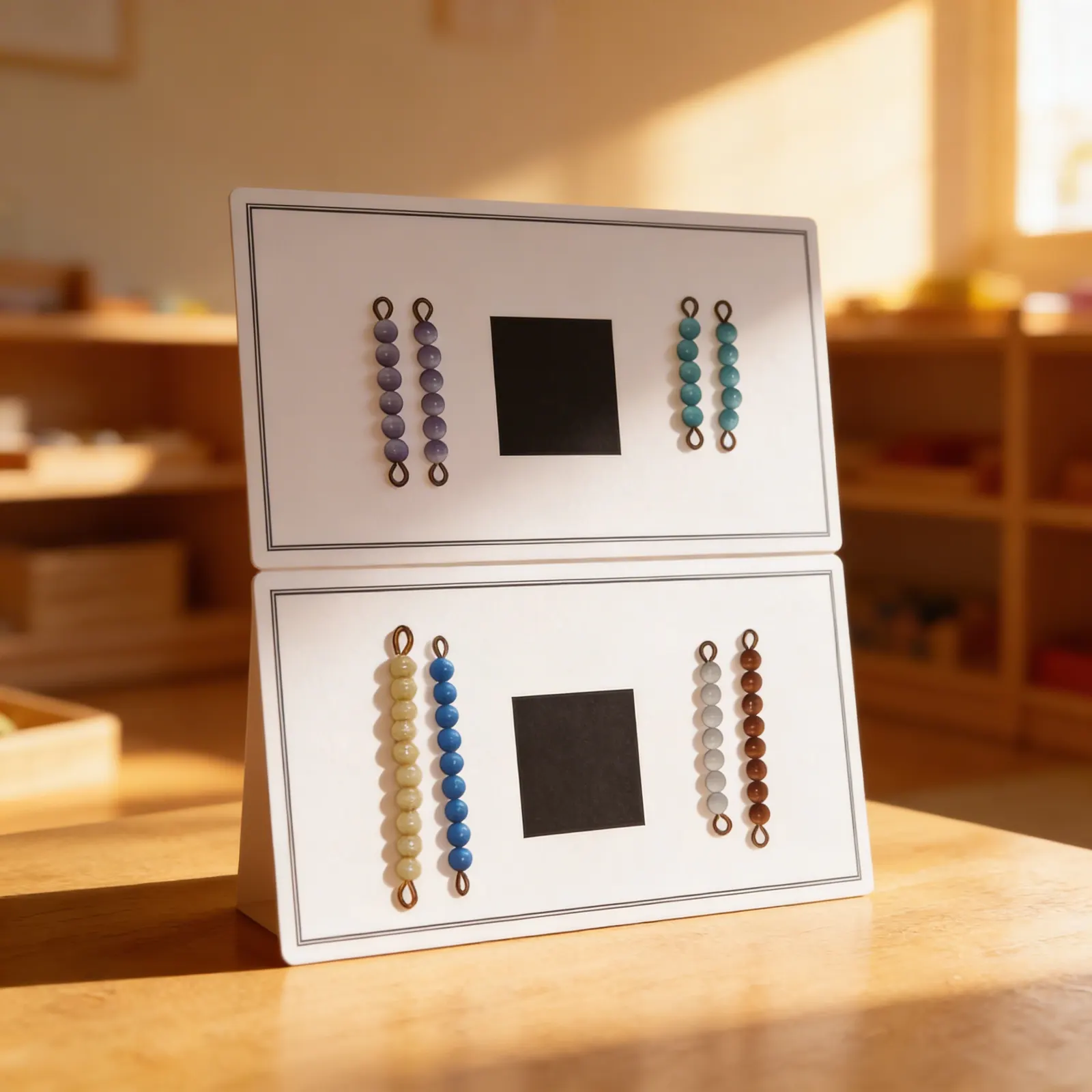
Igual, Mayor Que, Menor Que (Spanish Edition) in a child's hands
Igual, Mayor Que, Menor Que, the greater than and less than work in Spanish, using the teen numbers eleven to nineteen. The teens are the right place for this: they are the numbers a child has just learned to name and not yet learned to trust, so comparing them forces the naming to become knowledge. A greater than symbol is included to place between the pairs. The cards are in Spanish. Card stock, full colour.
Mathematical Reasoning
Develops understanding of quantity relationships and comparison symbols through visual representation.
Visual Discrimination
Strengthens ability to perceive differences in quantity through careful observation of bead arrangements.
Symbol Recognition
Introduces mathematical notation for greater than, less than, and equal to in meaningful contexts.
Bilingual Learning
Supports Spanish-speaking children in accessing mathematical concepts in their native language.
How to present it
Place the comparison cards on a mat or table. Have the symbol cards (>, <, =) available in a small basket. Ensure good lighting for clear visibility of bead quantities.
- 1Select one comparison card and examine the bead strings on both sides
- 2Count the beads on the left side, then count the beads on the right side
- 3Determine which side has more beads, fewer beads, or if they're equal
- 4Select the appropriate symbol card and place it in the empty box
- 5Read the complete mathematical statement aloud in Spanish
- 6Continue with remaining cards, creating a pattern of work
3 tips for parents
- Practice comparisons during daily life: 'Do you have more crackers or fewer crackers than your sister?'
- Support Spanish vocabulary even if you're not fluent - learn the three key terms together
- Create simple comparison games with household items like spoons or blocks

If you are not sure it suits your child, we answer in person.
Norbert Kovalčín, founder of Faborino · write to him
There is no review here yet. We will ask you for one after you buy. Write the first review
What's in the Box
- Comparison cards: Laminated with bead string illustrations
- Symbol placement cards: With empty boxes for practice
Size and material
| Packaging | 29 × 23 × 1 cm |
| Primary Material | Laminated cardstock |
| Manipulatives | Plastic counting beads |
| Recommended Age | 3-6 years |
Care
Wipe cards with damp cloth, dry immediately
Frequently Asked Questions
At what age can children start using these comparison cards?
These cards are designed for children ages 3-6, though children showing readiness for mathematical concepts around age 3 can begin with simple comparisons of 1-5 beads.
Do children need to know how to count before using this material?
While basic counting skills (1-10) are helpful, children can begin by visually comparing quantities without counting, naturally developing their understanding of more/less through the concrete bead representations.
What symbols are included with the cards?
The set includes the mathematical symbols for greater than (>), less than (<), and equal to (=), which children place in the empty box between the bead string images.
How many comparison cards are included in the set?
The set includes multiple cards featuring different bead string quantities, allowing for varied practice with numbers typically ranging from 1-20 beads per string.
Can this material be used by non-Spanish speaking children?
Yes, while the title is in Spanish, the mathematical symbols are universal and the visual nature of the bead comparisons makes this accessible to children regardless of language.
Product safety
Manufacturer: Nienhuis Montessori, Anders Celsiusstraat 15, 7442 PB Nijverdal, Netherlands
Igual, Mayor Que, Menor Que (Spanish Edition)