
Individual Glass Bead Bar Of 1Red
The first photo is the maker's own. The other shots are illustrative.
Inv. no. NIE-0090G001
- Maker
- Nienhuis Montessori, since 1929
- Approval
- AMI
- Bead
- Glass
- Wire
- Metal with protective coating
- EAN
- 8719924005238
Final price incl. VAT. Delivery €5.90, €145.80 to go for free delivery.
Advice, warranty and returns are handled by us.
Why it costs €3.20
Behind the price of the original are things you can check yourself.
AMI approval
The material is approved by the Association Montessori Internationale (AMI). Nienhuis has made Montessori materials since 1929.
A verifiable original
The EAN 8719924005238 is on the box. It is the maker's number, not ours.
Individual Glass Bead Bar Of 1 in a child's hands
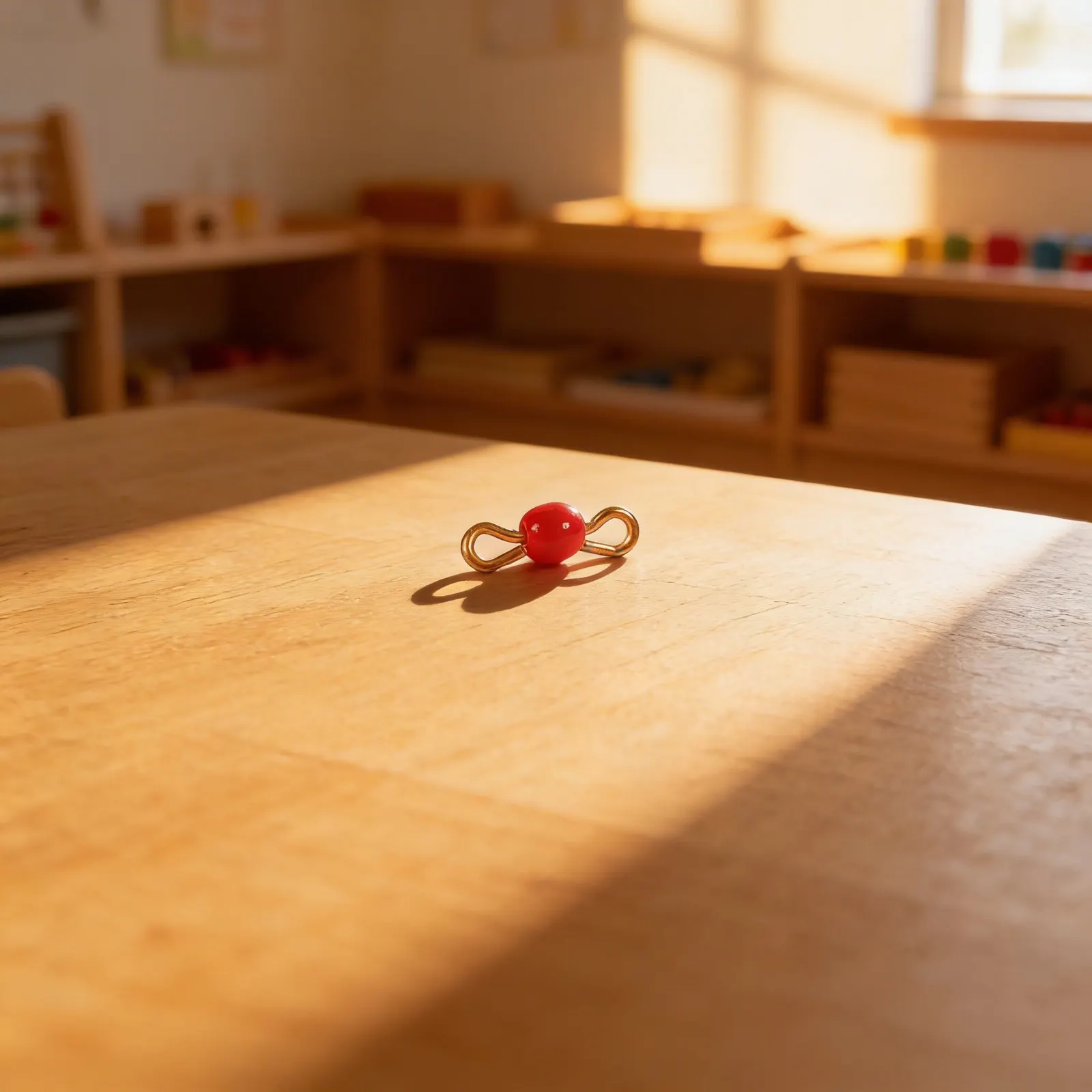
One glass bead bar of one in red, sold as a single piece. In the glass range a single bead still has the weight of glass, and that is the argument for it here: the bar of one is the unit everything else is measured against, and a unit that feels like nothing is easy to discount. Glass makes one bead worth picking up carefully. Red is one throughout the material. The nylon version is a separate item.
Number Concept Formation
Provides concrete representation of the unit, establishing the foundation for understanding our base-ten number system.
Mathematical Operations
Enables hands-on exploration of addition and subtraction through physical manipulation of quantities.
Sensorial Learning
The weight and feel of glass beads create memorable sensory impressions that support mathematical abstraction.
Fine Motor Precision
Handling individual beads refines pincer grasp and hand-eye coordination essential for later writing.
How to present it
Place a small tray containing several Individual Glass Bead Bars of 1 on a mat. Have the child wash their hands to enhance tactile sensitivity.
- 1Introduce the bead bar by holding it between thumb and index finger, saying 'This is one'
- 2Place the bead on the mat and count 'one' while touching it with your index finger
- 3Invite the child to hold the bead and repeat 'one'
- 4Practice forming different quantities using multiple unit beads
3 tips for parents
- Practice counting small objects at home (buttons, coins) to reinforce the concept of units
- When your child brings home work involving unit beads, ask them to teach you about 'one'
- Support careful handling by providing a small dish or tray for bead storage during work

If you are not sure it suits your child, we answer in person.
Norbert Kovalčín, founder of Faborino · write to him
There is no review here yet. We will ask you for one after you buy. Write the first review
What's in the Box
- Glass Bead Bar: Single red bead on wire (represents 1)
Size and material
| Packaging | 13 × 9 × 1 cm |
| Bead | Glass |
| Wire | Metal with protective coating |
| Recommended Age | 3-6 years |
Care
Wipe with damp cloth, handle with care to prevent breakage
Frequently Asked Questions
What is the purpose of the red glass bead bar of 1 in Montessori education?
The red glass bead bar of 1 represents the unit in the Montessori decimal system. It serves as the foundation for understanding place value, counting, and basic mathematical operations. Children use it to build numbers, learn addition and subtraction, and develop a concrete understanding of quantity before moving to abstract mathematical concepts.
How does this individual bead bar differ from the complete golden bead material set?
This is a single unit bead bar, while the complete golden bead material includes units (1), tens (10), hundreds (100), and thousands (1000). Individual bars are perfect for replacing lost pieces, extending existing materials, or creating specific mathematical exercises without purchasing a complete set.
What activities can children do with the glass bead bar of 1?
Children can use the unit bead for counting exercises, building numbers with other bead materials, learning odd and even concepts, performing addition and subtraction operations, and creating patterns. It's also used in combination with ten bars, hundred squares, and thousand cubes for place value work.
Why is the unit bead specifically red in color?
In the Montessori color-coding system, red represents units (1-9). This consistent color coding helps children visually distinguish between place values and creates a sensory association with numerical concepts. The red color for units is maintained throughout various Montessori math materials for continuity.
Is this bead bar compatible with other Montessori math materials?
Yes, this glass bead bar is designed to work seamlessly with all standard Montessori bead materials, including the golden bead material, bead chains, bead stairs, and the bead cabinet. The standardized size and wire construction ensure compatibility across different manufacturers' Montessori materials.
Product safety
Manufacturer: Nienhuis Montessori, Anders Celsiusstraat 15, 7442 PB Nijverdal, Netherlands
Individual Glass Bead Bar Of 1