
Individual Glass Bead Bar Of 3Pink
The first photo is the maker's own. The other shots are illustrative.
Inv. no. NIE-0090G003
- Maker
- Nienhuis Montessori, since 1929
- Approval
- AMI
- Beads
- Glass
- Wire
- Metal with looped ends
- EAN
- 8719924005252
Final price incl. VAT. Delivery €5.90, €145.10 to go for free delivery.
Advice, warranty and returns are handled by us.
Why it costs €3.90
Behind the price of the original are things you can check yourself.
AMI approval
The material is approved by the Association Montessori Internationale (AMI). Nienhuis has made Montessori materials since 1929.
A verifiable original
The EAN 8719924005252 is on the box. It is the maker's number, not ours.
Individual Glass Bead Bar Of 3 in a child's hands
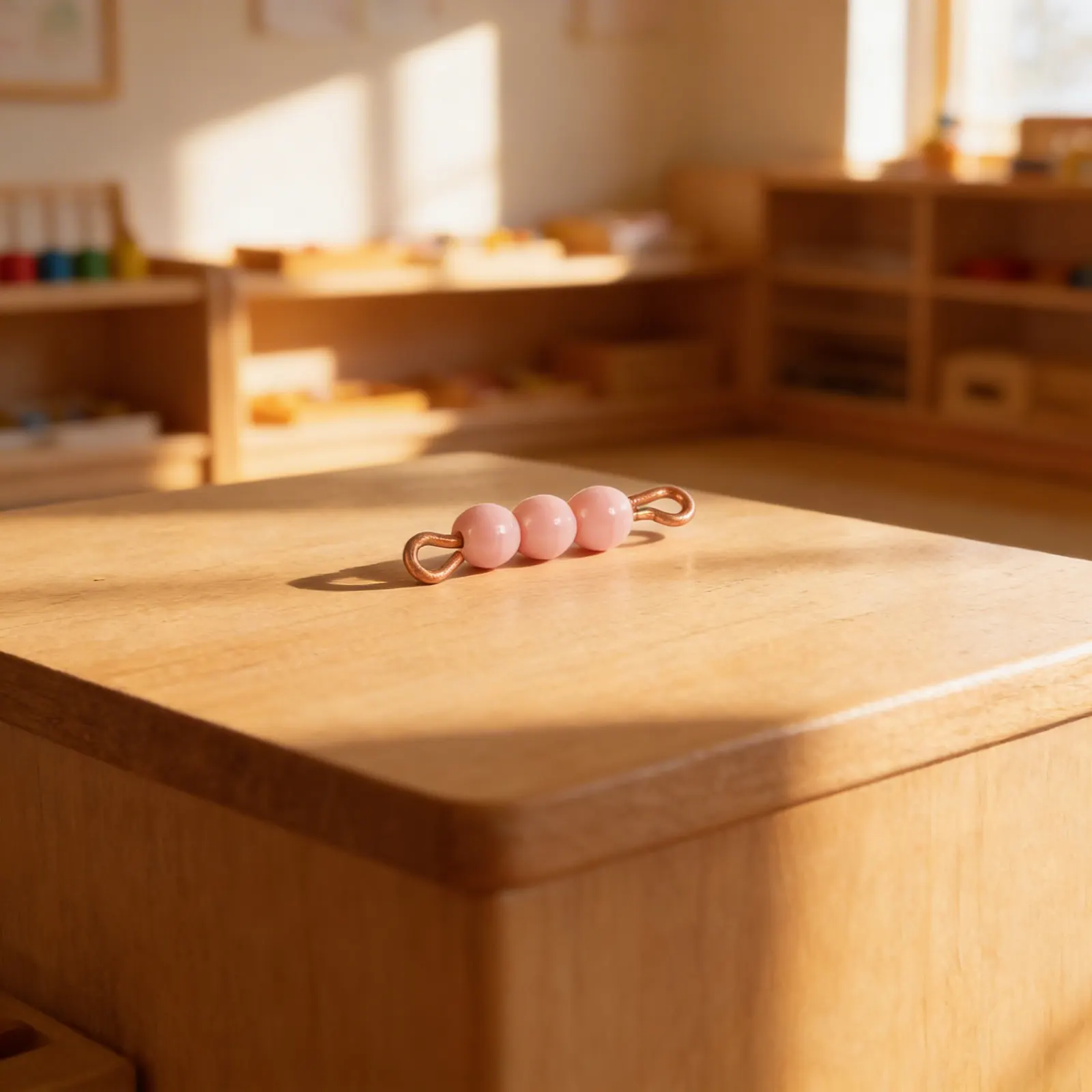
One glass bead bar of three in pink, sold as a single piece. The bead bars are the bead stair taken apart, and the short ones are the ones that go missing: a bar of three is small enough to be swept up with the crumbs and just long enough to be worth losing. Pink is three everywhere in the material, so the colour is how the bar is identified rather than by counting. Buy in the range you own; the nylon bars are separate items.
Concrete Number Sense
Children physically count and manipulate beads, building a sensorial understanding of quantity that forms the foundation for abstract mathematical thinking.
Visual Discrimination
The distinct pink color helps children identify and remember the quantity 3, supporting pattern recognition and the development of mathematical memory.
Fine Motor Coordination
Handling the bead bars and arranging them in various formations refines pincer grasp and hand-eye coordination essential for later writing.
Mathematical Relationships
Through combining bead bars, children discover number relationships, preparing for addition, skip counting, and early multiplication concepts.
How to present it
Place the glass bead bar on a small tray or mat. Have a cloth nearby for polishing the beads if needed.
- 1Invite the child to hold the bead bar, feeling its weight and texture
- 2Count each glass bead slowly, touching each one: 'One, two, three'
- 3Place the bar horizontally and run your finger along its length while saying 'three'
- 4Introduce the color association: 'This is the pink bar. Pink is three.'
3 tips for parents
- Practice finding groups of three objects at home to reinforce the quantity
- Reference the pink color when encountering three of something in daily life
- Handle the glass beads carefully, modeling respect for learning materials

If you are not sure it suits your child, we answer in person.
Norbert Kovalčín, founder of Faborino · write to him
There is no review here yet. We will ask you for one after you buy. Write the first review
What's in the Box
- Glass Bead Bar: Three pink beads on wire
Size and material
| Packaging | 13 × 9 × 0 cm |
| Beads | Glass |
| Wire | Metal with looped ends |
| Recommended Age | 3-6 years |
Care
Wipe gently with damp cloth; handle with care to prevent glass breakage
Frequently Asked Questions
What is the purpose of the pink 3-bead bar in Montessori mathematics?
The pink 3-bead bar helps children visualize and understand the quantity of three through hands-on manipulation. It's part of the bead stair material that introduces numbers 1-10, allowing children to physically experience quantities before moving to abstract number symbols.
How durable is the metal wire construction for classroom use?
The bead bar features sturdy metal wire with securely looped ends that withstand daily classroom handling. The wire is flexible enough for comfortable use while maintaining its shape, and the glass beads are firmly secured to prevent sliding or loss.
Can this bead bar be used independently or does it require the complete set?
While this individual bead bar can be used for specific lessons or replacements, it's most effective when used as part of the complete bead stair set (1-10) or with other mathematical materials. Individual bars are perfect for focused activities or replacing lost pieces.
What specific mathematical concepts can be taught with the 3-bead bar?
Children can explore counting to three, one-to-one correspondence, skip counting by 3s, simple addition combinations that equal 3, and comparing quantities. It's also used in the decimal system for building numbers and understanding place value.
Why is pink specifically used for the number 3 in Montessori?
Montessori materials use consistent color coding where each number 1-9 has a specific color. Pink represents 3 throughout all bead materials, helping children form strong visual associations between quantities and colors, supporting memory and pattern recognition.
Product safety
Manufacturer: Nienhuis Montessori, Anders Celsiusstraat 15, 7442 PB Nijverdal, Netherlands
Individual Glass Bead Bar Of 3