
Individual Glass Bead Square Of 4Yellow
The first photo is the maker's own. The other shots are illustrative.
Inv. no. NIE-0086G024
- Maker
- Nienhuis Montessori, since 1929
- Approval
- AMI
- Beads
- Glass
- Frame
- Metal wire
- EAN
- 8719924004866
Final price incl. VAT. Delivery €5.90, €139.70 to go for free delivery.
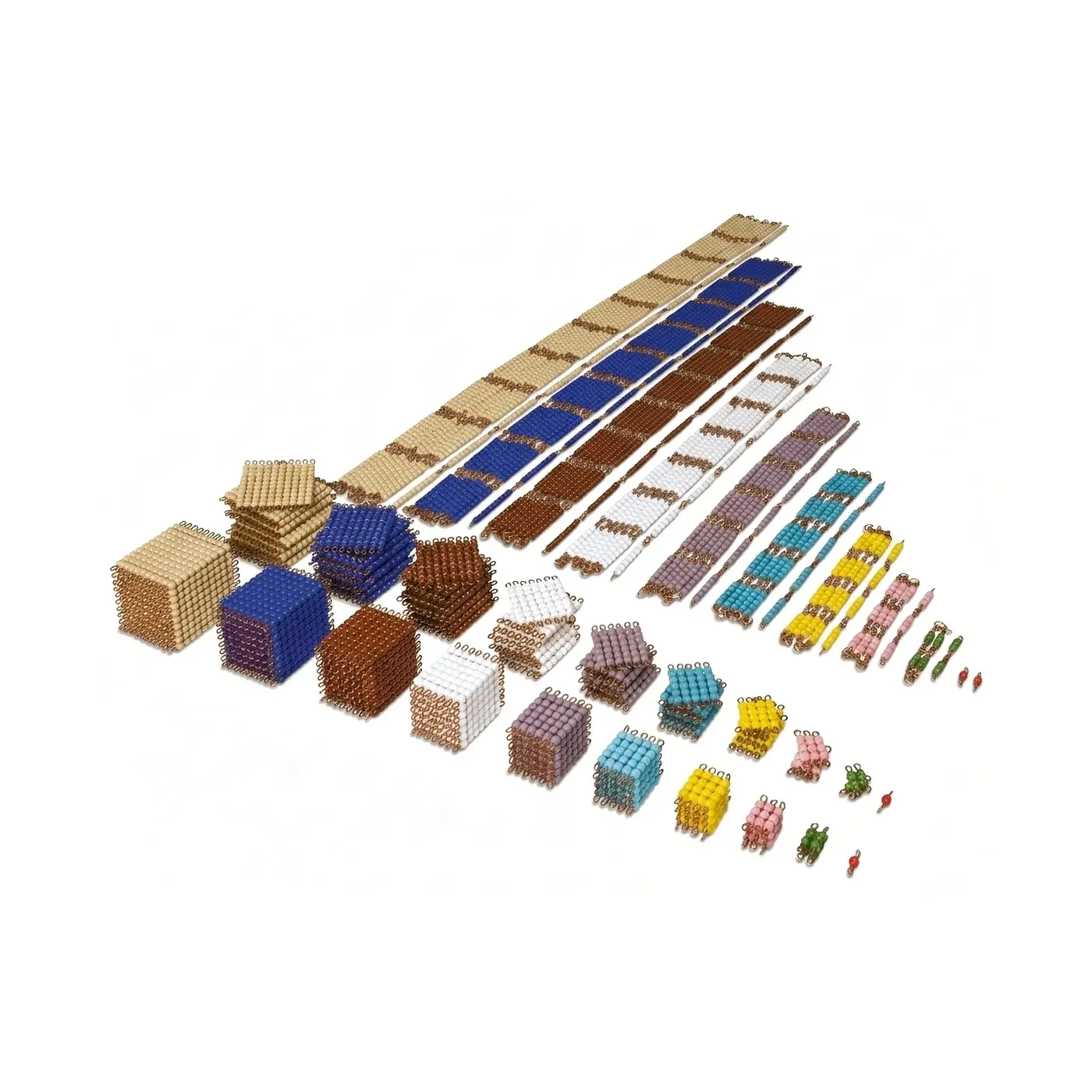 Individual Glass Beads €2,012.90
Advice, warranty and returns are handled by us.
Why it costs €9.30
Behind the price of the original are things you can check yourself.
AMI approval
The material is approved by the Association Montessori Internationale (AMI). Nienhuis has made Montessori materials since 1929.
A verifiable original
The EAN 8719924004866 is on the box. It is the maker's number, not ours.
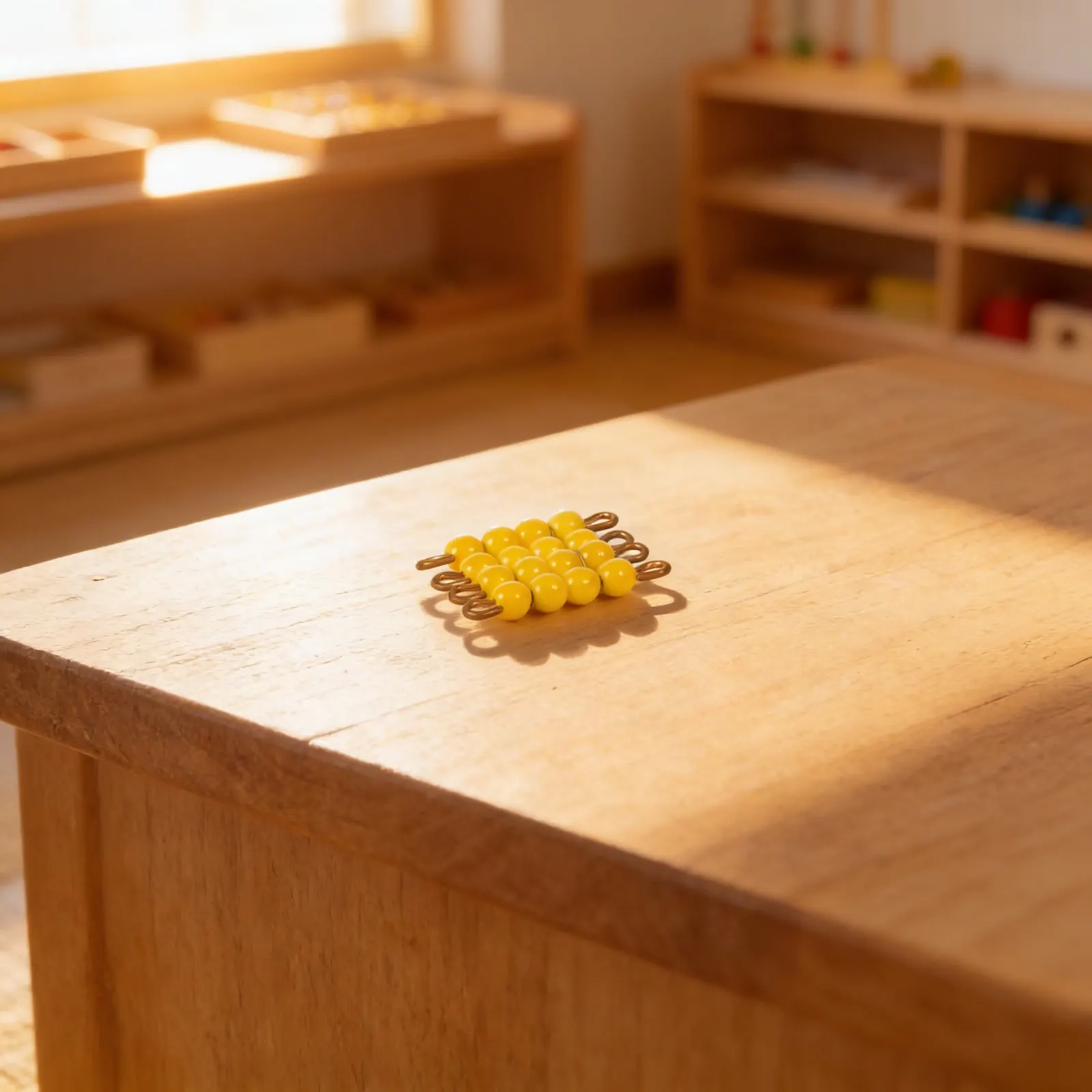
Individual Glass Bead Square Of 4 in a child's hands
Sixteen yellow glass beads on metal wire form this individual glass bead square of 4: four rows with four beads in each. It shows 4 × 4 = 16 as one flat piece that the child can pick up. The child can count the beads in a row, in a column and in the whole square. Four groups of four can be seen at once. Wipe the glass beads gently with a dry cloth and keep moisture away from the metal wire. It is one square, not a set. For ages 3 to 6.
Mathematical Abstraction
Bridges concrete counting to abstract understanding of squared numbers through visual and tactile exploration.
Pattern Recognition
Develops ability to recognize square formations and understand the relationship between linear and squared quantities.
Preparation for Algebra
Provides sensorial foundation for later algebraic concepts including area calculation and exponential relationships.
Fine Motor Refinement
Handling and counting individual beads strengthens pincer grip and hand-eye coordination.
How to present it
Place the glass bead square on a neutral work mat. Have paper and pencil available for older children who may wish to record their discoveries.
- 1Invite the child to count each bead individually, touching each one
- 2Count by rows: 'Four beads, four beads, four beads, four beads'
- 3Count by columns to verify the same pattern vertically
- 4Introduce the language: 'This is four squared' or 'four times four'
- 5Trace the outline of the entire square with your finger
3 tips for parents
- Look for square patterns in daily life: tiles, windows, or cookie arrangements to reinforce the concept
- When your child shows interest, count objects in groups of four at home
- Avoid rushing to written notation - let your child fully explore the concrete material first

If you are not sure it suits your child, we answer in person.
Norbert Kovalčín, founder of Faborino · write to him
There is no review here yet. We will ask you for one after you buy. Write the first review
What's in the Box
- Glass Bead Square: 4×4 configuration (16 beads total)
Size and material
| Packaging | 13 × 9 × 1 cm |
| Beads | Glass |
| Frame | Metal wire |
| Bead Color | Yellow |
| Recommended Age | 3-6 years |
Care
Wipe gently with dry cloth; avoid moisture on metal wires
Frequently Asked Questions
What mathematical concept does this yellow bead square teach?
This material teaches the concept of squaring numbers, specifically 4² = 16. Children can physically count and see that 4 taken 4 times equals 16 beads, providing a concrete understanding of multiplication and squared numbers.
How is this different from the complete bead chain materials?
This is an individual square representing 4², while bead chains show linear counting. The square format allows children to visualize the geometric representation of squaring, whereas chains focus on skip counting and multiplication facts.
What age is appropriate for introducing this material?
While suitable for ages 3-6, this material is typically introduced around age 4-5, after children have worked with the golden bead material and have a foundation in counting and quantity recognition.
How do the metal wires benefit the learning experience?
The parallel metal wires keep beads organized in the 4×4 formation, allowing children to clearly see rows and columns. This structure helps them understand that multiplication can be viewed both horizontally and vertically (4×4 or 4+4+4+4).
What other materials work well with this bead square?
This square coordinates with the complete bead chain materials, number rods, and golden beads. It also prepares children for more advanced work with the multiplication bead board and eventually abstract multiplication.
Product safety
Manufacturer: Nienhuis Montessori, Anders Celsiusstraat 15, 7442 PB Nijverdal, Netherlands
Individual Glass Bead Square Of 4