
Individual Glass Bead Square Of 7White
The first photo is the maker's own. The other shots are illustrative.
Inv. no. NIE-0086G027
- Maker
- Nienhuis Montessori, since 1929
- Approval
- AMI
- Beads
- White glass
- Wire
- Gold-colored metal
- EAN
- 8719924004897
Final price incl. VAT. Delivery €5.90, €132.10 to go for free delivery.
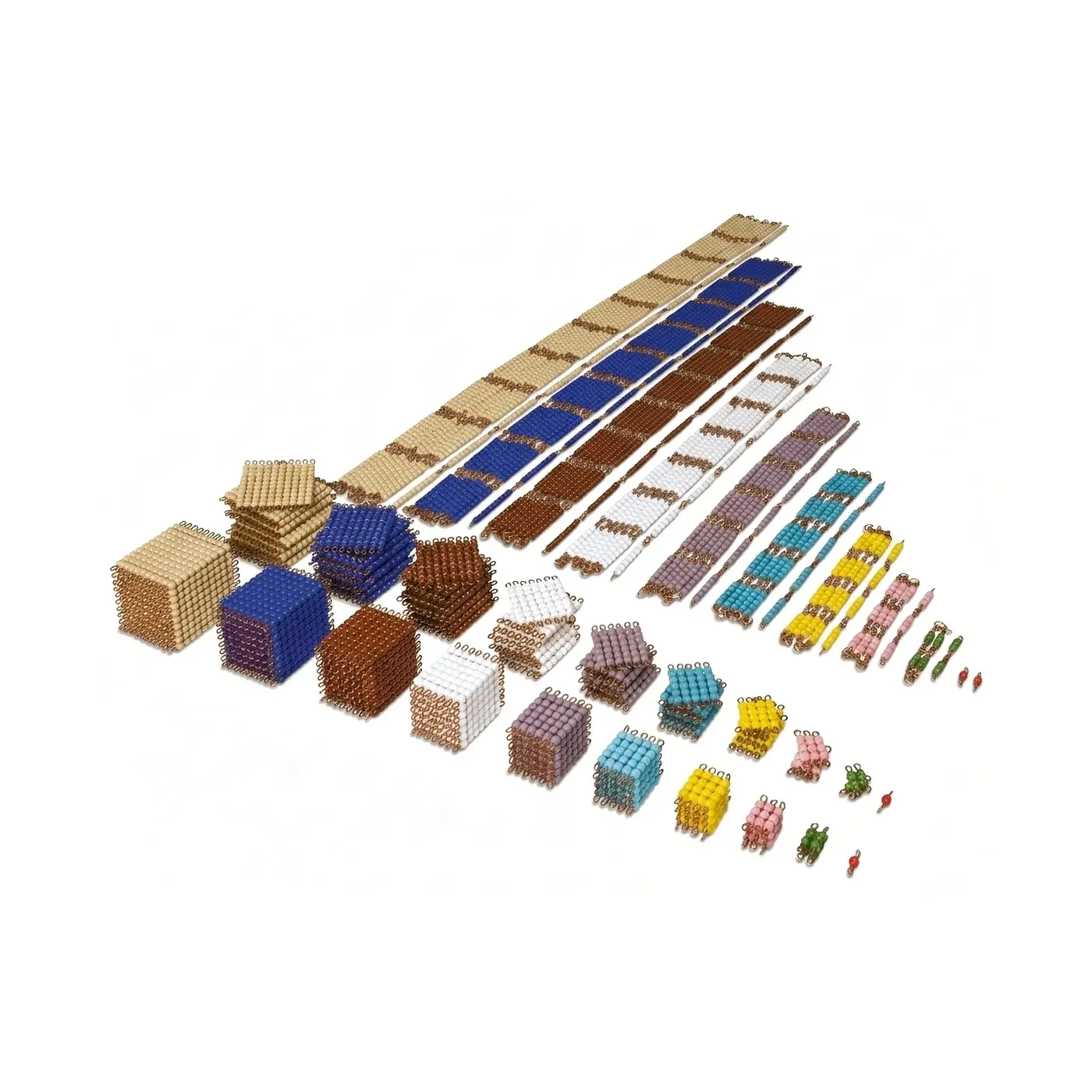 Individual Glass Beads €2,012.90
Advice, warranty and returns are handled by us.
Why it costs €16.90
Behind the price of the original are things you can check yourself.
AMI approval
The material is approved by the Association Montessori Internationale (AMI). Nienhuis has made Montessori materials since 1929.
A verifiable original
The EAN 8719924004897 is on the box. It is the maker's number, not ours.
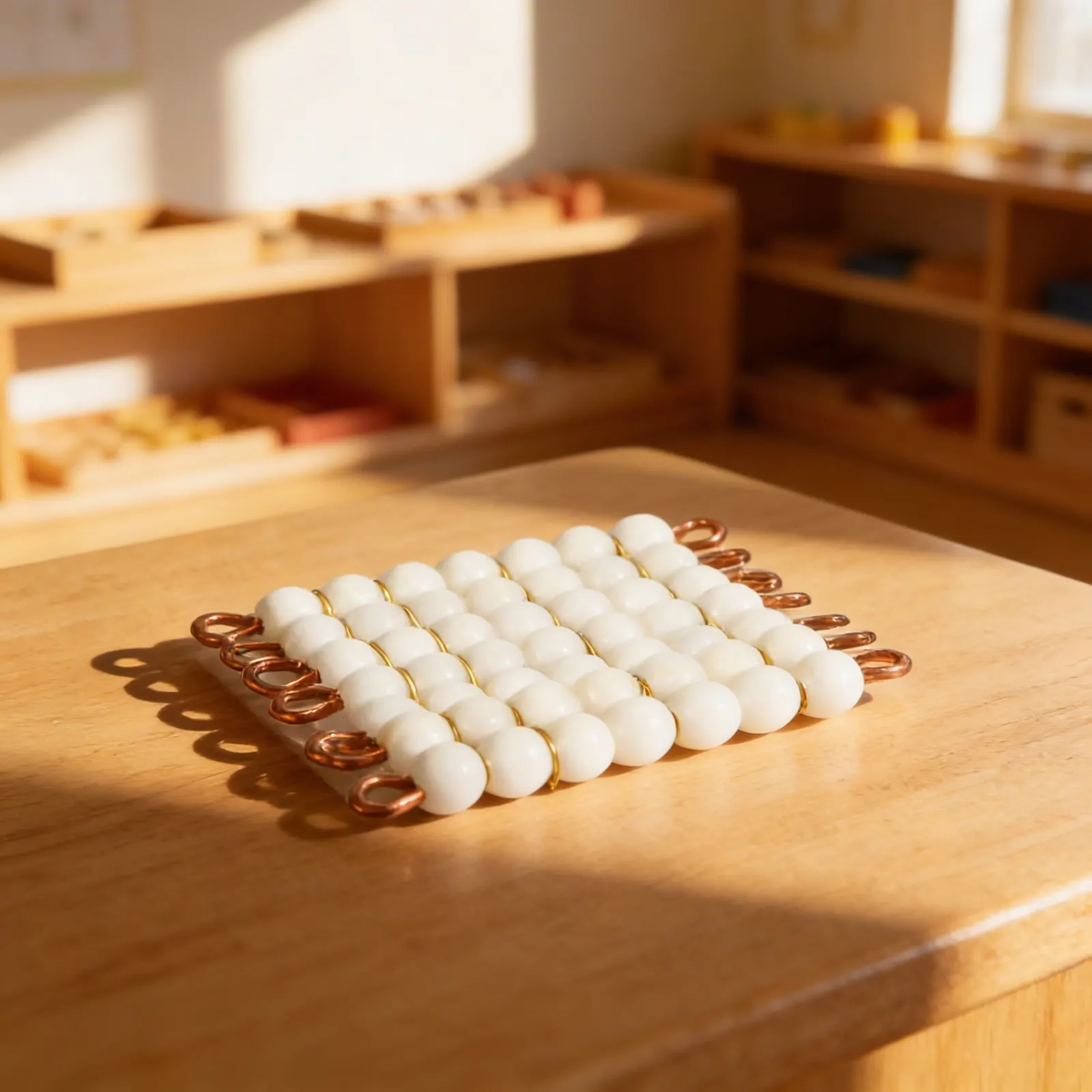
Individual Glass Bead Square Of 7 in a child's hands
A single square of seven: seven bead bars of seven wired flat into forty nine beads, in the white that stands for seven throughout the bead material. Seven is the one worth owning as an object. Every other table has a way in, doubling for two and four, fingers for five, the digits for nine, and seven has none, which is why a child who can recite most of the tables stalls on this one. Forty nine beads that can be counted along settle it. Sold individually. Glass beads on wire.
Mathematical Abstraction
Bridges concrete counting to abstract understanding of squaring and multiplication through visual and tactile experience.
Pattern Recognition
The square arrangement reveals mathematical patterns and relationships, supporting algebraic thinking development.
Sensorial Learning
The weight and texture of glass beads provide sensory feedback that reinforces numerical concepts.
How to present it
Place the glass bead square on a work mat. Have paper and pencil ready for recording discoveries.
- 1Invite the child to count each row of beads, verifying seven beads per row
- 2Count the number of rows, establishing seven rows total
- 3Calculate total beads by skip counting by sevens or direct counting
- 4Record the equation 7 × 7 = 49 or 7² = 49
3 tips for parents
- Create paper squares at home with 49 dots or stickers to reinforce the concept
- Look for square arrays in everyday life (tiles, windows) and count together
- Practice skip counting by 7s during daily activities like setting the table

If you are not sure it suits your child, we answer in person.
Norbert Kovalčín, founder of Faborino · write to him
There is no review here yet. We will ask you for one after you buy. Write the first review
What's in the Box
- Glass Bead Square of 7: 49 white beads in 7×7 arrangement
Size and material
| Packaging | 13 × 9 × 1 cm |
| Beads | White glass |
| Wire | Gold-colored metal |
| Recommended Age | 3-6 years |
Care
Gently wipe with dry cloth; avoid moisture
Frequently Asked Questions
What age group is this bead square appropriate for?
While listed for ages 3-6, the bead square of 7 is typically introduced around age 5-6 when children have mastered linear counting and are ready for skip counting and early multiplication concepts. It continues to be useful through elementary years for more advanced mathematical work.
How does this material help children understand the concept of squaring?
The square formation physically demonstrates that 7² equals 7 groups of 7 beads (49 total). Children can count by sevens while touching each row, seeing and feeling that squaring means multiplying a number by itself. The square shape provides a concrete, visual representation of this abstract concept.
What other mathematical concepts can be explored with this material?
Beyond squaring, children can explore skip counting by 7s, factors of 49, area concepts, commutative property of multiplication (7x7), and preparation for more complex algebraic thinking. It also supports work with the multiplication tables and can be used alongside other bead materials for operations.
Why are the beads white instead of colored like other Montessori bead materials?
In the Montessori system, white beads specifically represent the number 7. This color coding helps children instantly recognize quantities and builds visual memory for mathematical relationships. The consistent color system across all Montessori bead materials reinforces number recognition and mathematical patterns.
How does this individual square fit into the complete Montessori mathematics curriculum?
This bead square is part of the broader bead cabinet materials used for exploring powers of numbers. It works in sequence with bead chains, cubes, and other squares to build understanding of mathematical relationships. Children typically work with it after mastering the golden bead material and as they progress toward abstraction in mathematics.
Product safety
Manufacturer: Nienhuis Montessori, Anders Celsiusstraat 15, 7442 PB Nijverdal, Netherlands
Individual Glass Bead Square Of 7