
Individual Glass Bead Square Of 9Dark Blue
The first photo is the maker's own. The other shots are illustrative.
Inv. no. NIE-0086G029
- Maker
- Nienhuis Montessori, since 1929
- Approval
- AMI
- Beads
- Dark blue glass
- Structure
- Metal wire with looped ends
- EAN
- 8719924004910
Final price incl. VAT. Delivery €5.90, €120.10 to go for free delivery.
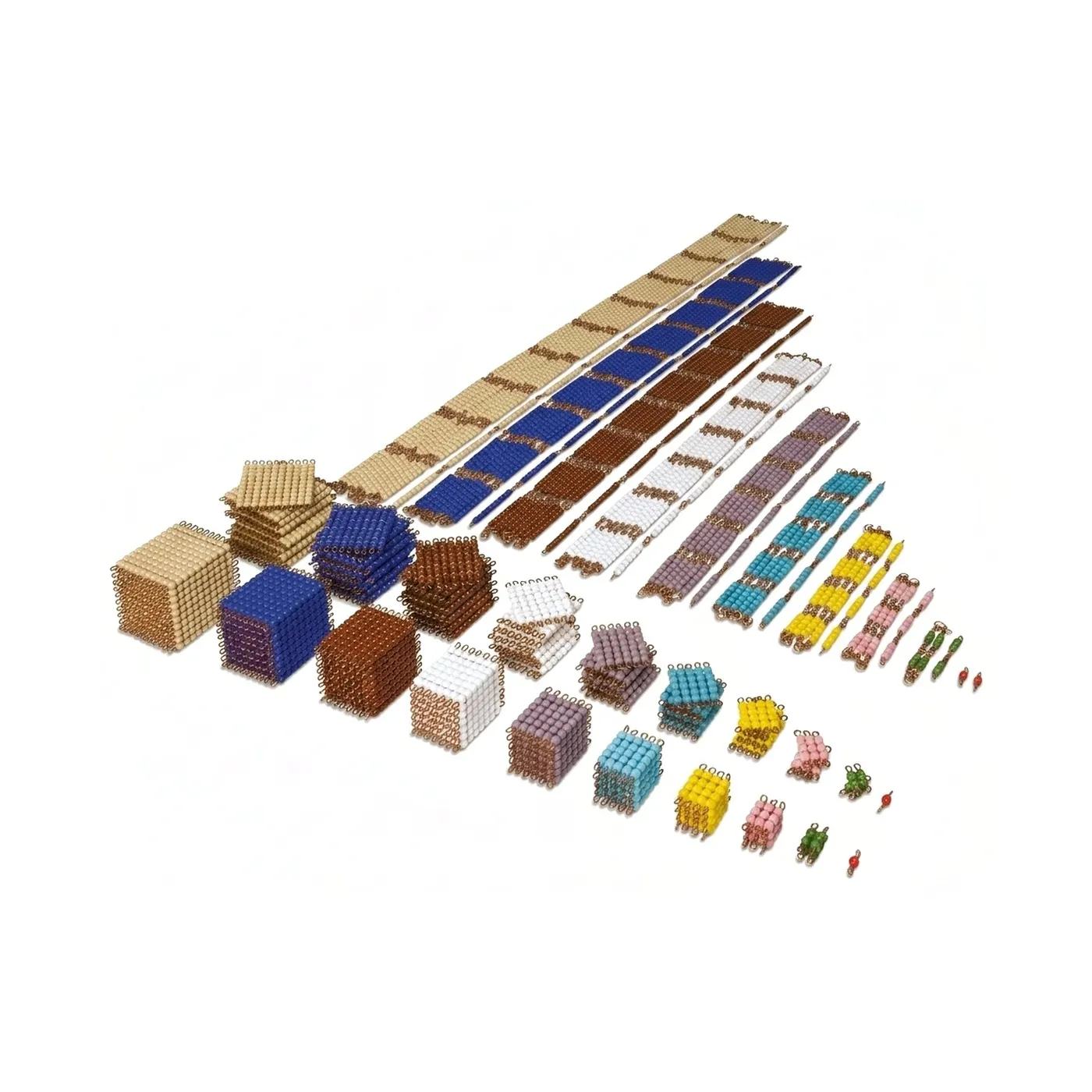 Individual Glass Beads €2,012.90
Advice, warranty and returns are handled by us.
Why it costs €28.90
Behind the price of the original are things you can check yourself.
AMI approval
The material is approved by the Association Montessori Internationale (AMI). Nienhuis has made Montessori materials since 1929.
A verifiable original
The EAN 8719924004910 is on the box. It is the maker's number, not ours.
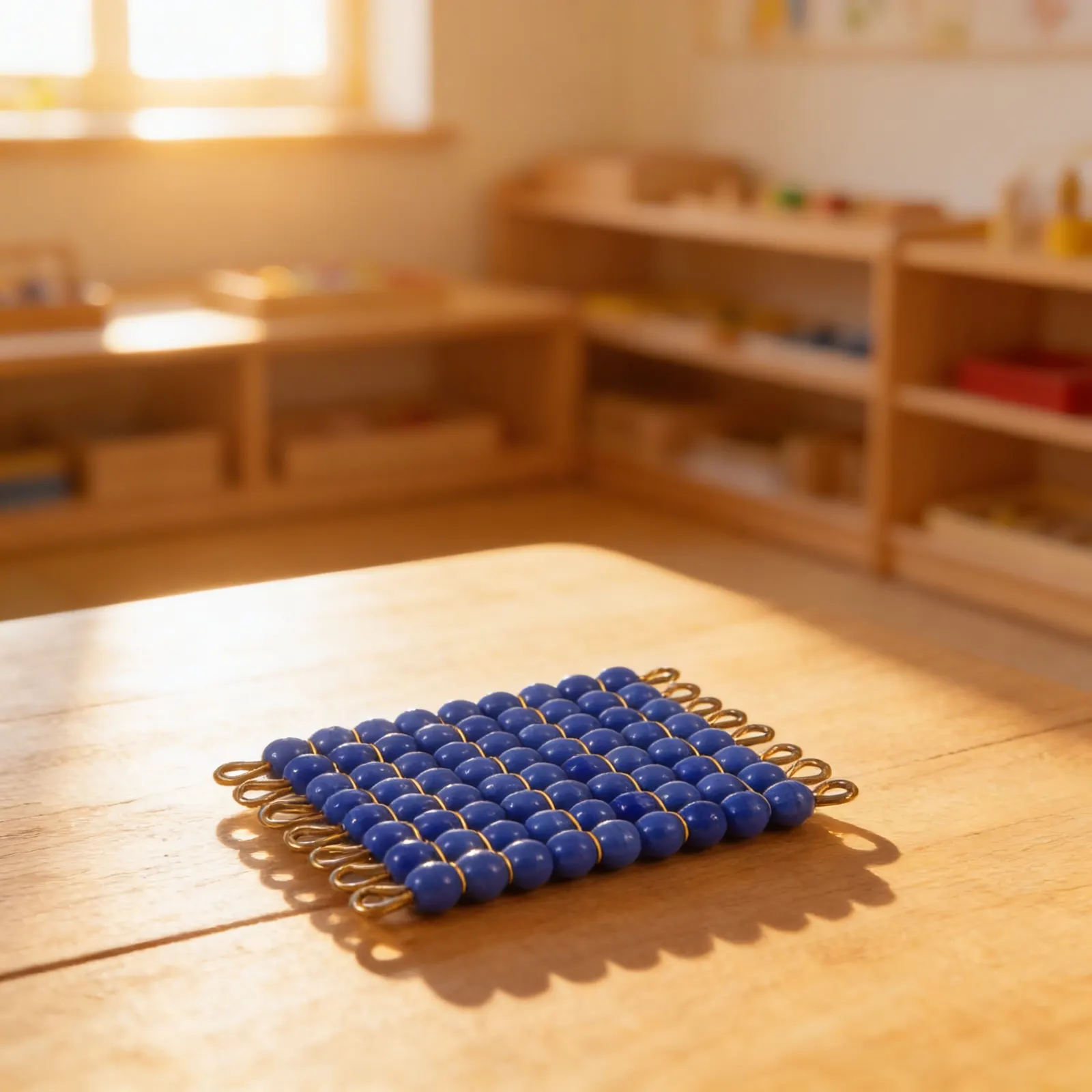
Individual Glass Bead Square Of 9 in a child's hands
A standalone component for targeted work, this individual Glass Bead Square of 9 features 81 precision-arranged dark blue glass beads forming a perfect 9x9 grid, essential for concrete mathematical exploration. The beads are securely strung on metal wire with looped edges, providing a tactile representation of squared numbers that bridges sensorial experience with abstract mathematical concepts in the Montessori mathematics curriculum.
Mathematical Understanding
Provides concrete representation of 9² = 81, supporting comprehension of squared numbers through visual and tactile exploration.
Skip Counting Skills
Enables practice counting by 9s and understanding multiplication through hands-on manipulation of grouped quantities.
Pattern Recognition
The square arrangement helps children visualize geometric patterns and relationships between linear and squared numbers.
Fine Motor Coordination
Handling and counting individual beads refines pincer grip and deliberate hand movements essential for later writing.
How to present it
Place the glass bead square on a neutral-colored mat. Have the child wash hands to protect the glass beads. Ensure good lighting to see the bead arrangement clearly.
- 1Introduce the square by having the child carry it carefully with both hands to the work mat
- 2Count the beads along one edge together: 'one, two, three... nine'
- 3Show how to verify the square by counting rows: '9 beads, 9 times makes 81'
- 4Demonstrate skip counting by 9s using the rows: 9, 18, 27, 36, 45, 54, 63, 72, 81
- 5Allow free exploration, encouraging the child to discover patterns within the square
3 tips for parents
- When your child mentions this work, ask them to draw the square shape and explain why it's called a square
- Connect to real-life squares: floor tiles, window panes, or checkerboards to reinforce the concept
- Avoid pushing memorization of 9² = 81; let understanding develop through repeated handling

If you are not sure it suits your child, we answer in person.
Norbert Kovalčín, founder of Faborino · write to him
There is no review here yet. We will ask you for one after you buy. Write the first review
What's in the Box
- Glass Bead Square of 9: 81 beads in 9x9 arrangement
Size and material
| Packaging | 13 × 9 × 1 cm |
| Beads | Dark blue glass |
| Structure | Metal wire with looped ends |
| Recommended Age | 3-6 years |
Care
Wipe gently with soft, dry cloth; handle with care to maintain wire shape
Frequently Asked Questions
What mathematical concepts does the Glass Bead Square of 9 teach?
This material introduces the concept of squaring numbers (9²=81), skip counting by 9s, and provides a concrete representation of multiplication. It helps children understand that a square number represents a number multiplied by itself through visual and tactile exploration.
How is this material used in the Montessori classroom?
Children count the beads individually and in rows, discovering that 9x9 equals 81. They use it alongside bead chains to compare linear and squared quantities, and as part of the complete bead chain cabinet work to understand mathematical relationships and patterns.
What is the recommended age range for this material?
The Glass Bead Square of 9 is designed for children ages 3-6 years, though it's typically introduced around age 4-5 when children have experience with linear counting and are ready to explore squared numbers and more complex mathematical concepts.
How does this differ from the bead chain of 9?
While the bead chain of 9 shows linear counting (nine groups of 9 beads in a line totaling 81), the bead square arranges the same 81 beads in a 9x9 grid format. This demonstrates how the same quantity can be represented differently and introduces the geometric concept of squaring.
What skills does working with this material develop?
This material develops mathematical reasoning, visual discrimination, understanding of squared numbers, preparation for more advanced multiplication, spatial awareness, and the ability to recognize patterns. It also strengthens concentration and provides sensorial preparation for abstract mathematical thinking.
Product safety
Manufacturer: Nienhuis Montessori, Anders Celsiusstraat 15, 7442 PB Nijverdal, Netherlands
Individual Glass Bead Square Of 9