
Individual Nylon Bead Bar Of 1Red
The first photo is the maker's own. The other shots are illustrative.
Inv. no. NIE-0090M001
- Maker
- Nienhuis Montessori, since 1929
- Approval
- AMI
- Bead Material
- Nylon
- Wire Material
- Metal with loop ends
- EAN
- 8719924005320
Final price incl. VAT. Delivery €5.90, €146.70 to go for free delivery.
Advice, warranty and returns are handled by us.
Why it costs €2.30
Behind the price of the original are things you can check yourself.
AMI approval
The material is approved by the Association Montessori Internationale (AMI). Nienhuis has made Montessori materials since 1929.
A verifiable original
The EAN 8719924005320 is on the box. It is the maker's number, not ours.
Individual Nylon Bead Bar Of 1 in a child's hands
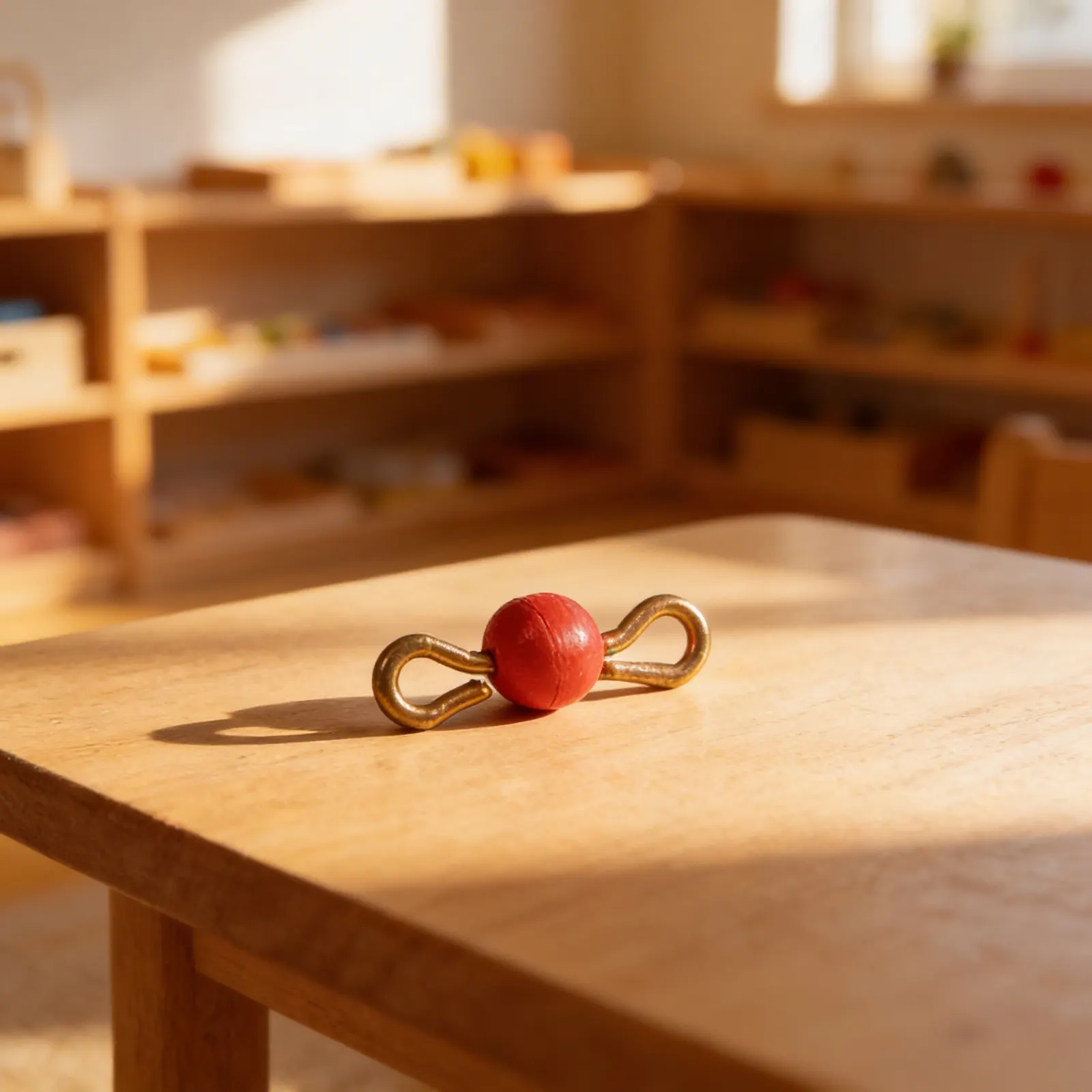
One nylon bead bar of one in red, sold as a single piece. A bar of one is a single bead on a wire, and it is the piece that makes the stair a stair: without it the series starts at two and the child never sees that one is the same kind of thing as nine, only shorter. It is also the smallest object in the material and the one that ends up in a pocket. Red is one throughout. The glass version is a separate item.
Number Concept Formation
Provides concrete representation of the unit, establishing the foundation for understanding quantity and the decimal system.
Mathematical Operations
Enables hands-on exploration of addition, subtraction, and skip counting through physical manipulation.
Visual Discrimination
Red color coding helps children instantly recognize units, supporting pattern recognition and mathematical relationships.
Fine Motor Control
Handling and linking individual beads refines pincer grasp and hand-eye coordination essential for later writing.
How to present it
Place the red bead bar on a small tray or mat. Have a basket of additional unit beads available for counting activities. Ensure good lighting to highlight the red color.
- 1Introduce the bead bar by holding it between thumb and index finger, saying 'This is one'
- 2Invite the child to hold the bead bar and repeat 'one' while touching the red bead
- 3Place the bead bar on the mat and count by touching: 'One'
- 4Demonstrate making quantities by adding more unit beads: 'One, and one more makes two'
3 tips for parents
- Practice counting single objects at home: 'one apple,' 'one spoon' to reinforce the unit concept
- Let your child count out items for daily tasks: 'Please bring me one napkin'
- Point out the number 1 in your environment: house numbers, clocks, books

If you are not sure it suits your child, we answer in person.
Norbert Kovalčín, founder of Faborino · write to him
There is no review here yet. We will ask you for one after you buy. Write the first review
What's in the Box
- Red Bead Bar: Single unit (1) representation
Size and material
| Packaging | 13 × 9 × 1 cm |
| Bead Material | Nylon |
| Wire Material | Metal with loop ends |
| Recommended Age | 3-6 years |
Care
Wipe with damp cloth; air dry completely
Frequently Asked Questions
What is the purpose of the red bead bar of 1 in Montessori mathematics?
The red bead bar of 1 represents the unit in the Montessori decimal system. It serves as the foundation for understanding quantity, counting, and place value, and is used in numerous mathematical activities including the introduction to the decimal system, addition, subtraction, and skip counting.
How durable is this individual nylon bead bar?
This bead bar features a high-quality nylon bead mounted on sturdy metal wire, designed to withstand repeated handling by young children. The materials are specifically chosen for their durability in classroom settings where the manipulatives are used daily for mathematical exploration.
Can I purchase multiple bead bars of 1 for classroom activities?
Yes, individual bead bars can be purchased separately to supplement existing bead materials or to create specific quantities needed for particular lessons. Many teachers purchase extras for activities requiring multiple units or for replacement purposes.
What age is appropriate for introducing the bead bar of 1?
Children can begin working with the bead bar of 1 as early as age 3, typically after they have worked with the number rods and sandpaper numerals. The concrete nature of the bead makes it ideal for young children who are in the sensitive period for order and small objects.
How does this bead bar differ from the complete bead stair set?
This is a single bead bar of 1 sold individually, while the complete bead stair includes bars from 1-10 in different colors. Individual bars are useful for replacing lost pieces, creating larger quantities for advanced work, or for specific activities that require multiple units.
Product safety
Manufacturer: Nienhuis Montessori, Anders Celsiusstraat 15, 7442 PB Nijverdal, Netherlands
Individual Nylon Bead Bar Of 1