
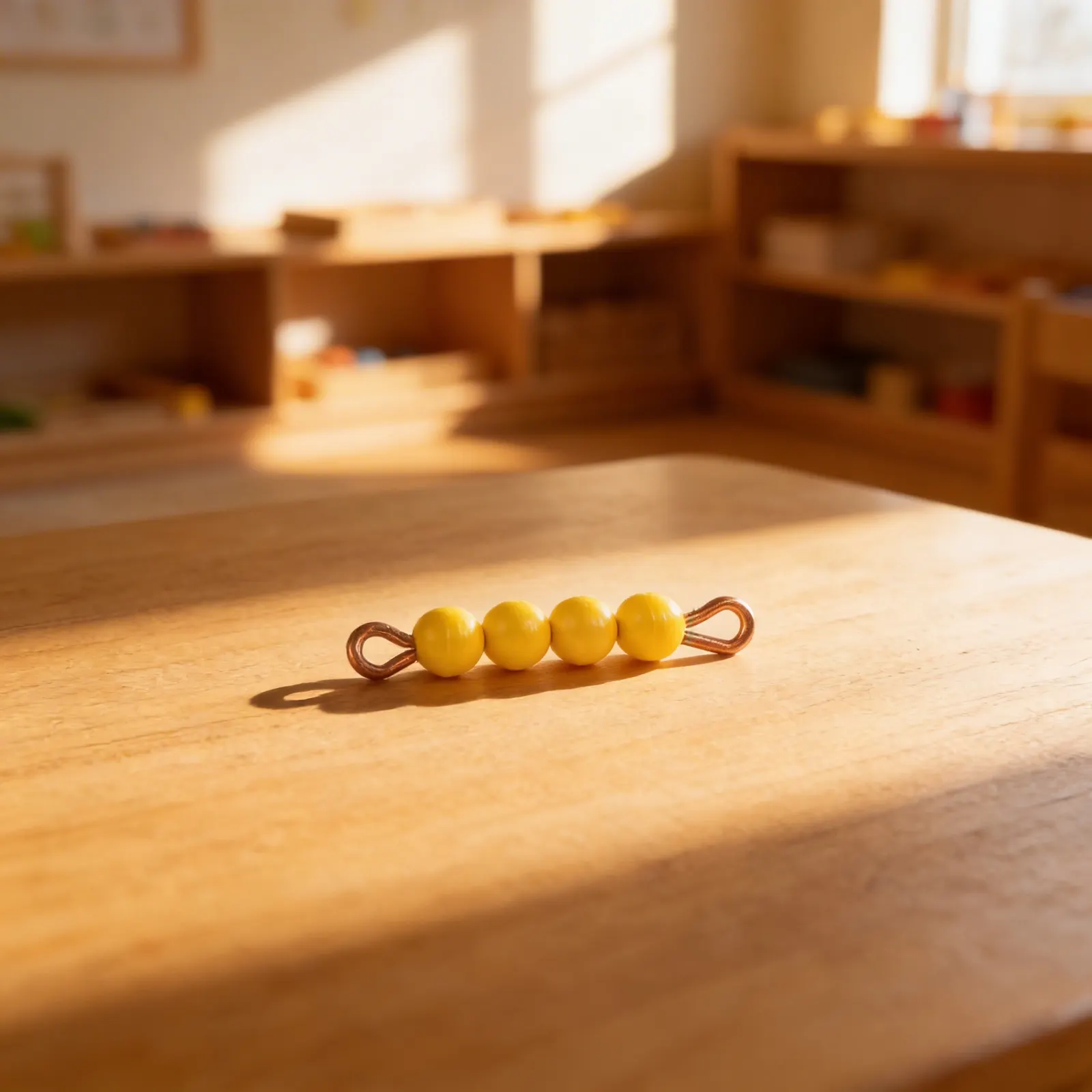
Individual Nylon Bead Bar Of 4Yellow
The first photo is the maker's own. The other shots are illustrative.
Inv. no. NIE-0090M004
- Maker
- Nienhuis Montessori, since 1929
- Approval
- AMI
- Beads
- Plastic
- Wire
- Metal with copper finish
- EAN
- 8719924005351
Final price incl. VAT. Delivery €5.90, €145.80 to go for free delivery.
Advice, warranty and returns are handled by us.
Why it costs €3.20
Behind the price of the original are things you can check yourself.
AMI approval
The material is approved by the Association Montessori Internationale (AMI). Nienhuis has made Montessori materials since 1929.
A verifiable original
The EAN 8719924005351 is on the box. It is the maker's number, not ours.
Individual Nylon Bead Bar Of 4 in a child's hands
One nylon bead bar of four in yellow, sold as a single piece. Four is the bar that gets used for doubling: two fours are eight, and a child can lay one against the eight bar and see it rather than take it on trust. That comparison is the beginning of multiplication, done with two objects and no writing. Yellow is four throughout the material. The glass version is a separate item.
Mathematical Understanding
Provides concrete representation of the quantity 4, supporting the transition from concrete to abstract numerical concepts.
Skip Counting Skills
Enables hands-on practice of counting by fours, laying foundation for multiplication tables.
Visual Discrimination
Color-coded yellow beads help children quickly identify and work with groups of four.
Fine Motor Control
Handling and arranging bead bars develops pincer grip and hand coordination.
How to present it
Place the bead bar of 4 on a felt mat. Have additional four-bars available in a small basket if doing skip counting or multiplication work.
- 1Invite the child to count each bead by touching them individually with their index finger, moving from left to right
- 2Place the bar horizontally and count again, then turn it vertically and count once more
- 3For skip counting, lay out multiple four-bars end to end and count: 4, 8, 12, 16
- 4Create simple multiplication layouts by arranging four-bars in rows to show 2x4, 3x4, etc.
3 tips for parents
- Point out groups of four in daily life (chair legs, car wheels) to reinforce the quantity
- Practice skip counting by 4s during routine activities like climbing stairs
- Create simple patterns with household items in groups of four to extend the concept

If you are not sure it suits your child, we answer in person.
Norbert Kovalčín, founder of Faborino · write to him
There is no review here yet. We will ask you for one after you buy. Write the first review
What's in the Box
- Individual Bead Bar: 4 yellow beads on wire
Size and material
| Packaging | 13 × 9 × 1 cm |
| Beads | Plastic |
| Wire | Metal with copper finish |
| Recommended Age | 3-6 years |
Care
Wipe with damp cloth, dry immediately
Frequently Asked Questions
What makes the yellow color significant for the bead bar of 4?
In the Montessori color-coding system, yellow consistently represents the number 4 across all mathematical materials. This color consistency helps children instantly recognize and work with the quantity 4, reinforcing number recognition and building strong associations between color and quantity.
How do children use this individual bead bar in Montessori math activities?
Children use the bead bar of 4 for skip counting by 4s, building multiplication tables (4x1, 4x2, etc.), creating number combinations that equal 4, and as part of larger decimal system work. It's also used in the bead chains, squares, and cubes for advanced counting and squaring exercises.
Why are the beads on copper-colored wire instead of string?
The copper-colored wire keeps the beads rigid and properly spaced, allowing children to clearly see and count each individual bead. The wire also makes the bars durable enough for repeated handling and enables them to lay flat for accurate counting and arrangement in mathematical layouts.
Can this bead bar be used with other Montessori math materials?
Yes, this bead bar integrates seamlessly with the complete Montessori math curriculum including the bead chains, hundred board, addition strip board, multiplication board, and the bank game. It's designed to work with all colored bead bars 1-10 for comprehensive number work.
What age-appropriate activities can a 3-year-old do with this material?
Three-year-olds can begin by simply counting the four beads, matching the bar to the numeral 4, using it for basic one-to-one correspondence activities, and incorporating it into simple addition exercises like 2+2=4. As they develop, they'll use it for more complex mathematical concepts.
Product safety
Manufacturer: Nienhuis Montessori, Anders Celsiusstraat 15, 7442 PB Nijverdal, Netherlands
Individual Nylon Bead Bar Of 4