
Individual Nylon Bead Bar Of 8Brown
The first photo is the maker's own. The other shots are illustrative.
Inv. no. NIE-0090M008
- Maker
- Nienhuis Montessori, since 1929
- Approval
- AMI
- Beads
- Nylon
- Wire
- Metal with copper-colored loops
- EAN
- 8719924005399
Final price incl. VAT. Delivery €5.90, €145.80 to go for free delivery.
Advice, warranty and returns are handled by us.
Why it costs €3.20
Behind the price of the original are things you can check yourself.
AMI approval
The material is approved by the Association Montessori Internationale (AMI). Nienhuis has made Montessori materials since 1929.
A verifiable original
The EAN 8719924005399 is on the box. It is the maker's number, not ours.
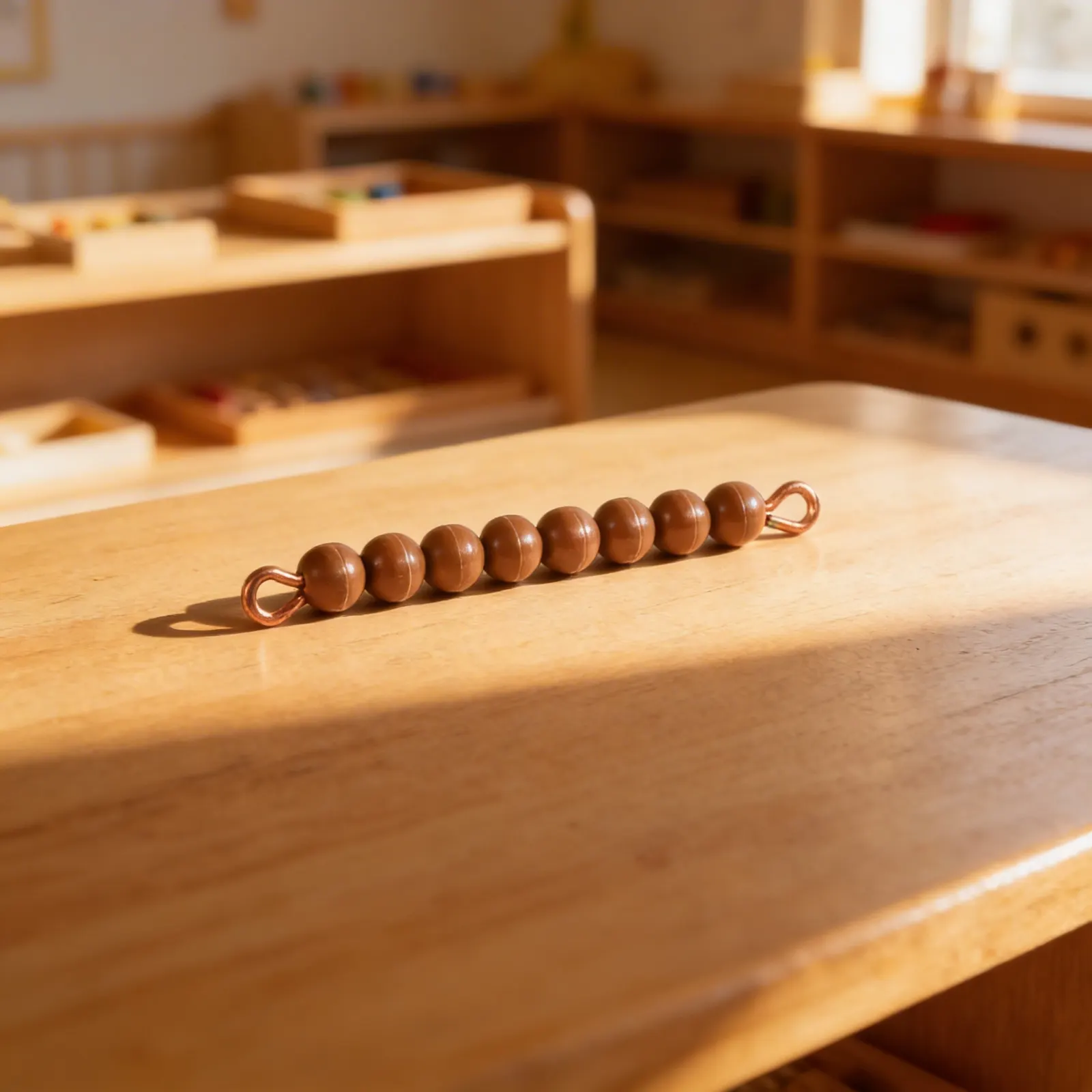
Individual Nylon Bead Bar Of 8 in a child's hands
One nylon bead bar of eight in brown, sold as a single piece. The eights and nines are the bars a child reaches for last and needs most: everything above five has to be counted or grouped, so the long bars are where the work of the bead stair actually happens. Nylon takes that handling better than glass, which is why classrooms with a busy snake game tend to own this range. Brown is eight throughout. The glass version is a separate item.
Number Sense
Provides concrete representation of quantity eight, supporting the transition from concrete to abstract mathematical thinking.
Mathematical Operations
Enables hands-on exploration of addition, subtraction, and multiplication through physical manipulation of quantities.
Pattern Recognition
Supports skip counting by eights and understanding of number patterns within the decimal system.
Fine Motor Control
Handling and counting individual beads refines pincer grasp and hand-eye coordination.
How to present it
Place the brown bead bar on a small tray. Have a soft work mat ready. Ensure good lighting to clearly see each individual bead.
- 1Invite the child to carry the tray to the work mat. Hold the bead bar horizontally with both hands, demonstrating careful handling
- 2Place the bead bar on the mat. Touch each bead individually while counting aloud: 'One, two, three, four, five, six, seven, eight'
- 3Invite the child to count the beads, guiding their finger to touch each one
- 4After counting, state clearly: 'This is eight. Eight beads.'
- 5Invite the child to hold the bar and feel its weight, experiencing eight as a physical quantity
3 tips for parents
- At home, find groups of eight objects (spoons, blocks, crayons) to reinforce the quantity
- During daily activities, notice and count sets of eight: 'Our pizza has eight slices!'
- Avoid rushing to written numerals; focus on quantity recognition through real objects

If you are not sure it suits your child, we answer in person.
Norbert Kovalčín, founder of Faborino · write to him
There is no review here yet. We will ask you for one after you buy. Write the first review
What's in the Box
- Brown Bead Bar: Single bar of 8 beads
Size and material
| Packaging | 13 × 9 × 1 cm |
| Beads | Nylon |
| Wire | Metal with copper-colored loops |
| Recommended Age | 3-6 years |
Care
Wipe with damp cloth, air dry completely
Frequently Asked Questions
What is the purpose of the brown bead bar of 8 in Montessori mathematics?
The brown bead bar of 8 is a concrete manipulative that helps children ages 3-6 visualize and understand the quantity eight. It's used for counting, building number sense, learning place value, and performing basic mathematical operations like addition and subtraction.
How does this individual bead bar differ from the complete bead stair set?
This is a single brown bead bar representing 8, sold individually. It's ideal for replacing lost or damaged bars from a complete bead stair set, or for purchasing extra bars for activities requiring multiple eights, such as skip counting or multiplication work.
What materials are used to make this bead bar and why?
The bar features 8 nylon beads strung on metal wire with copper-colored end loops. Nylon is chosen for its durability and smooth texture that's pleasant for small hands to handle. The metal wire maintains the bar's shape while the loops prevent beads from sliding off and make the bars easy to connect.
What mathematical activities can children do with the brown bead bar of 8?
Children can use it for counting to 8, skip counting by 8s, simple addition and subtraction, composing and decomposing numbers, exploring number patterns, and as a concrete representation when learning abstract number symbols. It's also used in the stamp game and other advanced Montessori math materials.
At what age should children start using the bead bar of 8?
Children typically begin using bead bars around age 3-3.5 in the Montessori classroom, starting with simple counting exercises. As they develop, they use the same material for increasingly complex mathematical concepts through age 6 and beyond, making it a versatile learning tool that grows with the child.
Product safety
Manufacturer: Nienhuis Montessori, Anders Celsiusstraat 15, 7442 PB Nijverdal, Netherlands
Individual Nylon Bead Bar Of 8