
Individual Nylon Bead Square Of 6Purple
The first photo is the maker's own. The other shots are illustrative.
Inv. no. NIE-0086M026
- Maker
- Nienhuis Montessori, since 1929
- Approval
- AMI
- Beads
- Purple nylon
- Frame
- Gold-colored metal wire
- EAN
- 8719924005054
Final price incl. VAT. Delivery €5.90, €139.70 to go for free delivery.
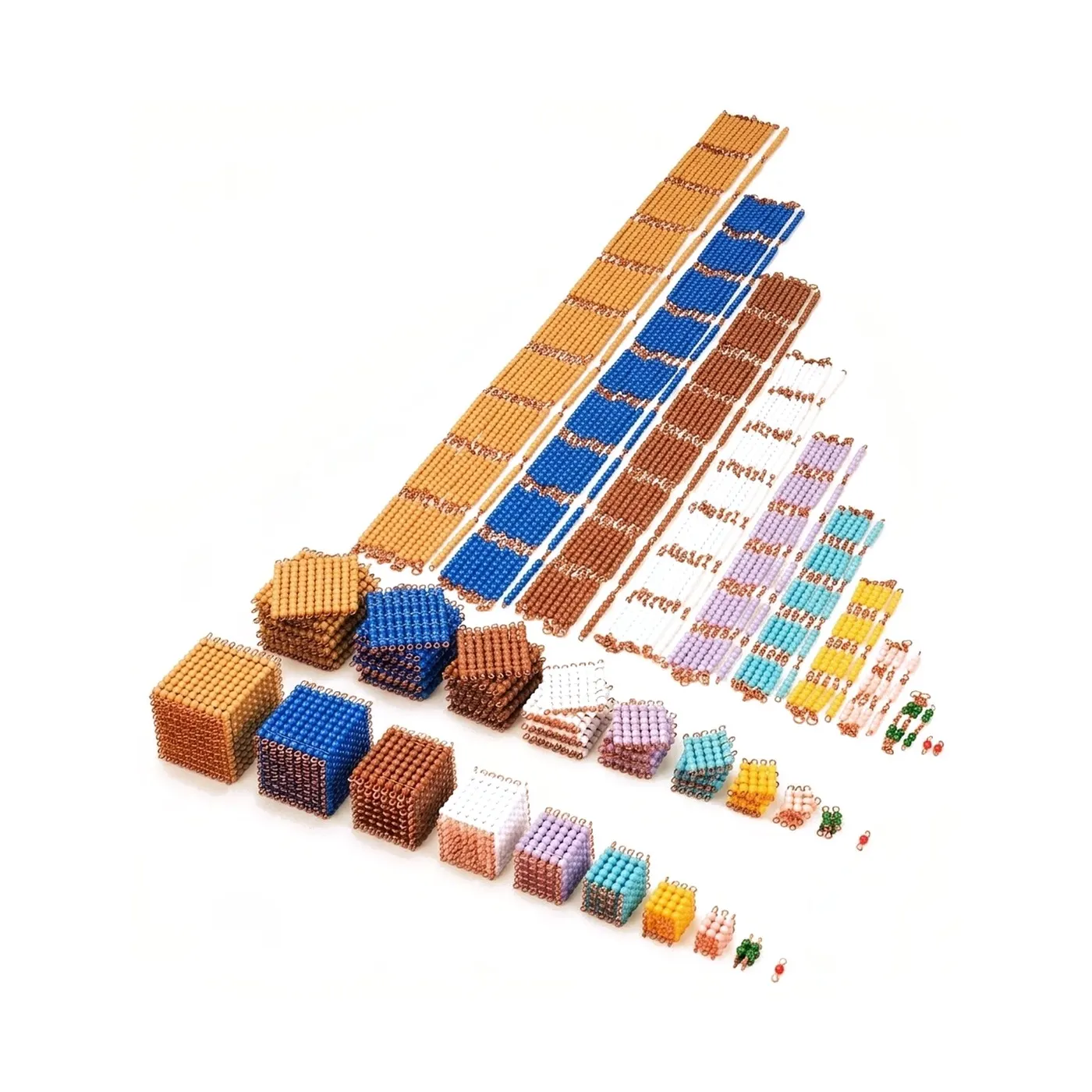 Individual Nylon Beads €1,223.90
Advice, warranty and returns are handled by us.
Why it costs €9.30
Behind the price of the original are things you can check yourself.
AMI approval
The material is approved by the Association Montessori Internationale (AMI). Nienhuis has made Montessori materials since 1929.
A verifiable original
The EAN 8719924005054 is on the box. It is the maker's number, not ours.
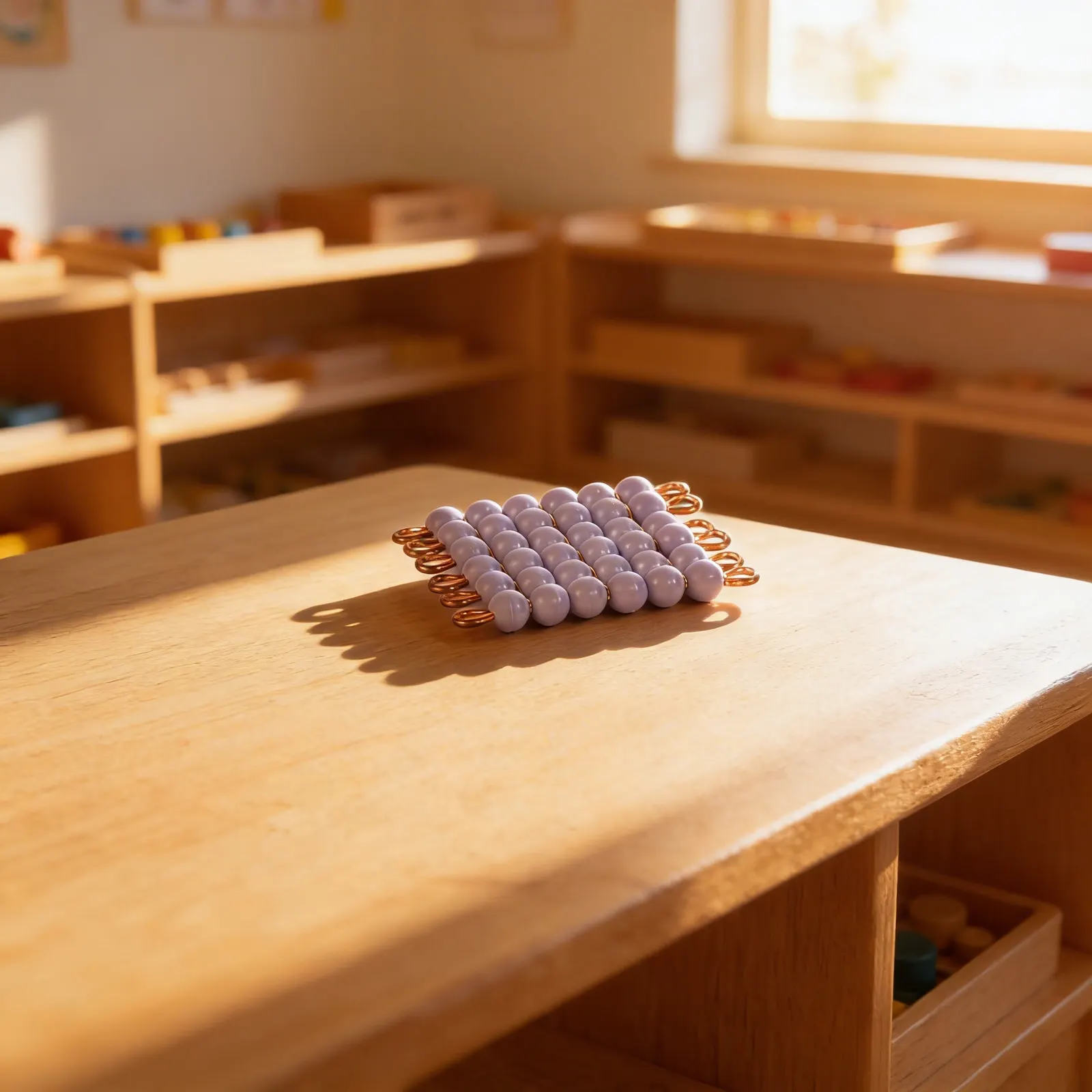
Individual Nylon Bead Square Of 6 in a child's hands
Great for replacing or extending sets, this individual Nylon Bead Square of 6 provides hands-on experience with the mathematical concept of squaring numbers, specifically six squared (6²). The purple beads are arranged in a precise 6×6 grid formation on parallel metal wires, creating a tactile representation of 36 as a square number. Part of the comprehensive bead material system, this square supports children in building concrete understanding of multiplication, area concepts, and algebraic foundations.
Mathematical Abstraction
Bridges concrete counting to abstract understanding of square numbers and multiplication facts through visual and tactile experience.
Spatial Reasoning
Develops understanding of area, dimensions, and geometric relationships through manipulation of the square formation.
Pattern Recognition
Supports discovery of mathematical patterns in square numbers and prepares for algebraic thinking.
Fine Motor Precision
Careful handling of the bead square refines finger control and deliberate movement patterns.
How to present it
Place the bead square on a mat with the metal wires running horizontally. Have numeral cards 6 and 36 available, along with squared notation card (6²) if child is familiar with this symbol.
- 1Invite the child to count the beads along one edge, establishing that each side contains 6 beads
- 2Count the beads row by row: 6, 12, 18, 24, 30, 36
- 3Demonstrate counting by columns to verify the total remains 36
- 4Show how 6 taken 6 times equals 36 by grouping rows with your fingers
- 5Place the numeral cards to show 6 × 6 = 36 or 6² = 36
3 tips for parents
- Look for square patterns in everyday life (floor tiles, windows) and relate them to the bead square concept
- Practice skip counting by 6s during daily routines, referencing the purple square's total of 36
- Create simple grid drawings on paper for your child to count and compare with their bead square work

If you are not sure it suits your child, we answer in person.
Norbert Kovalčín, founder of Faborino · write to him
There is no review here yet. We will ask you for one after you buy. Write the first review
What's in the Box
- Bead Square of 6: 36 purple beads in 6×6 formation
Size and material
| Packaging | 13 × 9 × 1 cm |
| Beads | Purple nylon |
| Frame | Gold-colored metal wire |
| Construction | Parallel wire threading |
| Recommended Age | 3-6 years |
Care
| Cleaning | Wipe with damp cloth, air dry completely |
| Storage | Keep flat to maintain shape |
Frequently Asked Questions
What mathematical concepts does the Bead Square of 6 teach?
The Bead Square of 6 teaches squaring numbers (6²=36), multiplication facts, area concepts, and provides a concrete foundation for algebraic thinking. Children physically see and touch that six squared equals 36 beads arranged in a perfect square.
How do children use this material in the classroom?
Children count the beads, trace the square's outline, and combine it with other bead materials to explore multiplication and squaring. They may also use it to solve problems like 6×6, understand square numbers, or as part of larger mathematical operations.
Why are the beads purple and what is the color coding system?
In Montessori mathematics, purple represents the number 6 throughout all materials. This consistent color coding helps children recognize numerical patterns and relationships across different mathematical concepts and materials.
What age is appropriate for introducing the Bead Square of 6?
While designed for ages 3-6, it's typically introduced around age 4-5 when children have mastered linear counting and are ready for multiplication concepts. The child should be familiar with the bead chains and have a solid understanding of quantities up to 36.
How does this material prepare children for abstract mathematics?
By physically handling 36 beads in a square formation, children internalize the concept of squaring before moving to abstract notation. This concrete experience creates a strong mental image that supports later understanding of exponents, area formulas, and algebraic expressions.
Product safety
Manufacturer: Nienhuis Montessori, Anders Celsiusstraat 15, 7442 PB Nijverdal, Netherlands
Individual Nylon Bead Square Of 6