
Infant Bell
Made by Nienhuis Montessori · shipped by Heutink International (Netherlands) About the maker
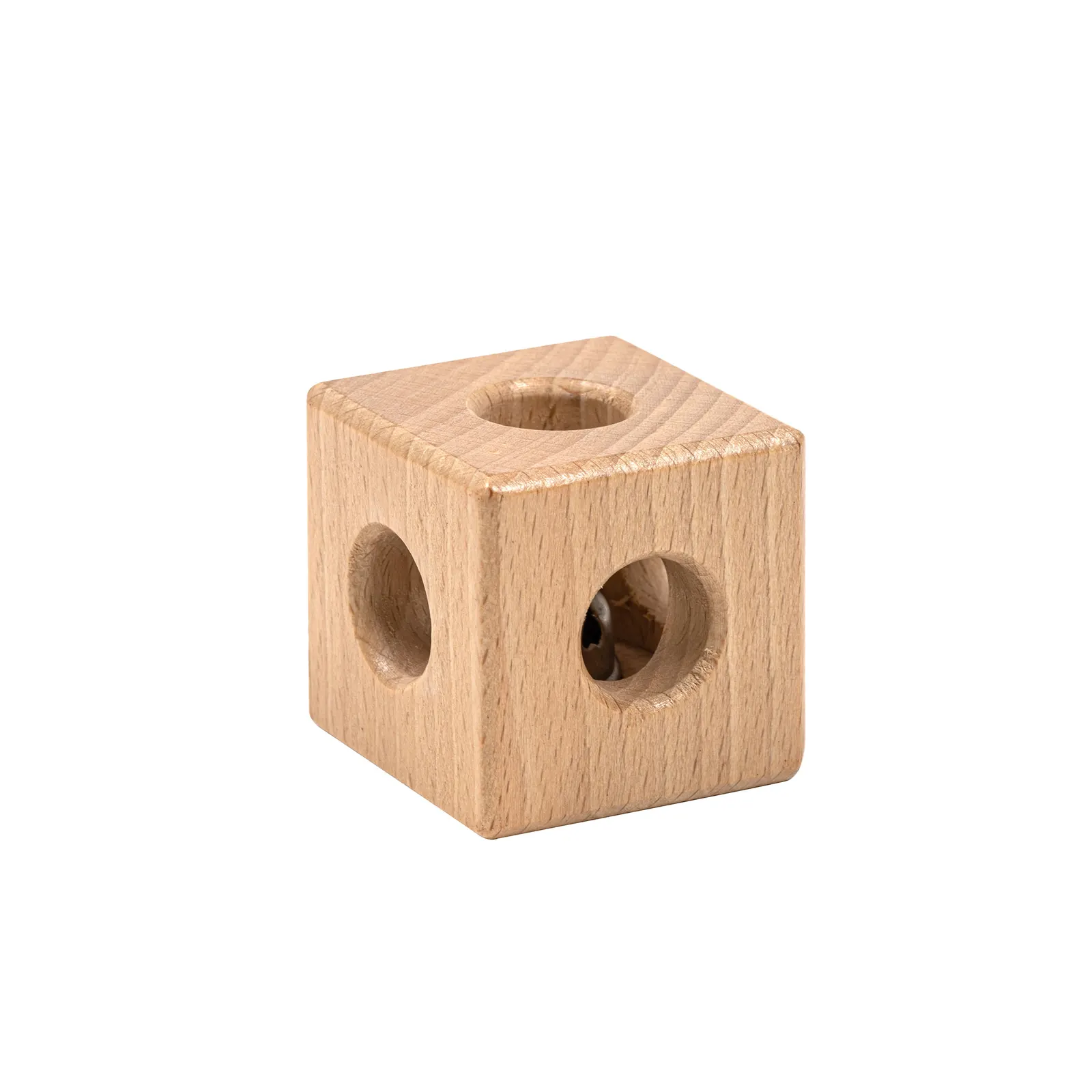
Infant Bell meets a baby at the exact moment they first learn to reach out and grasp on purpose. Around three to five months old, a child gains the coordination to take hold of an object and move it without relying on wrist motion alone, and the Infant Bell gives that new skill something worth repeating. Shaking it produces a soft, soothing sound rather than a sharp rattle, so the reward for reaching stays calm and easy to listen to. Made of natural wood, it is Faborino's answer to the earliest stage of intentional hand movement, for babies from birth through three years.
“The greatest sign of success for a teacher is to be able to say, 'The children are now working as if I did not exist.'”
The Infant Bell's wooden cube design with three circular holes addresses the infant's fundamental need to explore through grasping and manipulation.
- Develops pincer grasp through exploring circular holes
- Builds spatial awareness by navigating fingers through openings
- Strengthens hand muscles through varied grasping positions
- Enhances tactile discrimination with smooth wood surfaces
Read More
In Montessori infant environments, this 5×5×5 cm cube serves as one of the first materials for developing voluntary grasp control. The three precisely drilled holes create multiple grasping opportunities, allowing infants to discover different ways their fingers can interact with solid forms. Unlike simpler grasping objects, the Infant Bell's cube structure with openings introduces spatial awareness as babies learn to coordinate their finger movements through the holes. The smooth wooden surface provides essential tactile feedback during the critical period when infants are developing their sense of touch alongside motor control. This cube's specific geometry, solid faces interrupted by circular voids, helps infants understand object permanence as their fingers disappear and reappear through the holes. The Infant Bell bridges the developmental gap between reflexive grasping and intentional manipulation of objects.
How to present it
Follow the Montessori method of presentation for optimal child development.
Place the wooden cube on a low mat or blanket where the infant can reach it while on their stomach or seated with support.
- 1
Initially present the cube within the infant's visual field, allowing them to reach for it naturally
The cube's light color will attract attention against a contrasting mat - 2
When the infant grasps the cube, observe which holes they explore first
Infants often start by hooking one finger through a hole - 3
Allow extended exploration as the infant discovers they can grasp through multiple holes simultaneously
This discovery phase may take several sessions - 4
As coordination develops, the infant will begin passing the cube between hands using the holes as grip points
This bilateral coordination emerges around 6-8 months
Every Child Is a Little Creator

Heritage
Since 1929

In classrooms
Around the world

European brands
Nienhuis, GAM, Educo

AMI approved
To the association standard
Infant Bell
