
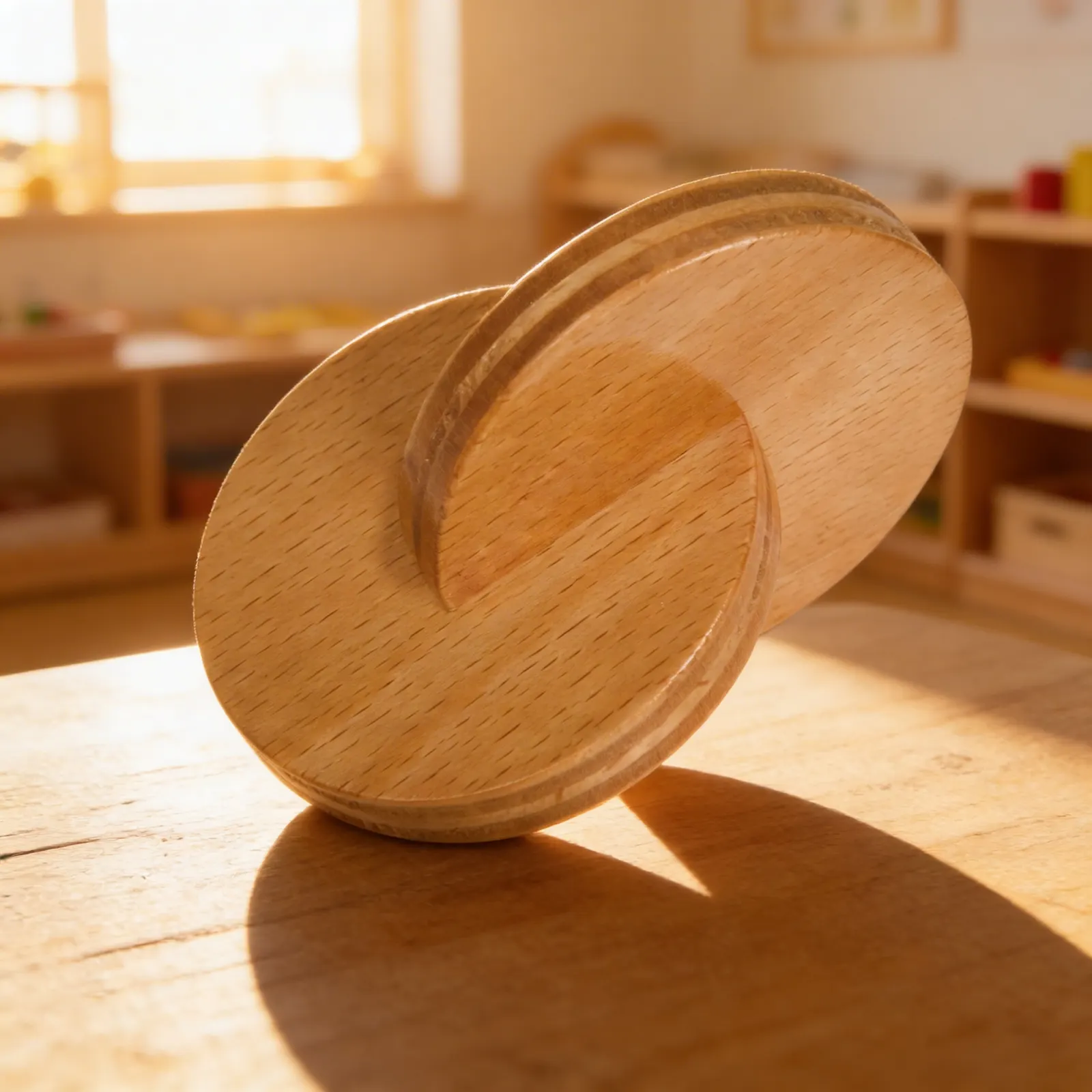
Interlocking Discs
The first photo is the maker's own. The other shots are illustrative.
Inv. no. NIE-048500
- Maker
- Nienhuis Montessori, since 1929
- Approval
- AMI
- Product size
- 5 cm
- Primary Material
- Natural wood
- Finish
- Polish
- EAN
- 8719924012922
Final price incl. VAT. Delivery €5.90, €132.10 to go for free delivery.
Advice, warranty and returns are handled by us.
Why it costs €16.90
Behind the price of the original are things you can check yourself.
AMI approval
The material is approved by the Association Montessori Internationale (AMI). Nienhuis has made Montessori materials since 1929.
A verifiable original
The EAN 8719924012922 is on the box. It is the maker's number, not ours.
Interlocking Discs in a child's hands
Two wooden discs of 5 cm that interlock, for the months around half a year when a baby begins passing an object from one hand to the other. That transfer is the whole exercise and it is a bigger step than it looks: the object has to be held, released and caught by the other hand in one movement, and the maker notes that working across the midline in this way has implications for both sides of the brain. Two discs is the right number, since one is not a transfer and three is a heap.
Spatial Intelligence
Assembling the perpendicular discs develops understanding of three-dimensional relationships and how objects fit together in space.
Fine Motor Control
Grasping, rotating, and fitting the discs together refines hand movements and strengthens finger muscles essential for later writing.
Problem-Solving Skills
Children discover through trial and error how the grooves align, building persistence and logical thinking abilities.
Sensory Exploration
The smooth wood texture and natural grain patterns provide rich tactile experiences that support sensory development.
How to present it
Place the two wooden discs on a low table or mat, separated but within the child's reach. Ensure the work surface is stable and at the child's chest height when seated.
- 1Sit beside the child and slowly pick up one disc, examining it with interest
- 2Hold the first disc steady and bring the second disc perpendicular to it
- 3Slide the discs together at their slots, using gentle pressure
- 4Once connected, lift the interlocked structure and turn it in the light
- 5Separate the discs with a gentle pulling motion and place them back on the surface
3 tips for parents
- Resist the urge to guide your child's hands, the discovery of perpendicular alignment should come through exploration
- When your child struggles with alignment, describe what you see rather than correcting: 'I notice the slot is facing up'
- Celebrate process over product, spinning the discs without connecting them is valuable exploration too

If you are not sure it suits your child, we answer in person.
Norbert Kovalčín, founder of Faborino · write to him
There is no review here yet. We will ask you for one after you buy. Write the first review
What's in the Box
- Interlocking wooden discs: 2 pieces with perpendicular grooves
Size and material
| Product size | 5 cm |
| Packaging | 22 × 11 × 8 cm |
| Primary Material | Natural wood |
| Finish | Polish |
| Recommended Age | 6 months - 3 years |
Care
Wipe with slightly damp cloth, air dry completely
Frequently Asked Questions
What age is appropriate for the interlocking discs?
The interlocking discs are designed for children ages 6 months to 3 years. Babies around 6-8 months can begin exploring them with supervision, while toddlers up to age 3 continue to refine their spatial understanding and hand-eye coordination through repeated use.
How do interlocking discs support early development?
These discs develop spatial awareness, problem-solving skills, and hand-eye coordination. Children learn about perpendicular relationships, practice precise hand movements, and build concentration as they figure out how to connect the two pieces at right angles.
What makes these discs a Montessori material?
Following Montessori principles, these discs isolate one concept (perpendicular assembly), are made from natural materials, and are self-correcting - children can see and feel when they've successfully interlocked the pieces. They encourage independent exploration and repetition.
How should I present the interlocking discs to my child?
Start by slowly demonstrating how the discs fit together, using deliberate movements. Place them on a tray at your child's level. Allow plenty of time for exploration without correcting - children learn through trial and error. Store them assembled or separated based on your child's skill level.
Are the wooden discs safe for babies who are still mouthing objects?
Yes, these discs are made from smooth, polished wood with no splinters or sharp edges. However, always supervise young children during play. The size is designed to prevent choking hazards, but adult supervision is recommended for children under 3 years.
Product safety
Manufacturer: Nienhuis Montessori, Anders Celsiusstraat 15, 7442 PB Nijverdal, Netherlands
Interlocking Discs