
Introduction To Decimal QuantityIndividual Beads Glass
The first photo is the maker's own. The other shots are illustrative.
Inv. no. NIE-0250G0
- Maker
- Nienhuis Montessori, since 1929
- Approval
- AMI
- Storage Box
- Natural wood with sliding lid
- Beads
- Glass golden beads
- EAN
- 8719924011901
Final price incl. VAT. Free delivery.
Advice, warranty and returns are handled by us.
Why it costs €237.90
Behind the price of the original are things you can check yourself.
AMI approval
The material is approved by the Association Montessori Internationale (AMI). Nienhuis has made Montessori materials since 1929.
A verifiable original
The EAN 8719924011901 is on the box. It is the maker's number, not ours.
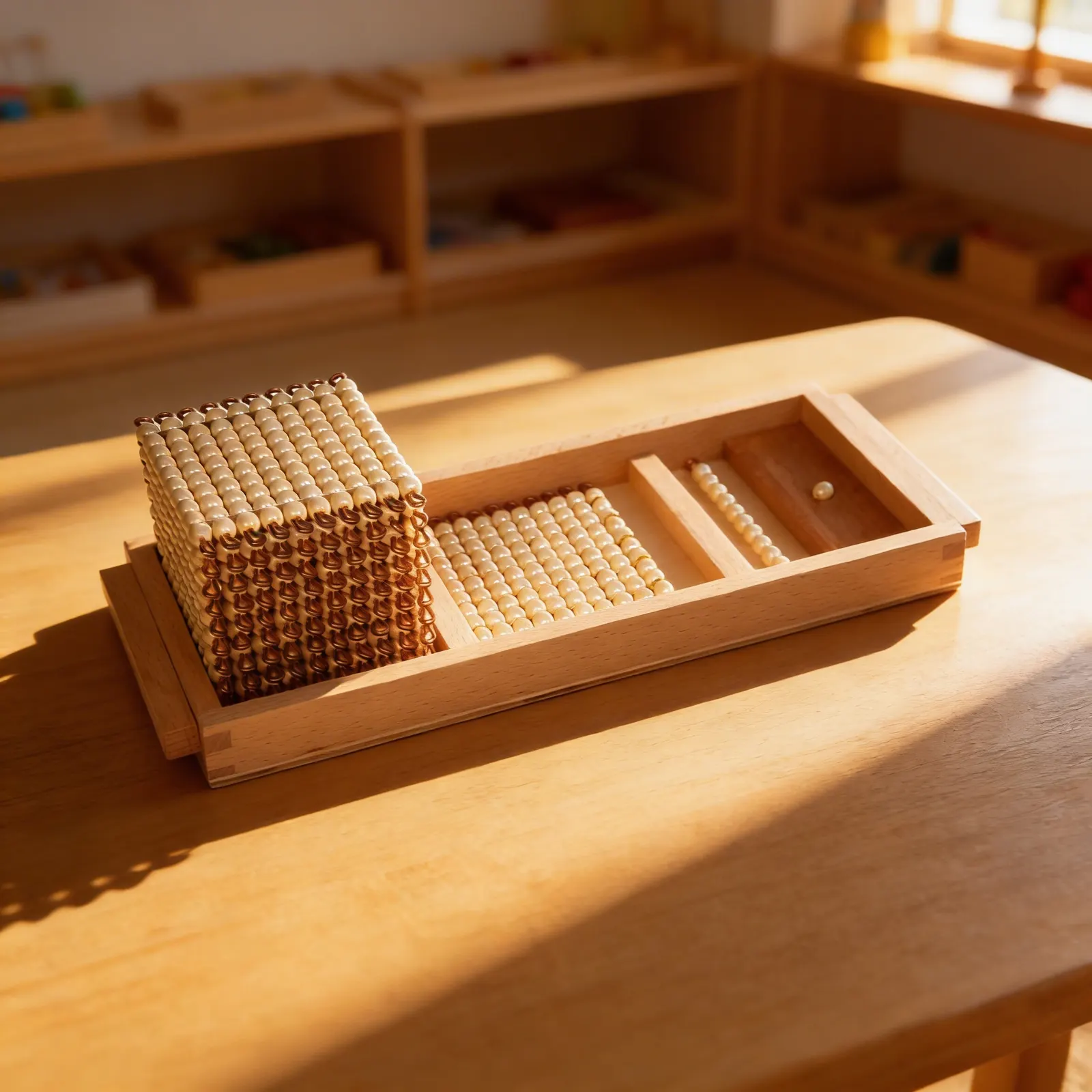
Introduction To Decimal Quantity in a child's hands
A tray of golden bead material laid out for one job: introducing the quantities one, ten, hundred and thousand before any symbol is attached to them. The child fetches each in turn, feels the jump in weight and size, and learns the names as names of things rather than of numerals. Keeping quantity and symbol apart at this stage is deliberate; the number cards are a separate material and a later lesson, and they are ordered separately. Glass beads with a wooden tray, for ages 3 to 6.
Decimal System Understanding
Introduces place value concepts through concrete manipulation of quantities, building foundation for advanced mathematics.
Visual Discrimination
Children learn to recognize and differentiate between units, tens, and hundreds through visual and tactile exploration.
Mathematical Abstraction
Bridges concrete materials to abstract number concepts, preparing for mental mathematics.
Order and Precision
Organized presentation cultivates mathematical thinking and attention to systematic arrangement.
How to present it
Place the wooden box on a mat. Slide open the lid to reveal compartments. Set out a small tray for the child's work. Ensure golden hundred-squares are visible in their compartment and individual beads are accessible.
- 1Introduce a single golden bead, saying 'This is one unit.' Let the child hold and examine the glass bead.
- 2Present a ten-bar (ten beads on wire), counting each bead together: 'One, two, three... ten. This is ten.'
- 3Show the hundred-square, inviting the child to count the rows and columns to verify it contains one hundred beads.
- 4Create simple quantities using combinations: 'Can you make 23?' Guide laying out 2 ten-bars and 3 unit beads.
- 5Practice exchanging: trade ten unit beads for one ten-bar, demonstrating equivalent quantities.
3 tips for parents
- Practice decimal concepts during everyday activities: 'We have 10 grapes. That's like one ten-bar!'
- Support careful handling by modeling gentle movements when working with glass materials
- Celebrate when your child makes connections between bead quantities and numbers they see in daily life

If you are not sure it suits your child, we answer in person.
Norbert Kovalčín, founder of Faborino · write to him
There is no review here yet. We will ask you for one after you buy. Write the first review
What's in the Box
- Wooden Storage Box: With sliding lid and compartments
- Hundred Squares: Glass bead squares representing 100
- Individual Bead Bars: Various quantities on metal wire
- Presentation Tray: For organized material display
Size and material
| Packaging | 31 × 9 × 11 cm |
| Storage Box | Natural wood with sliding lid |
| Beads | Glass golden beads |
| Bead Bars | Metal wire construction |
| Recommended Age | 3-6 years |
Care
Wipe wooden box with damp cloth; handle glass beads with care
Frequently Asked Questions
What age is this Introduction to Decimal Quantity material suitable for?
This material is designed for children ages 3-6 years old, aligning with the Montessori early childhood curriculum for introducing mathematical concepts through concrete, manipulative materials.
What exactly is included in this decimal quantity set?
The set includes premium glass golden bead squares representing hundreds and individual glass bead bars on metal wire, all organized in a handcrafted wooden storage box with sliding lid and multiple compartments for easy organization.
How does this material help children learn about the decimal system?
Children gain a concrete, sensorial understanding of decimal quantities by physically handling and counting the beads, allowing them to see and feel the difference between units, tens, and hundreds before moving to abstract number concepts.
Why are the beads made of glass instead of plastic?
Glass beads provide a premium tactile experience with appropriate weight and texture, helping children develop fine motor skills while appreciating the value and beauty of the material, which encourages careful handling and respect for learning tools.
How is this different from the complete golden bead material?
This is an introductory set focusing specifically on decimal quantity concepts, while the complete golden bead material includes additional components for more advanced operations. This set is perfect for initial decimal system exploration and quantity recognition.
Product safety
Manufacturer: Nienhuis Montessori, Anders Celsiusstraat 15, 7442 PB Nijverdal, Netherlands
Introduction To Decimal Quantity