
Introduction To Decimal QuantityIndividual Beads Nylon (Nienhuis)
The first photo is the maker's own. The other shots are illustrative.
Inv. no. NIE-0250M0
- Maker
- Nienhuis Montessori, since 1929
- Approval
- AMI
- Beads
- Nylon
- Frame
- Metal wire
- EAN
- 8719924011918
Final price incl. VAT. Free delivery.
Advice, warranty and returns are handled by us.
Why it costs €155.90
Behind the price of the original are things you can check yourself.
AMI approval
The material is approved by the Association Montessori Internationale (AMI). Nienhuis has made Montessori materials since 1929.
A verifiable original
The EAN 8719924011918 is on the box. It is the maker's number, not ours.
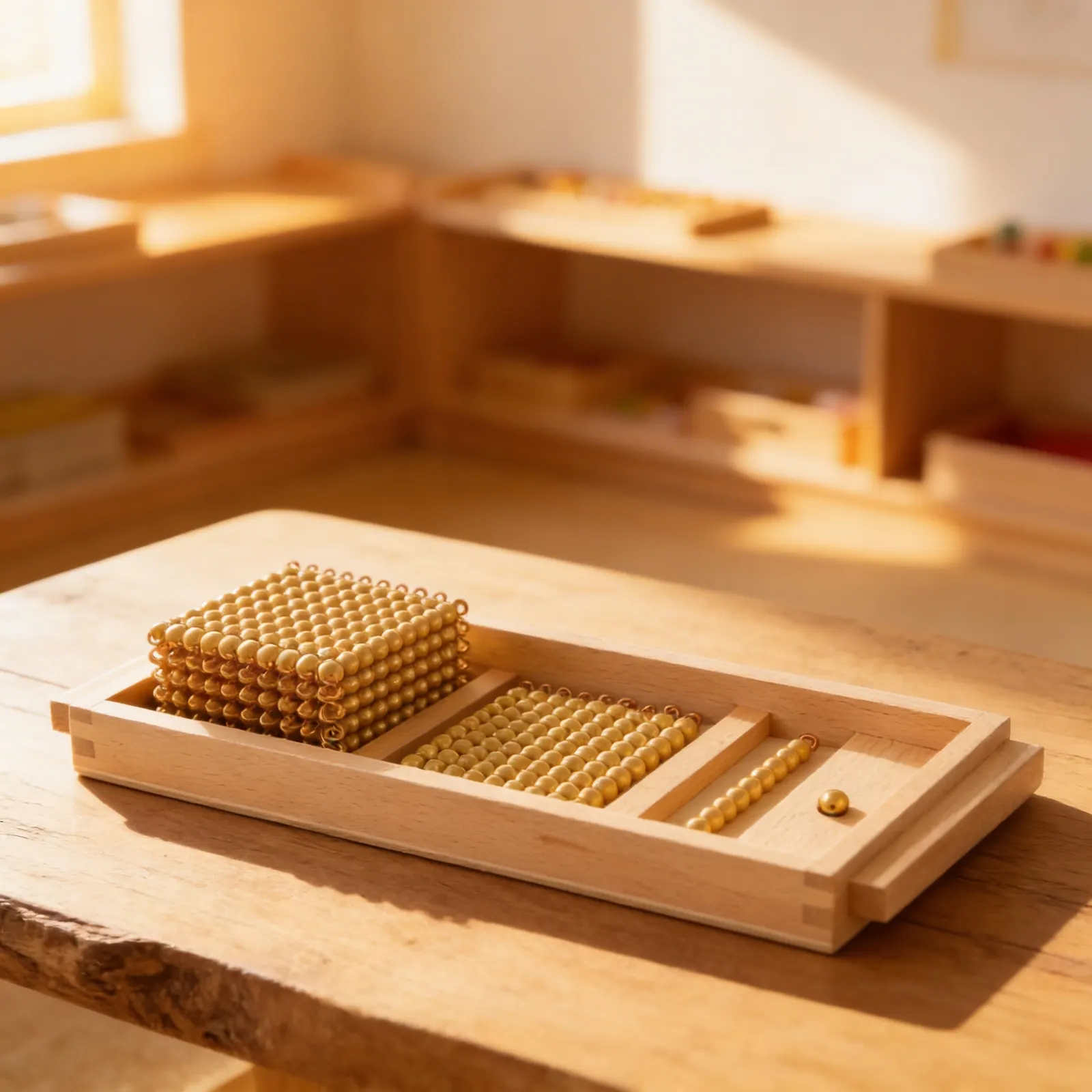
Introduction To Decimal Quantity in a child's hands
A tray of golden bead material in nylon, holding the quantities one, ten, hundred and thousand for the first introduction. The child fetches each in turn and meets the size of the jump before any name or symbol is attached, which is the order the whole decimal sequence depends on. Nylon is the version most classrooms pick for this stage, because a first introduction gets handled by a lot of hands. The number cards are a separate material and a later lesson, and are ordered separately. Nylon beads with wood, for ages 3 to 6.
Mathematical Foundation
Concrete manipulation of decimal quantities builds deep understanding of place value and the base-ten number system.
Abstract Thinking
Progresses from concrete bead handling to abstract number concepts through repeated sensorial experience.
Fine Motor Control
Precise handling of individual beads and bead bars refines pincer grip and hand-eye coordination.
Concentration
Systematic work with decimal quantities develops sustained focus and attention to mathematical relationships.
How to present it
Place the wooden tray on a mat. Remove the sliding lid and arrange beads by hierarchy: unit beads in one section, ten-bars in another, hundred-squares and thousand-cube if included.
- 1Introduce unit beads by counting them one by one into the child's hand
- 2Count out ten unit beads, then show the ten-bar, demonstrating they represent the same quantity
- 3Build quantities using different combinations (e.g., 23 using two ten-bars and three units)
- 4Practice exchanging: when accumulating ten units, exchange for one ten-bar
3 tips for parents
- Practice counting objects at home in groups of ten to reinforce the concept
- When your child mentions large numbers, ask 'How many tens would that be?'
- Avoid rushing to written numerals - concrete understanding with beads comes first

If you are not sure it suits your child, we answer in person.
Norbert Kovalčín, founder of Faborino · write to him
There is no review here yet. We will ask you for one after you buy. Write the first review
What's in the Box
- Wooden storage tray: with sliding lid and compartments
- Golden bead squares: representing hundreds and thousands
- Individual bead bars: for units and tens
- Wire-mounted beads: organized by decimal place value
Size and material
| Packaging | 31 × 11 × 9 cm |
| Beads | Nylon |
| Frame | Metal wire |
| Storage | Wooden tray with sliding lid |
| Recommended Age | 3-6 years |
Care
Wipe wooden tray with damp cloth; clean beads gently with soft brush
Frequently Asked Questions
What's included in this decimal quantity bead material?
This set includes individual golden nylon beads representing units (1), tens (10-bead bars), hundreds (100-bead squares), and thousands (1000-bead cubes), all mounted on wire frames and stored in a wooden tray with sliding lid for organized storage.
How do children use these beads to learn decimal quantities?
Children physically handle and count the beads to understand place value concepts. They can exchange 10 units for a ten-bar, 10 ten-bars for a hundred-square, and 10 hundred-squares for a thousand-cube, experiencing the base-ten system through concrete manipulation.
Why are nylon beads used instead of traditional glass beads?
Nylon beads are more durable, lightweight, and safer for young children aged 3-6. They maintain the golden color and tactile experience of traditional Montessori materials while being less prone to breakage and easier for small hands to manipulate.
What mathematical concepts can be taught with this material?
This material introduces place value, decimal system hierarchy, counting to 1000, skip counting, basic addition and subtraction with regrouping, and the foundation for understanding large numbers through hands-on exploration of quantities.
How does this material prepare children for future math learning?
By providing concrete representations of abstract numbers, children develop a deep understanding of quantity and place value. This sensorial experience creates a strong foundation for later work with the golden bead material, stamp game, and eventual abstract mathematical operations.
Product safety
Manufacturer: Nienhuis Montessori, Anders Celsiusstraat 15, 7442 PB Nijverdal, Netherlands
Introduction To Decimal Quantity