
Kitchen Utensils 3 Part Cards
The first photo is the maker's own. The other shots are illustrative.
Inv. no. NIE-EC0638A
- Maker
- Nienhuis Montessori, since 1929
- Material
- Durable plastic
- Finish
- Pre-cut with rounded corners
- EAN
- 8719924043131
Final price incl. VAT. Delivery €5.90, €126.10 to go for free delivery.
Advice, warranty and returns are handled by us.
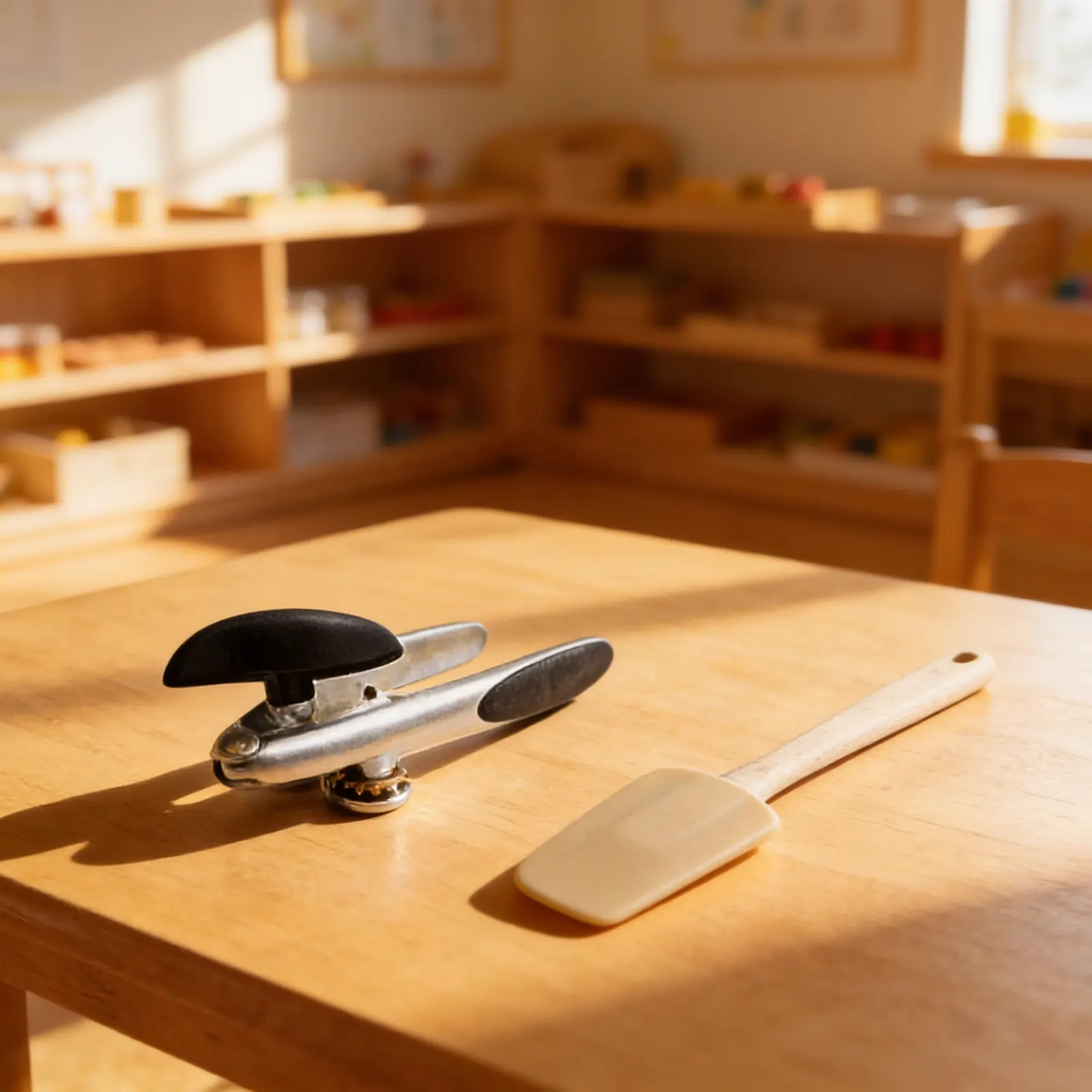
Kitchen Utensils 3 Part Cards in a child's hands
Three part cards for kitchen utensils, with a real photograph of each. This is the vocabulary set whose control is in the next room: a child who names a whisk on a card can go and find one, hold it and use it, and very little else in a nomenclature cupboard can be verified that fast. It also feeds directly into the food preparation work. Picture, label and control card. Durable plastic. In English.
Vocabulary Expansion
Introduces specific terminology for kitchen implements, building precise language skills essential for practical life activities.
Visual Discrimination
Develops the ability to identify and match visual representations with corresponding labels, strengthening cognitive connections.
Classification Skills
Supports understanding of categories and functions as children group utensils by purpose or characteristics.
Reading Preparation
Label matching activities prepare for reading through visual word recognition and left-to-right scanning patterns.
How to present it
Lay out a work mat. Place the picture cards in a column on the left side. Stack the label cards separately.
- 1Invite the child to identify any familiar utensils from the picture cards
- 2Select one picture card and name the utensil clearly: 'This is a whisk'
- 3Find the corresponding label card and place it below the picture
- 4Continue matching all pictures to labels, then use control cards to check
- 5Mix the cards and invite the child to match independently
3 tips for parents
- Point out these utensils during meal preparation at home, using the same vocabulary
- Let your child match real kitchen tools to the card images during cooking together
- Create a low drawer with child-safe versions of the pictured utensils for independent exploration

If you are not sure it suits your child, we answer in person.
Norbert Kovalčín, founder of Faborino · write to him
There is no review here yet. We will ask you for one after you buy. Write the first review
What's in the Box
- Picture Cards: Approx. 6 cards with kitchen utensil photographs
- Label Cards: Matching text labels for each utensil
- Control Cards: Combined picture and label cards for self-correction
Size and material
| Packaging | 15 × 15 × 1 cm |
| Material | Durable plastic |
| Finish | Pre-cut with rounded corners |
| Recommended Age | 3-6 years |
Care
Wipe with slightly damp cloth, dry immediately
Frequently Asked Questions
What kitchen utensils are included in this 3-part card set?
This set typically includes 12-18 common kitchen utensils such as spatula, whisk, ladle, tongs, peeler, grater, measuring cups, rolling pin, wooden spoon, can opener, strainer, and mixing bowl. Each utensil is represented with a clear photographic image card, label card, and control card.
How do children use these kitchen utensil cards in Montessori activities?
Children begin by matching the picture cards to control cards, then progress to reading and matching label cards. Activities include vocabulary lessons, classification exercises (sorting by function or material), and integration with practical life activities. The cards support language development and cultural studies lessons about food preparation.
What skills do these kitchen utensil cards help develop?
These cards develop vocabulary acquisition, visual discrimination, reading readiness, and classification skills. They enhance practical life connections, support cultural awareness about cooking tools, and build foundations for food preparation activities. The material also strengthens concentration and independent learning.
Can these cards be used with actual kitchen activities?
Yes, these cards complement hands-on cooking experiences beautifully. Use them to introduce utensils before practical life activities, create matching games with real objects, or as reference cards during food preparation lessons. They bridge abstract learning with concrete experiences in the kitchen.
What is the recommended presentation sequence for these cards?
Start with 3-4 familiar utensils, presenting picture-to-picture matching first. Progress to picture-to-label matching once the child can identify items. Introduce reading labels independently, then extend with classification activities, discussion about utensil functions, and connections to cultural cooking traditions.
Product safety
Manufacturer: Nienhuis Montessori, Anders Celsiusstraat 15, 7442 PB Nijverdal, Netherlands
Kitchen Utensils 3 Part Cards