
Knobless Cylinder Pattern Cards: 2D Matching Extensions
Made by Nienhuis Montessori · shipped by Heutink International (Netherlands) About the maker
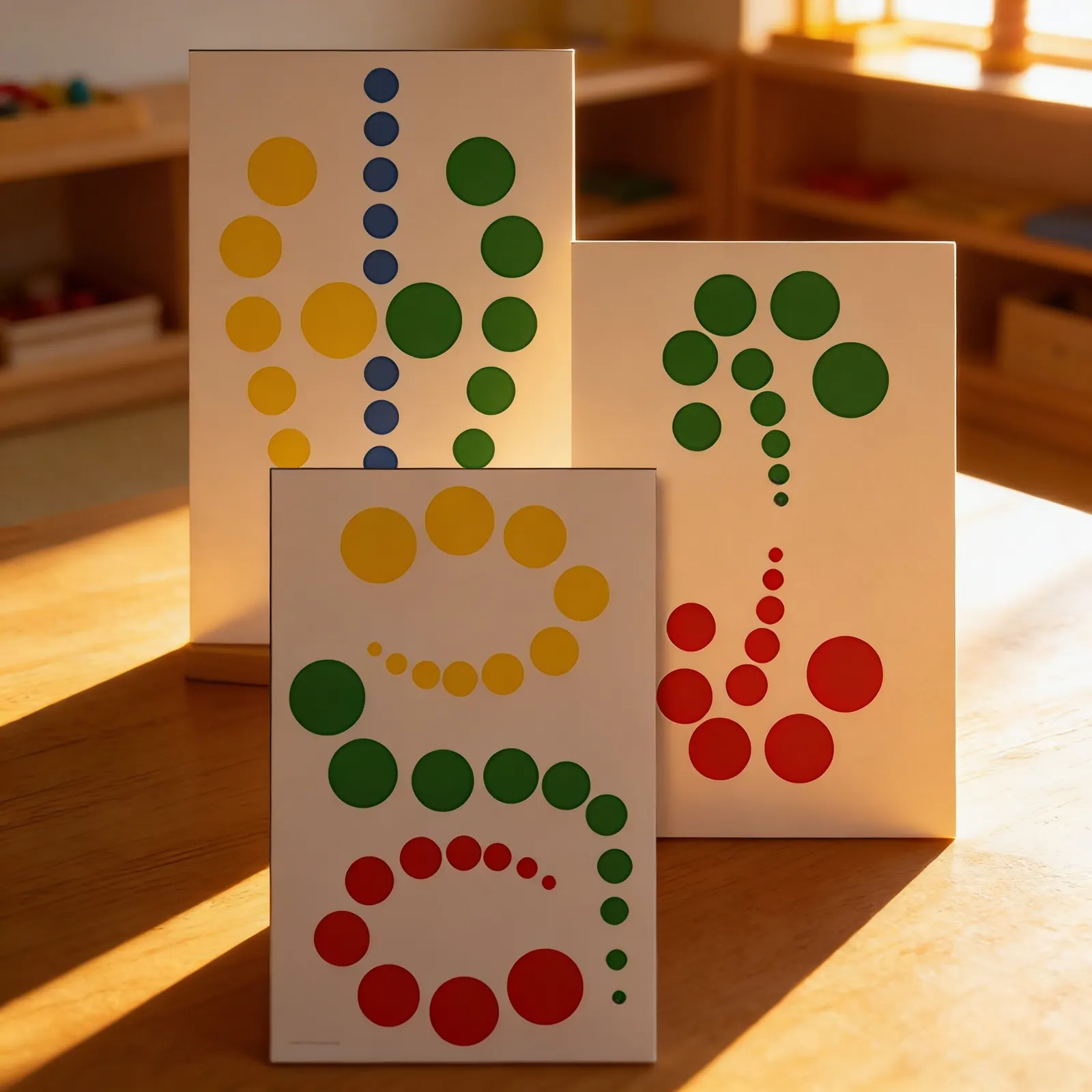
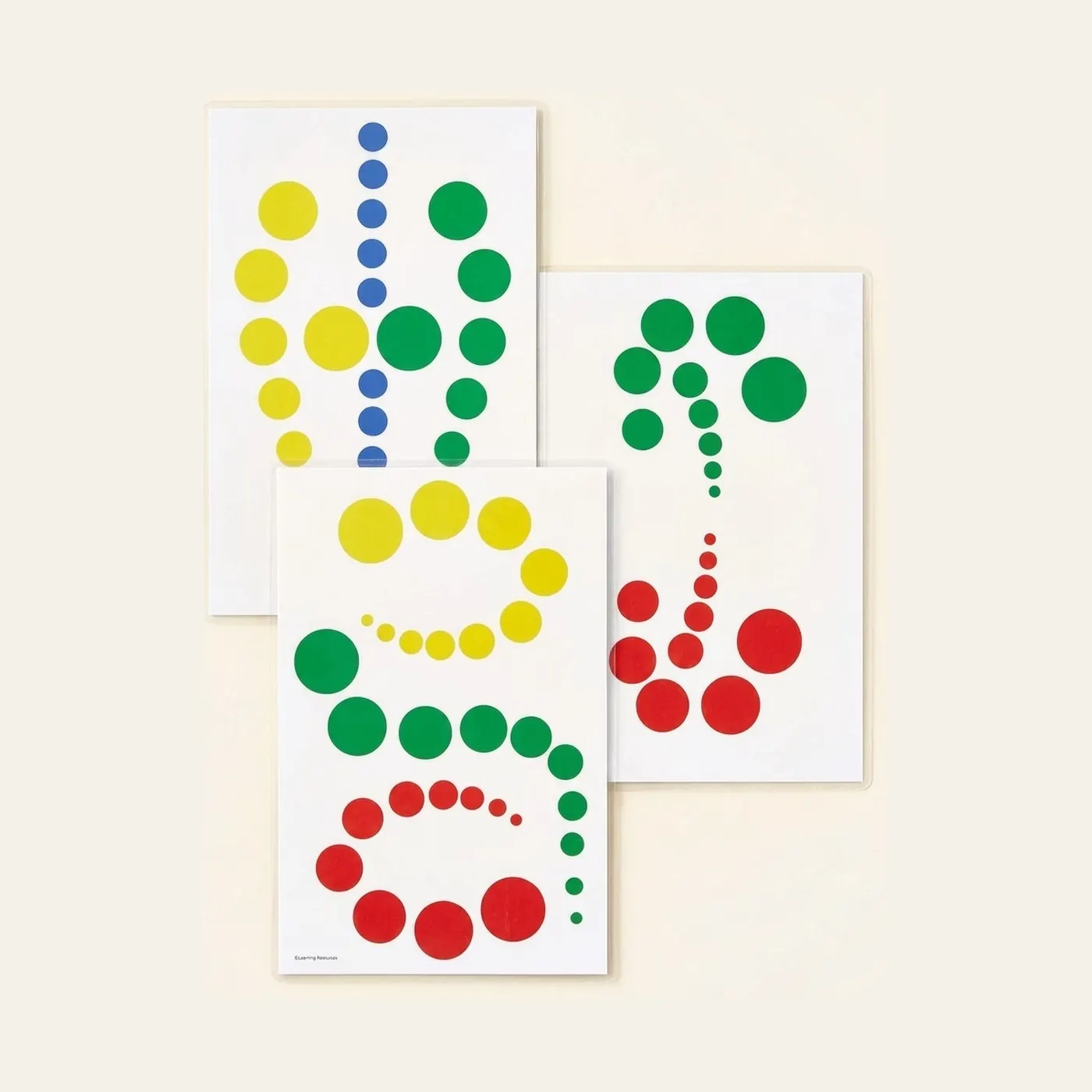
Pattern cards for the knobless cylinders, showing arrangements to build. The cards turn a set of forty loose cylinders into a task with an end: the pattern is on the card, the child builds it and can see whether it matches. That is a different exercise from grading by size, and it is what keeps the knobless sets in use after the obvious work is done. Durable plastic with rounded corners. The cylinders and the chart are separate items.
“Children display a universal love of mathematics, which is par excellence the science of precision, order, and intelligence.”
The Knobless Cylinder Pattern Cards exemplify Montessori's principle of moving from concrete to abstract understanding.
- Visual discrimination of graduated dimensions in two-dimensional form
- Development of one-to-one correspondence between 3D objects and 2D representations
- Refinement of order and sequence through systematic pattern matching
- Preparation for mathematical concepts of measurement and seriation
Read More
After extensive sensorial exploration with the three-dimensional knobless cylinders, children transition to two-dimensional representations, building the abstraction skills essential for later academic work. This material bridges sensorial experiences with mathematical concepts, demonstrating how early concrete work lays foundations for abstract thinking. The cards honor the child's need for repetition and self-correction, as patterns can be matched and verified independently. By isolating the difficulty of dimension recognition without the knobs, children refine their visual discrimination and develop the ability to perceive subtle gradations in size, a skill directly transferable to mathematical seriation and measurement concepts.
How to present it
Follow the Montessori method of presentation for optimal child development.
Place the pattern cards on a mat. Bring the corresponding set of knobless cylinders in their box. Ensure adequate workspace for both materials.
- 1
Select one pattern card and place it at the top of the mat
Start with the red cylinders (varying in two dimensions) as they're most visually distinct - 2
Remove cylinders from their box one at a time, examining each carefully
Model holding cylinders at eye level to assess diameter - 3
Match each cylinder to its corresponding circle on the pattern card
Place cylinders directly on the circles to verify correct matching - 4
Once complete, remove cylinders systematically and return to box
Remove from smallest to largest to reinforce gradation - 5
Select a new pattern card and repeat the process
Progress from simple linear patterns to more complex arrangements
Every Child Is a Little Creator

Heritage
Since 1929

In classrooms
Around the world

European brands
Nienhuis, GAM, Educo
Knobless Cylinder Pattern Cards: 2D Matching Extensions
