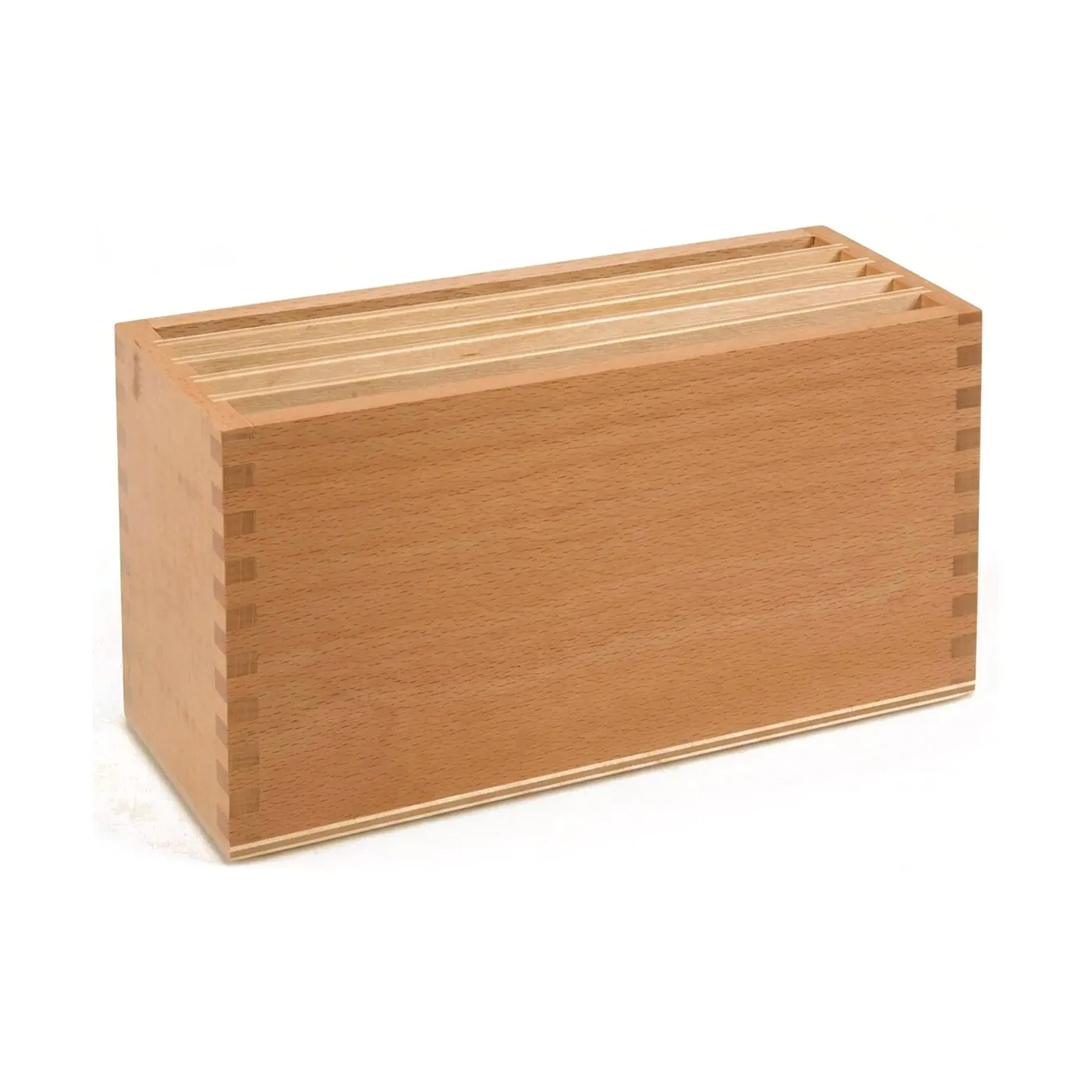
Land Form Cards
The first photo is the maker's own. The other shots are illustrative.
Inv. no. NIE-022900
- Maker
- Nienhuis Montessori, since 1929
- Approval
- AMI
- Product size
- 20 × 20 cm
- Card Material
- Heavy cardstock
- Finish
- Matte coating
- EAN
- 8719924011031
€43.90
Final price incl. VAT. Delivery €5.90, €105.10 to go for free delivery.
✓ In Stock. Delivery in 5 to 9 working days.
1
30 daysto return
Advicebefore and after
Invoicefor companies
Advice, warranty and returns are handled by us.
The original
Why it costs €43.90
Behind the price of the original are things you can check yourself.
AMI approval
The material is approved by the Association Montessori Internationale (AMI). Nienhuis has made Montessori materials since 1929.
A verifiable original
The EAN 8719924011031 is on the box. It is the maker's number, not ours.
What the child does
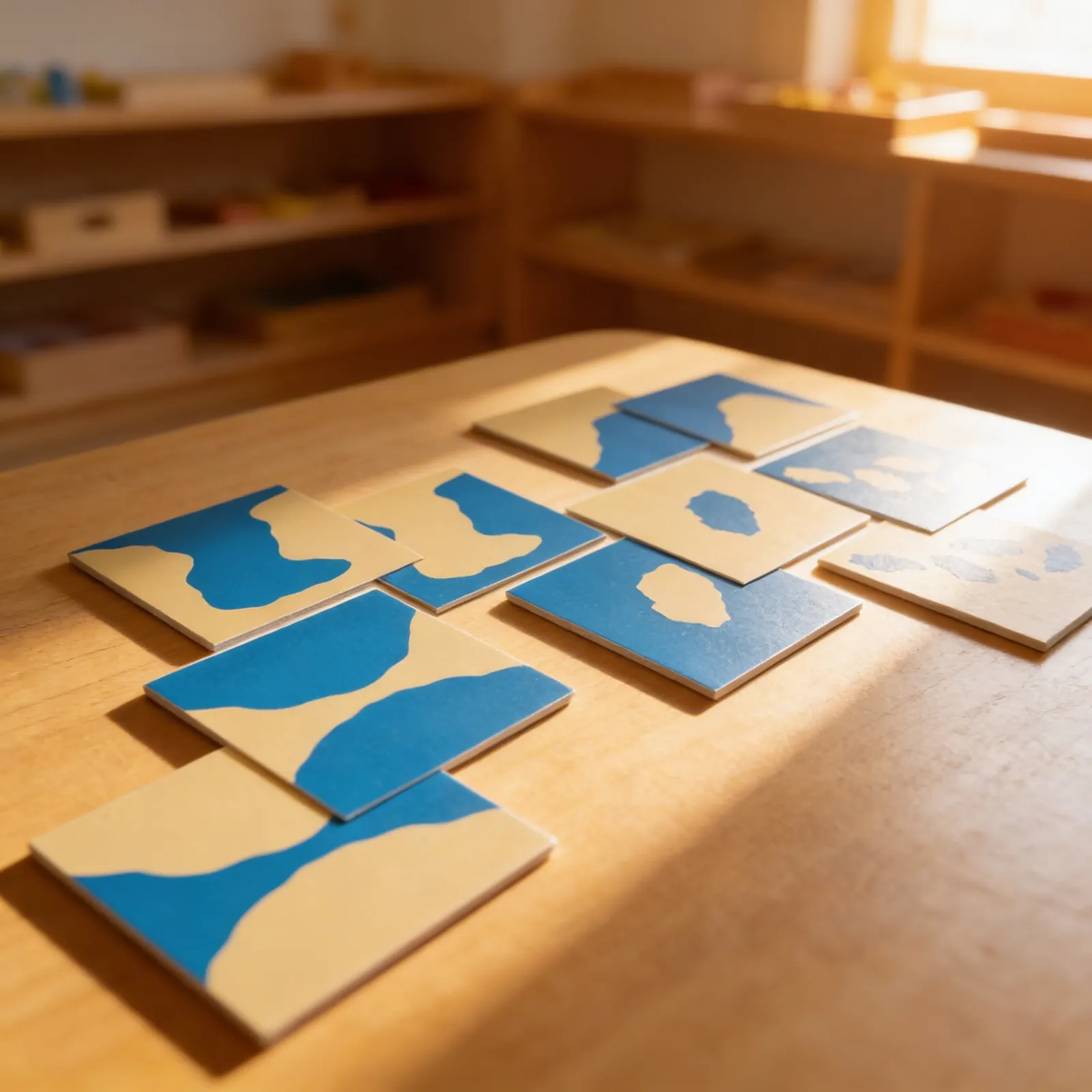
Land Form Cards in a child's hands
Geography comes alive through touch, these Land Form Cards introduce children to fundamental geographic concepts through visual matching activities. Each card features clear representations of land and water forms like islands, lakes, and peninsulas, helping children understand how land and water interact in nature. The contrasting colors and simple designs make abstract geographic concepts concrete and accessible for young learners.
Geographic Awareness
Children develop understanding of how land and water forms shape our world through concrete visual representations.
Visual Discrimination
Matching activities strengthen observation skills and ability to identify subtle differences in shapes.
Vocabulary Development
Introduces specific geographic terminology like 'peninsula' and 'archipelago' at the appropriate developmental stage.
Abstract Thinking
Transitions children from concrete objects to symbolic representations, preparing for map work.
Activity Guide
How to present it
Lay out Land Form Cards on a mat, organizing matching pairs separately. Ensure adequate lighting to highlight the contrasting colors between land and water areas.
- 1Present three land form cards (e.g., island, lake, peninsula) and name each one clearly
- 2Invite the child to match identical cards, placing pairs together
- 3Introduce the three-period lesson: 'This is an island,' 'Show me the peninsula,' 'What is this?'
- 4Once familiar with several forms, invite the child to sort cards by characteristic (surrounded by water, contains water, etc.)
3 tips for parents
- Point out land and water forms during travel or in picture books, connecting to card vocabulary
- Create simple land forms in sand or with play dough during bath time or outdoor play
- Look at maps together, finding examples of islands, peninsulas, and other forms learned with cards
From the same makerNienhuis
Accessories
Why it is in our selection
If you are not sure it suits your child, we answer in person.
Norbert Kovalčín, founder of Faborino · write to him
There is no review here yet. We will ask you for one after you buy. Write the first review
Details
What's in the Box
- Land Form Cards: Approx. 10 matching pairs
- Geographic Forms: Islands, lakes, peninsulas, etc.
Size and material
| Product size | 20 × 20 cm |
| Packaging | 17 × 13 × 1 cm |
| Card Material | Heavy cardstock |
| Finish | Matte coating |
| Recommended Age | 3-6 years |
Care
Wipe with dry cloth; avoid moisture
Frequently Asked Questions
What land forms are included in this card set?
The set typically includes fundamental land and water forms such as island, lake, peninsula, gulf, strait, isthmus, archipelago, bay, cape, and system of lakes. Each form is presented with clear visual representations using contrasting colors for land and water.
How do children use these land form cards?
Children match identical cards, learn vocabulary through three-period lessons, and can create their own land forms with clay or sand and water. The cards serve as control cards for self-correction when working with 3D land form models or trays.
What skills do land form cards develop?
These cards develop geographic vocabulary, visual discrimination, understanding of spatial relationships between land and water, classification skills, and preparation for more advanced geography studies. They also enhance language development and scientific thinking.
Are these cards suitable for non-readers?
Yes, the cards are designed for ages 3-6 and feature clear visual representations that don't require reading skills. The contrasting colors and simple designs allow young children to understand geographic concepts through visual learning and matching activities.
How do these cards connect to other Montessori geography materials?
Land form cards complement 3D land form models, sandpaper globe, colored globe, and puzzle maps. They provide the vocabulary foundation for understanding geographic features children will encounter in more advanced geography work and outdoor explorations.
Product safety
Manufacturer: Nienhuis Montessori, Anders Celsiusstraat 15, 7442 PB Nijverdal, Netherlands
Land Form Cards
€43.90